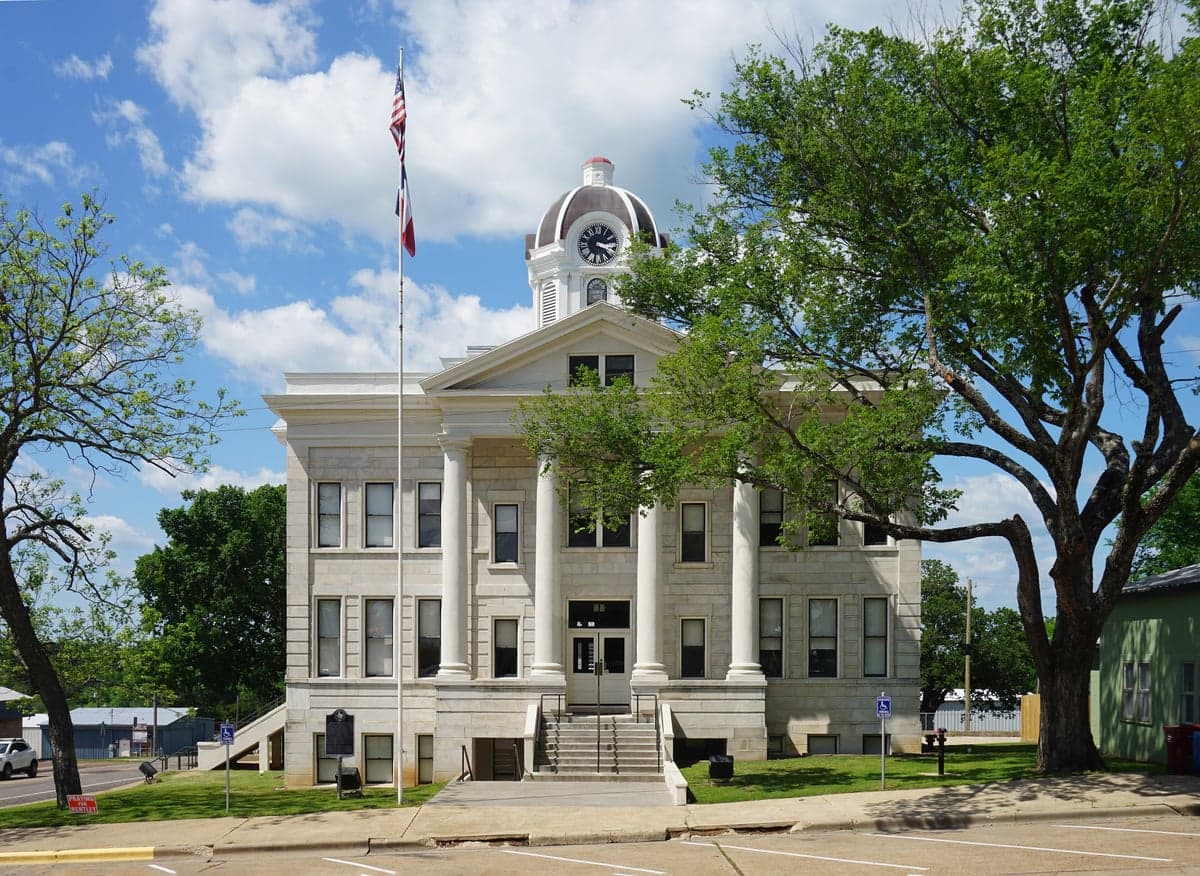
Photo: Wikipedia
Political ClimatePolitical Climate in Franklin County
Showing county-level results — no local-only data available.
Lean and PVI are calculated from this county’s 2020 and 2024 presidential results, Cook-style.
Political rankings in Texas
- Most Conservative Cities in Texas
- Most Liberal Cities in Texas
- Best Liberal-Leaning Towns in the South
- Safest Liberal-Leaning Towns in the South
- Safest Conservative-Leaning Towns in the South
- Affordable Small Towns for Conservatives
- Most Affordable Liberal-Leaning Small Towns in the U.S.
- Safest Conservative-Leaning Cities in the U.S.
- Most Conservative Counties in Texas
- Most Liberal Counties in Texas
Local Political AnalysisPolitical Analysis of Franklin County
Franklin County, Texas, is a reliably Republican stronghold, carrying a Cook Partisan Voting Index (PVI) of R+10, which makes it roughly 10 points more Republican than the national average. The county’s politics are deeply rooted in rural, agricultural traditions, and while the broader state of Texas has seen explosive growth in its urban metros, Franklin County’s trajectory has remained steady and conservative. The county seat, Mount Vernon, is the political heart of the area, and its voters consistently deliver decisive margins for GOP candidates, though the picture isn’t entirely monolithic.
How it compares
Compared to the state of Texas as a whole, Franklin County is noticeably more conservative. Texas as a whole is a Republican state, but its politics are increasingly shaped by the massive, diverse populations of Houston, Dallas, Austin, and San Antonio, which have created competitive suburban and urban districts. Franklin County, by contrast, is part of the rural East Texas bloc that has no such counterweight. In recent cycles, statewide GOP candidates have carried Franklin County by margins of 30 to 40 points, even in years when their statewide victory was narrower. The county’s R+10 PVI reflects this, but the actual voting behavior in Mount Vernon and the smaller communities of Talco and Winnsboro tends to run even more red than the index suggests. There are no true "blue" precincts in the county, but the precincts around Lake Cypress Springs and the southern edge near Winnsboro show slightly more competitive numbers, often driven by a mix of retirees and second-home owners from the Dallas-Fort Worth metroplex.
What this means for residents
For conservative residents, the political climate means their values are reflected in local governance without much friction. The county commissioners court, school board, and constable offices are all held by Republicans, and issues like gun rights, low taxes, and limited regulation are the default assumptions of local policy. For liberal or moderate residents, the reality is that they are a distinct minority. There is no organized Democratic Party presence in the county, and progressive voices are rarely heard in public meetings. That said, the political culture here is not hostile in a personal sense—most folks are neighborly and judge you by your character, not your yard signs. The practical effect is that liberal residents often keep their politics private, and they have little influence over local decisions, but they also face little direct harassment. The bigger tension in the county is not partisan but geographic: the older farming communities in the north around Talco are losing population, while the lake areas in the south are growing, bringing in newcomers who care more about water quality and property values than about the county’s agricultural heritage.
What daily life is like for families
Daily life in Franklin County is shaped by a slower pace and a strong sense of community. The Mount Vernon Independent School District is the anchor for most families, and Friday night football games at the Tiger Stadium are a genuine social institution. The county has a population of just over 10,000, so everyone knows everyone, and that intimacy cuts both ways—it’s supportive, but it can also feel insular. The nearest major city is Sulphur Springs to the west, and for serious shopping or medical care, many residents drive to Tyler or even Dallas, which is about 90 minutes away. The cost of living is low, and property taxes are modest compared to the suburban counties around Dallas, which is a major draw for families moving out of the metroplex. However, the trade-off is limited job opportunities; most employment is in education, healthcare, agriculture, or small local businesses, and many residents commute to jobs in Titus County or Hopkins County.
Culturally, Franklin County is a place where church attendance is high, and the Baptist and Methodist congregations in Mount Vernon set a moral tone that influences everything from school policies to local ordinances. The county is dry in parts, and alcohol sales are restricted, which reflects the area’s conservative Christian values. The biggest policy distinction from the rest of Texas is the county’s resistance to rapid development—there is no zoning in the unincorporated areas, and the county government is skeptical of any state or federal mandates. Looking forward, the county is likely to stay solidly red, but the demographic shift from farming to lakefront living will slowly change the conversation, with more focus on environmental protection and infrastructure than on traditional agricultural issues.

State Political ClimatePolitical Climate in Texas
State Political AnalysisPolitical Environment in the State
Texas is a solidly Republican state, but the nature of that majority is shifting beneath the surface. The GOP has won every statewide race since 1994, and Donald Trump carried the state by 5.6 points in 2024 — a narrower margin than his 8.5-point win in 2016. The coalition is a classic Sun Belt mix: rural and small-town voters, evangelical Protestants, and a growing share of suburbanites, powered by a business-friendly, low-tax ethos that still defines the state’s brand. But the 10-to-20-year arc is one of slow demographic churn — the big metros are getting bluer, the exurbs are getting redder, and the state’s 40 electoral votes are now a genuine battleground target for Democrats in a way they weren’t a decade ago.
Urban vs. rural divide
The political map of Texas is a tale of three geographies. The big metros — Austin, Houston, Dallas, and San Antonio — are the Democratic engine room. Travis County (Austin) gave Biden 71% in 2020 and Harris 74% in 2024, making it the state’s most reliably liberal urban core. Harris County (Houston) flipped to Biden in 2020 and stayed blue in 2024, though by a thinner margin. Meanwhile, the rural and small-town counties that blanket West Texas, the Panhandle, and East Texas are deep red — Lubbock and Amarillo anchor a region where Republicans routinely win 80% or more of the vote. The real action is in the suburbs and exurbs. Collin County (north of Dallas) and Fort Bend County (southwest of Houston) are the swing zones: Collin went from 57% Romney in 2012 to 54% Trump in 2024, while Fort Bend — one of the most ethnically diverse counties in the nation — flipped to Biden in 2020 and stayed narrowly blue. The Rio Grande Valley border counties like Hidalgo and Cameron are the wildcard: historically Democratic, they shifted sharply toward Trump in 2020 and 2024, driven by working-class Latino voters and a realignment over energy, immigration enforcement, and social conservatism.
Policy environment
Texas’s policy posture is defined by what it doesn’t do as much as what it does. There is no state income tax — the state funds itself through a 6.25% sales tax (plus local add-ons that can push it to 8.25% in cities like Austin and Houston) and high property taxes, which average around 1.8% of home value, among the highest in the nation. Regulation is light: no state-level rent control, minimal land-use planning outside of major cities, and a permitting process for businesses that ranks among the fastest in the country. Education policy is a flashpoint — the state uses a school voucher program (the “Texas Education Savings Account” passed in 2023) that lets parents divert public funds to private or homeschool costs, while public school funding per pupil remains below the national average. Healthcare is a mixed bag: Texas has the highest uninsured rate in the country (about 17%) because it has refused Medicaid expansion under the Affordable Care Act, yet it has also become a national hub for medical innovation in Houston’s Texas Medical Center. Election law is strict: voter ID is required, early voting runs 14 days, and mail-in ballots are restricted to seniors and those with qualifying disabilities.
Recent policy direction
The last five years have pushed Texas decisively to the right on a broad front. On guns, the state became a constitutional carry state in 2021, allowing permitless carry of handguns for adults 21 and over. On abortion, Texas passed SB 8 in 2021 (the “heartbeat bill” with a private-enforcement mechanism) and then a near-total ban in 2022, with no exceptions for rape or incest — a stance that has made Dallas and Austin hubs for out-of-state abortion funds and travel networks. On education and parental rights, the 2023 “Parental Bill of Rights” (HB 900) restricted library content and required parental consent for certain classroom materials, while the 2021 “Critical Race Theory” law (SB 3) limited how race and history are taught in public schools. On speech and privacy, Texas passed a law in 2021 (HB 20) that bars social media platforms from deplatforming users based on political viewpoint — a law currently tied up in federal court. Property rights got a boost with the 2023 “Texas Homestead Act” expansion, which raised the property tax exemption for homeowners. On voting, the 2021 SB 1 tightened ballot access — banning drive-thru voting and 24-hour early voting, and adding new ID requirements for mail ballots. The direction is clear: Texas is betting on a low-tax, low-regulation, culturally conservative model, and it’s willing to fight the federal government to keep it.
Civil unrest & political movements
Texas has a long history of political friction, and the last few years have been no exception. The 2020 George Floyd protests in Austin and Houston drew tens of thousands of demonstrators and led to a defund-the-police push in Austin that was later partially reversed. On the right, the “Texas First” movement — a loose coalition of gun-rights activists, election-integrity advocates, and border hawks — has become a powerful force in GOP primaries, pushing the party further right. Immigration is the most visible flashpoint: Governor Greg Abbott’s Operation Lone Star has deployed state troopers and National Guard to the border, bused migrants to El Paso and other sanctuary cities, and installed razor wire along the Rio Grande — a policy that has drawn lawsuits from the Biden administration and praise from border communities that feel overwhelmed. Secession talk is mostly rhetorical — the Texas Nationalist Movement polls around 10-15% support — but it keeps the “Texas can leave” narrative alive in conservative media. Election integrity remains a live issue: the 2020 and 2024 cycles saw Republican-led audits of Harris County voting machines, and the 2024 election saw a record number of poll watchers deployed by both parties. A new resident will notice the political energy — yard signs, bumper stickers, and a general willingness to talk politics with strangers that’s more common here than in the Northeast or West Coast.
Projection
Over the next 5-10 years, Texas is likely to stay Republican but get more competitive. The state is adding roughly 1,000 new residents a day, and the growth is concentrated in the blue-leaning metros — Austin, Dallas, and Houston — plus the purple suburbs of San Antonio. If that trend holds, the 2028 and 2032 presidential races could be decided by 1-2 points in Texas, making it a true swing state. But the rural and exurban backlash is real: the 2024 results showed Republicans making gains among Latino voters in the border counties and among working-class voters in the suburbs, which could offset some of the urban growth. The state’s policy direction is unlikely to reverse — the GOP’s primary electorate is firmly in control, and the low-tax, pro-business model is popular with the transplants who are moving in. A new resident should expect a state that remains culturally conservative at the statehouse level, but with a growing urban-rural split that will make local elections in Austin, Houston, and Dallas increasingly competitive — and increasingly consequential.
For a new resident, the bottom line is this: Texas offers a genuinely different political environment than most of the country. If you value low taxes, minimal regulation, and a government that defers to local control on most issues, you’ll find a lot to like. If you’re more liberal, you’ll find the big cities — Austin especially — are blue islands with strong progressive communities, but you’ll also find state laws that override local ordinances on everything from fracking bans to sanctuary city policies. The practical takeaway is to choose your county carefully: your experience of Texas politics will be dramatically different in Travis County than in Collin County, and both are a short drive from the other. The state is big enough to accommodate both, but it’s not neutral — it’s a red state with blue cities, and it’s getting more competitive, not less.
* Values derived from national, state, county, city and local statistics and may differ in a specific area. Last updated: 2026-10-28T05:31:49.000Z
Narrative content on this page is AI-generated and may contain mistakes. Verify any details that matter before acting on them.
ReloMaps may earn a commission from affiliate links at no extra cost to you.

