
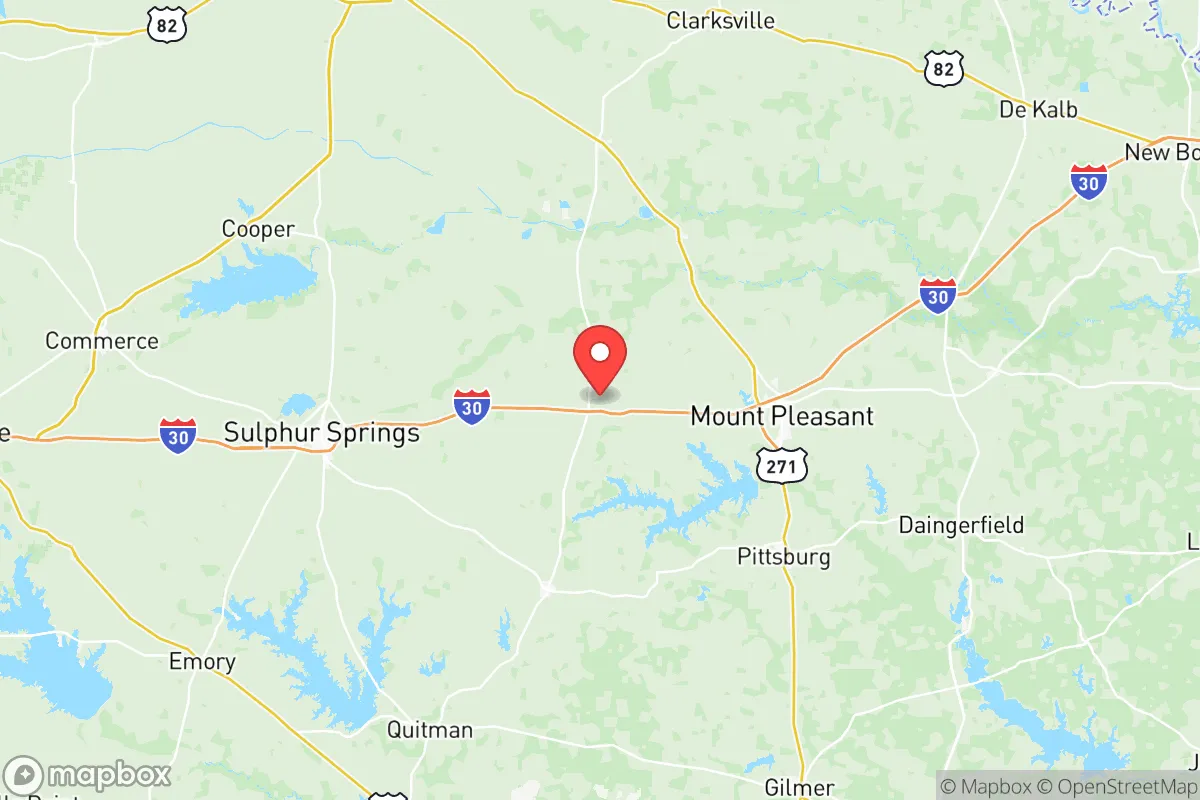
Photo: Wikipedia
Personal Sovereignty in Franklin County
Strong independent fundamentals that actively favor personal liberty and low regulation.
What does Personal Sovereignty tell us?
Personal Sovereignty measures your capacity for self-reliance and independence with minimal government friction. Higher scores mean fewer barriers between you and the way you want to live... but it assumes you have the space you need and good neighbors.
What does this tell us?
Personal Sovereignty measures your capacity for self-reliance and independence with minimal government friction. Higher scores mean fewer barriers between you and the way you want to live... but it assumes you have the space you need and good neighbors.
State Policy
Energy independence: Net exporter (195% of energy produced in-state)
Personal Liberty
Homesteading

Personal Liberty Analysis
Franklin County, Texas, offers one of the lightest-touch regulatory environments in the state, a place where personal sovereignty is less a political talking point and more a default operating system. With a population hovering near 10,000 spread across unincorporated land and small towns like Mount Vernon (the county seat), Winnsboro, and Talco, the county operates with a distinctly rural, hands-off ethos. For individuals and families weighing relocation, the practical question isn't whether the county respects autonomy — it’s how that autonomy manifests across taxes, self-defense law, land use, and daily liberties compared to the Dallas-Fort Worth metroplex just 90 minutes south.
Tax burden and regulatory posture: how Franklin County compares to DFW
Franklin County’s tax environment is a primary draw for sovereignty-minded relocators. The county’s total property tax rate typically lands around $0.55 to $0.65 per $100 of assessed value, roughly half of what you’ll find in Collin or Dallas County, where combined city, county, and school district rates often exceed $2.00. The trade-off is visible in services: there’s no large county hospital district, and the sheriff’s office operates with a lean budget, but residents accept that trade in exchange for keeping more of their income. Texas has no state income tax, and Franklin County levies no special-purpose district taxes for things like flood control or transit — a stark contrast to the sprawling municipal utility districts (MUDs) that pepper new subdivisions around Mount Pleasant or Sulphur Springs.
Regulatory posture is equally restrained. The county has no zoning ordinance for unincorporated areas, meaning property use is governed primarily by deed restrictions (if any) and state health and safety codes. Mount Vernon, the largest town at roughly 2,700 residents, does enforce a modest set of building codes and a subdivision ordinance, but its permitting process is measured in days, not months. Winnsboro, which straddles the Franklin-Wood county line, is similarly permissive, though its historic downtown district carries design review for commercial facades. Talco, a former oil-boom town of about 500, has effectively no regulatory apparatus beyond basic utility hookups. For a family that wants to build a shop before a house, or run a small repair business from a pole barn, Franklin County presents almost no bureaucratic friction.
Self-defense and gun law specifics: constitutional carry and castle doctrine in practice
Texas’s statewide framework governs firearms in Franklin County, and the county’s culture treats that framework as a floor, not a ceiling. Permitless carry (constitutional carry) has been law since 2021, so any adult who can legally possess a firearm may carry it openly or concealed without a license. The county sheriff’s office in Mount Vernon is publicly supportive of the Second Amendment, and there are no county-specific restrictions on magazine capacity, ammunition types, or firearm storage. The Texas Castle Doctrine, codified in Penal Code Chapter 9.31, presumes a homeowner’s reasonable fear of deadly threat when an intruder unlawfully enters a dwelling or vehicle — a presumption that applies with equal force in the unincorporated areas around Scroggins and the residential streets of Mount Vernon.
One practical distinction: Franklin County is a rural jurisdiction with response times that can stretch 15 to 20 minutes for the furthest corners of the county, particularly around the Lake Cypress Springs and Lake Bob Sandlin areas. That reality makes personal defense a matter of individual readiness rather than reliance on rapid police response. The county has no gun-free zones beyond those mandated by state law (schools, courthouses, and secure areas of jails), and the Mount Vernon courthouse square is a place where open carry is a common, unremarkable sight. For a relocating family, the practical takeaway is that self-defense law here is as permissive as Texas allows, and the local culture reinforces rather than resists that posture.
Self-reliance and homesteading viability: lot sizes, zoning, and off-grid feasibility
Homesteading in Franklin County is not a lifestyle experiment — it’s a continuation of how the area has always operated. Unincorporated land parcels commonly sell in 5-to-50-acre tracts, with prices ranging from $3,000 to $6,000 per acre depending on proximity to water and timber quality. There is no county-wide zoning, so a property owner can keep livestock, operate a sawmill, or erect a workshop without seeking a conditional use permit. The county does enforce the Texas Health and Safety Code’s requirements for on-site sewage facilities (septic systems), which require a permit from the county environmental health office, but the process is straightforward for standard gravity-fed systems on adequate acreage.
Off-grid feasibility is genuinely high, with caveats. The county has no building code for unincorporated areas, so a cabin built to owner specifications is legal as long as it meets septic and electrical safety standards. Solar arrays are unrestricted, and net metering is available through the local electric cooperatives — Franklin County Electric Cooperative and Tri-County Electric Cooperative — though buyback rates are modest. Rainwater harvesting is actively encouraged; Texas law (HB 3391) prohibits HOAs from banning it, and Franklin County has no county-level restrictions. The areas around Scroggins and Purley are particularly suited to self-sufficient living, with deep soils for gardens, abundant surface water, and sparse neighbors. By contrast, the small incorporated towns of Mount Vernon and Winnsboro do have municipal water and sewer hookup requirements if you build within city limits, so the unincorporated county is the clear choice for maximum autonomy.
Personal liberties: parental rights, medical autonomy, speech, and property
Franklin County’s personal liberty environment tracks the broader Texas conservative framework, with local enforcement that is generally non-intrusive. Parental rights are strongly protected: Texas law requires parental consent for most medical procedures on minors, and the county’s school districts — Mount Vernon ISD, Winnsboro ISD, and Rivercrest ISD — have adopted policies that emphasize parental notification for health services and curriculum transparency. The county has seen no local ordinances attempting to restrict medical freedom; Texas’s 2023 law prohibiting COVID-19 vaccine mandates applies to all employers in the county, and there is no county health authority pushing beyond state minimums.
Speech and property rights are treated with similar deference. There are no county noise ordinances, no sign regulations in unincorporated areas, and no restrictions on political expression on private property — a stark contrast to the HOA-governed suburbs of DFW where yard signs and vehicle parking are often regulated. Property rights are further reinforced by Texas’s strong private property protections, including the requirement that the county compensate landowners for any regulatory taking. The one notable constraint is the Texas Open Meetings Act and Public Information Act, which apply to county government but do not restrict individual conduct. For a family that values the freedom to homeschool (no state registration required), practice alternative medicine (within state scope-of-practice laws), or simply live without a homeowners association dictating lawn height, Franklin County delivers a level of personal latitude that is increasingly rare in Texas’s growing metros.
Relative to other Texas counties, Franklin County sits comfortably in the top tier for personal sovereignty. It lacks the extreme libertarian experimentation of far-West Texas counties like Hudspeth or Loving, but it also avoids the creeping regulatory creep visible in the Hill Country counties of Hays or Comal, where explosive growth has brought subdivision rules and environmental restrictions. For a single individual or family seeking a place where the state’s presence is felt mainly through property tax bills and the occasional sheriff’s patrol, Franklin County offers a durable, low-friction environment — one where the default answer to most questions is “yes, unless there’s a specific reason not to.” That posture, combined with affordable land and a genuine rural culture of mutual aid, makes it a strong candidate for anyone whose relocation calculus prioritizes freedom over convenience.

* Values derived from national, state, county, city and local statistics and may differ in a specific area. Last updated: 2026-10-28T05:31:49.000Z
Narrative content on this page is AI-generated and may contain mistakes. Verify any details that matter before acting on them.
ReloMaps may earn a commission from affiliate links at no extra cost to you.

