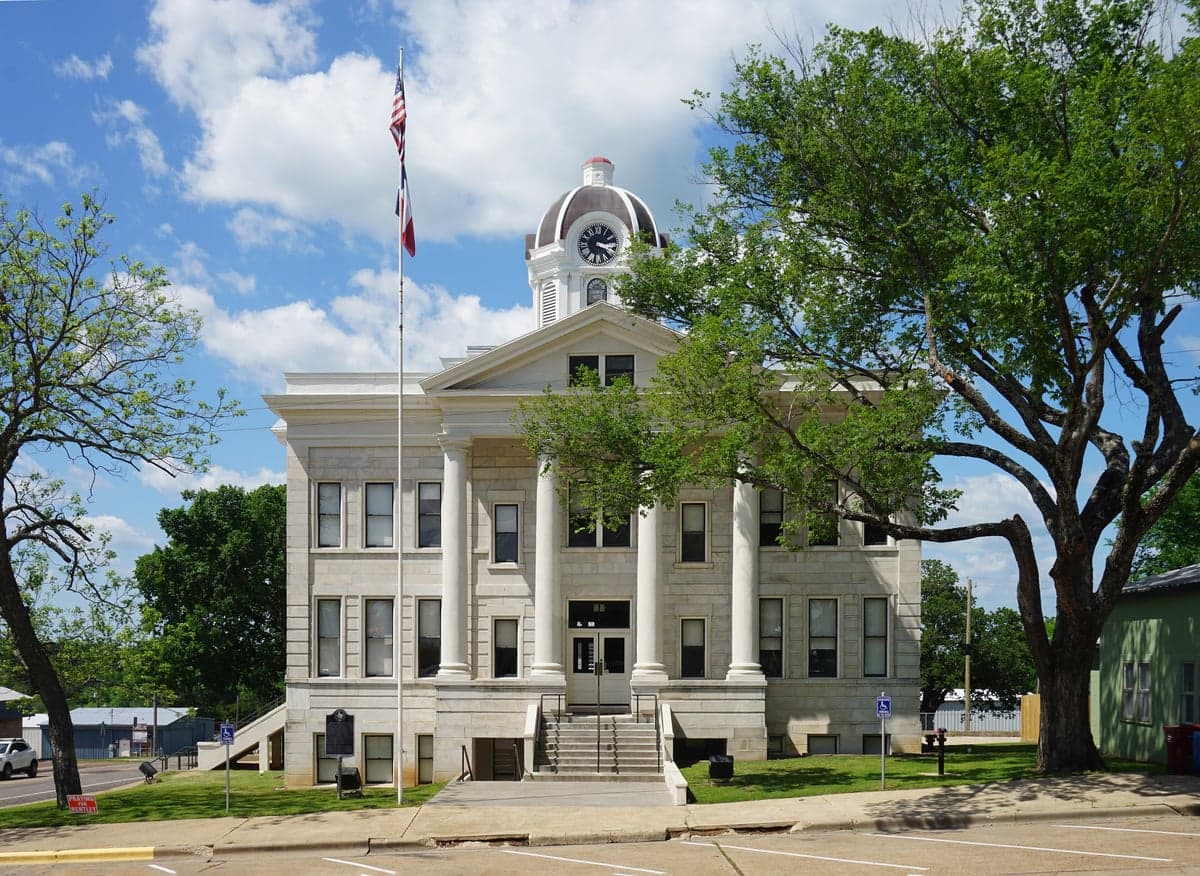
Photo: Wikipedia
Demographics of Franklin County
Affluence Level in Franklin County
A middle-class area roughly in line with national averages across income, home values, education, and employment.
People of Franklin County
Franklin County, Texas, is a rural, predominantly white community of 10,522 residents where the population has remained remarkably stable for over a century. The county’s identity is rooted in its Deep East Texas location—a working landscape of timber, cattle, and small-town commerce centered on the county seat of Mount Vernon and the smaller communities of Winnsboro and Talco. With a foreign-born population of just 4.2% and a 77.7% white majority, Franklin County is one of the least ethnically diverse counties in the Dallas–Fort Worth periphery, though its Hispanic population has grown to 14.3% in recent decades.
Settlement & growth (pre-1960)
Before Anglo-American settlement, the area that would become Franklin County was part of the traditional hunting grounds of the Caddo Confederacy, particularly the Hasinai and Kadohadacho groups, who lived in settled agricultural villages along the Red River and its tributaries. The Spanish claimed the region as part of New Spain in the 16th century, but no permanent Spanish settlements were established this far east. The land remained a sparsely populated frontier buffer zone between Spanish Texas and French Louisiana until the early 19th century.
The first permanent Anglo settlers arrived in the 1830s and 1840s, primarily yeoman farmers from Tennessee, Kentucky, and Arkansas who followed the Red River westward. These early settlers were overwhelmingly of Scots-Irish and English descent, drawn by cheap land grants under the Republic of Texas and later the state of Texas. They established small subsistence farms along the Sulphur River and its creeks, growing cotton and corn and raising hogs and cattle. The community of Mount Vernon, founded in the 1840s, became the county seat when Franklin County was formally organized in 1875, carved out of Titus County.
The post-Civil War period brought a second wave of settlement. The arrival of the St. Louis Southwestern Railway (the "Cotton Belt Route") in the 1880s connected the county to national markets and spurred the founding of Winnsboro in the county's southwest corner and Talco in the northeast. These railroad towns attracted merchants, blacksmiths, and cotton ginners, while the surrounding countryside filled with tenant farmers and sharecroppers. A significant Black population, descended from enslaved people who worked the pre-war cotton plantations, settled in rural communities and small enclaves around Mount Vernon and Winnsboro; by 1900, Black residents made up roughly 20% of the county's population.
The early 20th century brought modest economic diversification. The discovery of the Talco oil field in 1936 triggered a brief boom in the northeastern part of the county, drawing roughnecks and speculators to Talco and the surrounding area. However, the Great Depression and the mechanization of cotton farming drove many Black and white tenant farmers off the land. The Great Migration saw a substantial outflow of the county's Black population to Dallas, Chicago, and other industrial cities between 1940 and 1970, a demographic shift that permanently reshaped the county's racial composition. By 1960, Franklin County's population had fallen to roughly 6,000 residents, a decline from its 1930 peak of 8,494.
Modern era (post-1965)
The 1965 Hart-Cellar Act, which eliminated national-origin quotas, had minimal direct impact on Franklin County. Unlike urban Texas counties that saw waves of immigration from Mexico, Vietnam, and India, Franklin County's foreign-born population remains just 4.2% today—far below the Texas state average of 17.2%. The county's modern demographic story is instead one of domestic migration and the slow diversification of its existing population.
The most significant post-1965 shift has been the growth of the Hispanic population, which rose from under 2% in 1970 to 14.3% today. This growth is not the result of new international immigration but rather the northward movement of Hispanic families from South Texas and the Rio Grande Valley, drawn by work in the region's poultry processing plants, timber industry, and oil-field services. These families have concentrated primarily in and around Mount Vernon and Winnsboro, where they work at facilities like the Pilgrim's Pride poultry plant in nearby Pittsburg and the various sawmills and logging operations that anchor the local economy.
The Black population, now 5.1%, has stabilized after decades of out-migration. The descendants of the county's original Black families remain concentrated in the historic communities around Mount Vernon and in the southern part of the county near the Wood County line. The East/Southeast Asian population (0.2%) and Indian-subcontinent population (0.0%) are negligible, reflecting the county's lack of the professional and technology sectors that have driven Asian immigration to the Dallas–Fort Worth metroplex.
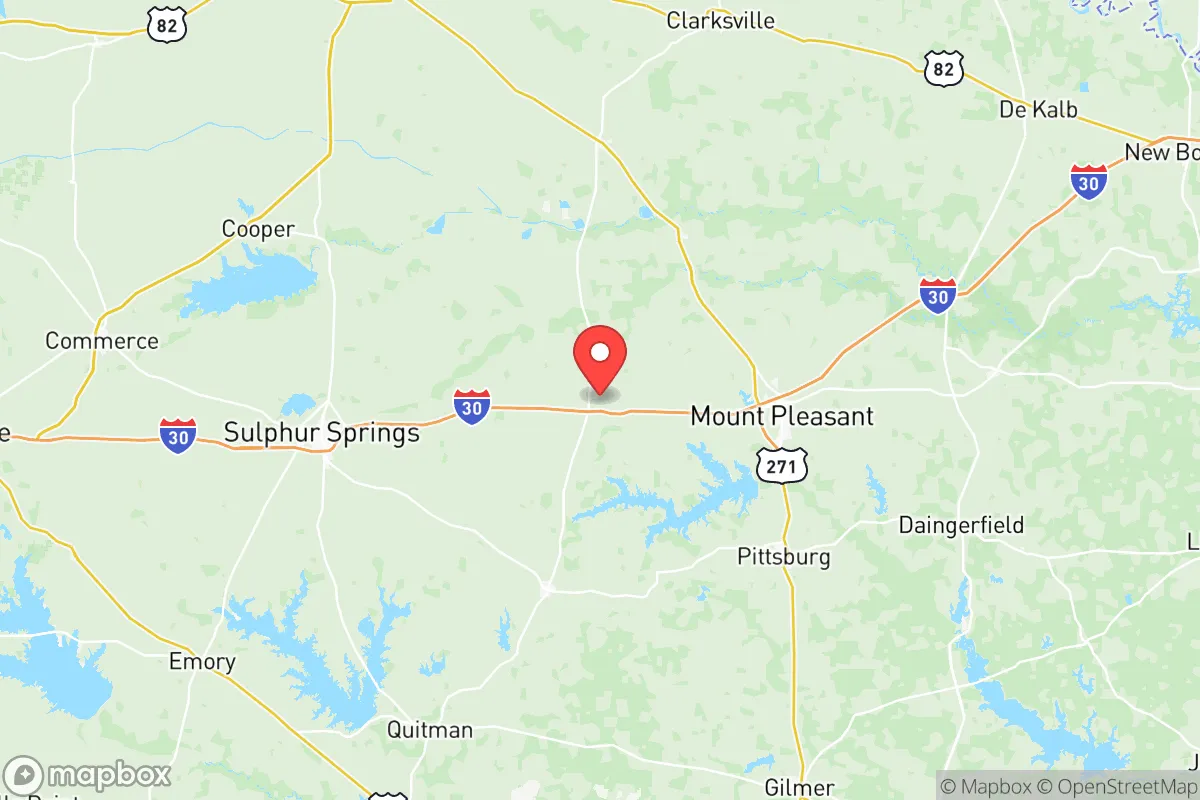
Domestically, Franklin County has experienced modest growth as a bedroom community for the northeastern edge of the Dallas–Fort Worth metroplex. The completion of Interstate 30 through the southern part of the county in the 1980s made Mount Vernon and the Lake Cypress Springs area accessible to commuters working in Sulphur Springs, Greenville, and even Dallas, roughly 90 minutes to the west. This has attracted a small but steady stream of retirees and remote workers seeking affordable land and a slower pace of life, contributing to the county's 29.3% college-educated rate—a figure that, while below the national average, represents a significant increase from prior decades.
The future
Franklin County's population is projected to grow slowly but steadily over the next two decades, reaching roughly 12,000–13,000 residents by 2040. The county is becoming slightly more diverse, driven primarily by the continued growth of the Hispanic population, which is younger on average than the county's white population and has higher birth rates. Projections suggest the Hispanic share could reach 18–20% by 2040, while the white share declines to roughly 72–74%. The Black population is expected to remain stable at 5–6%, and the Asian and Indian populations are likely to remain minimal unless the county attracts significant new employers.
The geographic pattern of growth is likely to continue concentrating around Mount Vernon and the Interstate 30 corridor, with new residential development spreading along the shores of Lake Cypress Springs and Lake Monticello. The county's cultural identity—rooted in rural self-reliance, evangelical Protestantism, and a strong hunting and fishing tradition—is likely to persist, though it will increasingly be leavened by the influence of newcomers from the metroplex. The county voted overwhelmingly Republican in recent elections, a pattern that shows no signs of changing given the demographic trajectory.
One wildcard is the potential for industrial development. The county's position along the I-30 corridor and its proximity to the growing East Texas oil and gas fields could attract logistics and manufacturing investment, which would accelerate population growth and diversification. Conversely, the county's limited water resources and aging infrastructure could constrain growth, preserving its rural character.
Franklin County is becoming a slightly more diverse, slowly growing rural community that retains its Deep East Texas character while inching into the orbit of the Dallas–Fort Worth metroplex. For someone moving in now, the county offers a stable, affordable, and safe environment with a strong sense of local identity—but it remains a place where the population is overwhelmingly white, native-born, and conservative, and where the pace of change is measured in decades rather than years.

* Values derived from national, state, county, city and local statistics and may differ in a specific area. Last updated: 2026-10-28T05:31:49.000Z
Narrative content on this page is AI-generated and may contain mistakes. Verify any details that matter before acting on them.
ReloMaps may earn a commission from affiliate links at no extra cost to you.

