Photo: Wikipedia
Political ClimatePolitical Climate in Burnet County
Showing district-level results — no local-only data available.
Local Political AnalysisPolitical Analysis of Burnet County
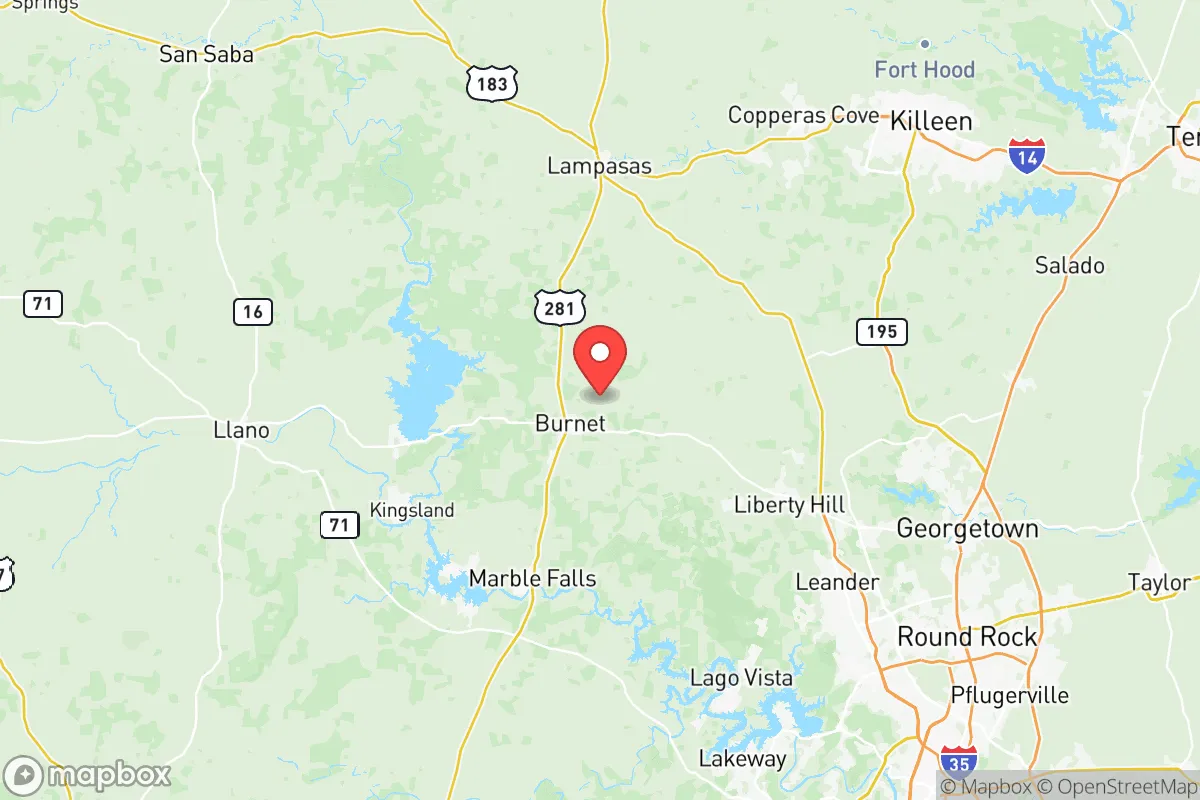
Burnet County is a reliably Republican stronghold, with a Cook PVI of R+11 that makes it significantly more conservative than Texas as a whole (R+4). The county has voted for the GOP presidential candidate by margins exceeding 30 points in recent cycles, and that trend shows no sign of reversing. However, the political landscape isn't uniform across the county — the fast-growing city of Marble Falls, particularly its newer subdivisions near Lake Marble Falls, has shown slightly more competitive tendencies, while the rural precincts around Bertram and Burnet itself remain deeply red.
How it compares
At R+11, Burnet County is nearly three points more Republican than the state's overall R+4 rating. That gap matters in practice: while statewide races in Texas are often competitive enough to draw serious campaign spending, Burnet County is treated as safe territory by both parties. In the 2024 presidential election, the county gave the Republican ticket over 70% of the vote, compared to roughly 56% statewide. The most conservative pockets are the unincorporated areas west of Burnet and around Lake Buchanan, where GOP turnout routinely exceeds 80%. The relative swing precincts are in Marble Falls proper, where a mix of new arrivals from Austin and younger families have pushed Democratic performance into the low 30s — still a clear minority, but a noticeable shift from a decade ago when the same precincts hovered in the mid-20s.
What this means for residents
For conservative residents, the county's lean means local elections are typically decided in the Republican primary, not the general election. School board, city council, and county commissioner races are often settled by a few hundred votes in the spring. For liberal residents, the reality is that their votes rarely affect the outcome of countywide or federal races, but they do have influence in Marble Falls city elections, where turnout is lower and a motivated minority can swing a ward. The practical effect is that the county government remains consistently conservative on issues like property tax rates, land use regulation, and Second Amendment protections. There is no serious organized progressive presence in county politics, though the Marble Falls Democratic Club has grown its membership steadily since 2020.
Culturally, Burnet County feels more like West Texas than the Hill Country suburbs to the east. Gun ownership is near-universal, church attendance is high, and the local economy is still tied to ranching, quarrying, and lake tourism rather than tech or services. The county has resisted the kind of rapid development seen in Williamson and Hays counties, partly by design — zoning is minimal, and the county commissioners have consistently voted against any form of countywide planning authority. That hands-off approach appeals to residents who moved here specifically to escape the regulatory environment of Austin, but it also means infrastructure struggles to keep pace with growth. The long-term trajectory points toward continued Republican dominance, but with a slow drift toward competitiveness in Marble Falls as the population grows and diversifies. For now, Burnet County remains one of the most reliably conservative counties in Central Texas, and that identity shapes everything from local tax policy to the character of daily life.

State Political ClimatePolitical Climate in Texas
State Political AnalysisPolitical Environment in the State
Texas has been a reliably Republican state for the past three decades, with a Cook Partisan Voting Index of R+4, but the reality on the ground is far more nuanced than a single number suggests. The state’s dominant coalition is built on a foundation of conservative voters in the sprawling suburbs, small towns, and rural areas, but that coalition has been steadily fraying at the edges as fast-growing metros like Austin, Dallas, Houston, and San Antonio pull the state closer to purple. Over the last 10 to 20 years, the trajectory has been a slow but measurable shift leftward in the major urban centers, while the exurbs and rural counties have dug in deeper, creating a political landscape that feels like two different states under one capitol dome.
Urban vs. rural divide
The political map of Texas is a study in contrasts. The major metros — Harris County (Houston), Dallas County, Bexar County (San Antonio), and Travis County (Austin) — have become Democratic strongholds, with Travis County routinely voting 70%+ Democratic in presidential elections. Meanwhile, the vast rural and exurban expanse, from the Panhandle down through West Texas and into East Texas, votes Republican by margins of 60% to 80%. The real battleground is the suburban ring around these cities, places like Collin County (north of Dallas), Fort Bend County (southwest of Houston), and Williamson County (north of Austin). These counties were once reliably red but have been trending purple or even blue in recent cycles. Collin County, for example, went from a 27-point Republican margin in 2012 to just 9 points in 2020. The divide isn’t just geographic — it’s demographic, with younger, more diverse, and college-educated voters clustering in the cities and inner suburbs, while older, whiter, and more rural voters dominate the rest of the state.
Policy environment
Texas’s policy environment is defined by a low-tax, low-regulation posture that has been consistent for decades. There is no state income tax, which is the single biggest draw for many relocators, and property taxes are among the highest in the nation to compensate — averaging around 1.6% to 1.8% of assessed value, though recent legislation has pushed for modest compression. The regulatory climate is business-friendly, with minimal zoning in many areas and a right-to-work law that limits union power. On education, the state funds public schools through a complex recapture system (often called “Robin Hood”) that redistributes property tax revenue from wealthier districts to poorer ones, which has been a source of perennial controversy. School choice and voucher programs have been a major legislative battleground, with Governor Greg Abbott pushing for education savings accounts, though rural Republicans have often blocked them over fears of draining rural school funding. Healthcare policy remains largely unexpanded — Texas is one of the few states that has not expanded Medicaid under the Affordable Care Act, leaving roughly 1.5 million uninsured adults in the coverage gap. Election laws have been tightened in recent years, with the 2021 passage of SB 1, which added ID requirements for mail-in voting, limited drive-through and 24-hour voting options, and expanded poll watcher access — changes that supporters say ensure integrity and critics argue suppress turnout.
Recent policy direction
The last few legislative sessions have pushed Texas decisively in a conservative direction across multiple fronts. On gun and self-defense law, Texas became a permitless carry state in 2021 with HB 1927, allowing most adults to carry a handgun without a license or training. On parental and education rights, the 2023 session saw the creation of a school library review process and restrictions on how race and gender can be taught in public schools, codified in HB 900 and SB 3. Speech and privacy issues have been shaped by the state’s social media law, HB 20, which prohibits large platforms from moderating content based on viewpoint — a law that has been partially blocked by courts but signals the state’s posture. On medical and bodily autonomy, Texas passed one of the nation’s strictest abortion bans in 2021 (SB 8), effectively outlawing the procedure after six weeks, and a trigger law that banned it entirely after the Dobbs decision, with no exceptions for rape or incest. Property rights remain strong, though the state has seen fights over eminent domain for pipelines and transmission lines. Taxation has remained stable, with no income tax and periodic property tax relief packages, most recently in 2023 when voters approved a $12.7 billion package to raise the homestead exemption and compress school tax rates. Voting and ballot access have tightened, as noted, with SB 1 being the most significant change, though early voting hours remain generous by national standards.
Civil unrest & political movements
Texas has seen its share of political flashpoints in recent years. The 2020 protests following George Floyd’s murder in Minneapolis sparked large demonstrations in Austin, Houston, and Dallas, with Austin seeing particularly sustained protests that led to clashes between police and demonstrators. The state legislature responded with the 2021 “Back the Blue” law (HB 9), which increased penalties for protesting near police and for damaging property during demonstrations. Immigration politics are a constant undercurrent, especially along the border in places like El Paso and the Rio Grande Valley. Governor Abbott’s Operation Lone Star, launched in 2021, deployed state troopers and National Guard to the border, bused migrants to Democratic-led cities, and led to the arrest of thousands on state trespassing charges — a program that has been both praised by conservatives and criticized by civil liberties groups. Secession rhetoric, while not mainstream, has a vocal fringe, with the Texas Nationalist Movement pushing for a referendum on independence, though polling consistently shows support below 20%. Election integrity controversies have been persistent, with the 2020 and 2022 cycles seeing high-profile audits in Harris and Dallas counties, though no evidence of widespread fraud has been found. A new resident would notice the political polarization most visibly in yard signs, bumper stickers, and the tone of local news coverage, but daily life in most suburbs and cities remains civil and functional.
Projection
Over the next 5 to 10 years, Texas is likely to continue its slow drift toward competitiveness at the statewide level, driven by the same demographic forces that have turned Georgia and Arizona purple. The influx of domestic migrants from California and the Northeast — roughly 1,000 people per day — tends to be younger and more diverse, and while not all are Democrats, they are pulling the suburbs leftward. The I-35 corridor from San Antonio through Austin to Dallas will remain the epicenter of this shift, while the Permian Basin and the Panhandle will stay deeply red. The state’s Republican majority in the legislature is likely to shrink but not disappear, meaning policy will remain conservative but may moderate on some edges — particularly on school funding and property taxes — as the party tries to hold onto suburban voters. A new resident moving in now should expect to find a state that is still broadly conservative in its laws and culture, but where the political conversation is increasingly shaped by the growing urban and suburban populations. In a decade, Texas may look more like a lean-red state than a solid-red one, with competitive races for the presidency and Senate becoming the norm rather than the exception.
For someone choosing Texas, the bottom line is this: you’ll live in a state with no income tax, a business-friendly regulatory environment, and a government that is actively conservative on social and cultural issues. If that aligns with your values, you’ll find a welcoming political climate. If it doesn’t, you’ll still find vibrant blue cities and suburbs where you can live comfortably, but you’ll be in a state where your vote for president or senator may not be decisive for the foreseeable future. The practical takeaway is that Texas offers a wide range of political environments within its borders — from the deep red of Lubbock to the deep blue of Austin — and your experience will depend heavily on which of those you choose to call home.
* Values derived from national, state, county, city and local statistics and may differ in a specific area. Last updated: 2026-06-23T20:04:54.000Z
Narrative content on this page is AI-generated and may contain mistakes. Verify any details that matter before acting on them.
ReloMaps may earn a commission from affiliate links at no extra cost to you.

