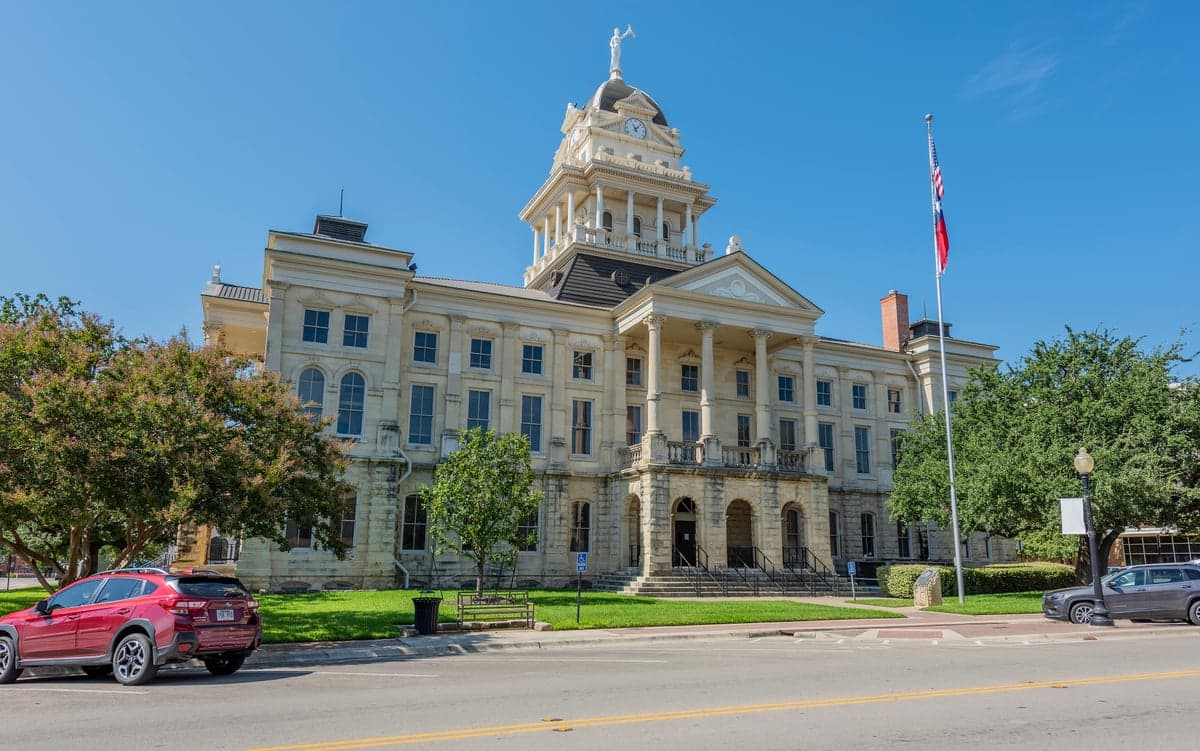
Photo: Wikipedia
Political ClimatePolitical Climate in Bell County
Showing district-level results — no local-only data available.
Local Political AnalysisPolitical Analysis of Bell County
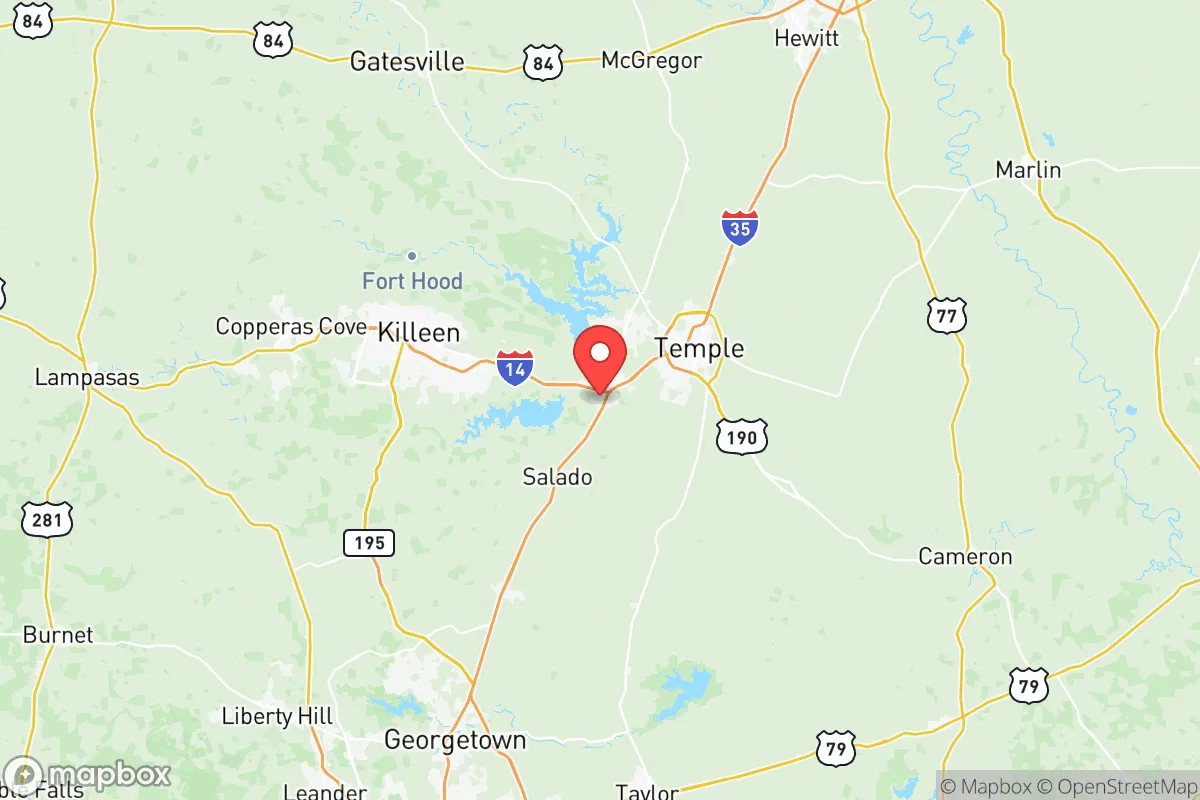
Bell County has shifted from a competitive swing area to a solidly Republican stronghold, carrying a Cook PVI of R+11 that makes it significantly more conservative than Texas as a whole (R+4). The county voted for Donald Trump by roughly 15 points in 2024, a margin that has widened steadily since 2016. This rightward trend is driven largely by explosive growth in the southern half of the county, where new subdivisions around Harker Heights and Nolanville have brought in a wave of military-affiliated families and retirees from redder parts of the country. Meanwhile, the city of Belton has held as a moderate-leaning island, and the historically Black neighborhoods in eastern Temple still vote reliably Democratic, but those pockets are shrinking as a share of the overall electorate.
How it compares
Texas statewide races are competitive enough that Democrats can win in Harris County and still lose statewide by a few points. In Bell County, that same statewide Democratic performance would result in a double-digit loss. The county's R+11 rating means a generic Republican candidate starts with an 11-point structural advantage over a generic Democrat, even before factoring in candidate quality or turnout. That gap is most visible in the rural precincts north of Belton and west of Salado, where GOP turnout regularly exceeds 75%. By contrast, the precincts around the University of Mary Hardin-Baylor in Belton and the downtown Temple area near Baylor Scott & White Medical Center have swung back toward Democrats in recent cycles, but those precincts account for less than 15% of the county's total vote. The county's trajectory mirrors the broader shift of I-35 corridor counties — Williamson County to the south went from blue-leaning to purple, while Bell County has gone from purple to deep red.
What this means for residents
For conservative residents, the political climate is comfortable and affirming. Local offices — from the county commissioners court to the school boards in Belton and Temple — are dominated by Republicans, and policy debates tend to center on growth management, tax rates, and infrastructure rather than cultural flashpoints. Conservative voters can expect their values to be reflected in county-level decisions on law enforcement, property taxes, and Second Amendment issues without much friction. For liberal residents, the reality is more isolating. Democratic candidates rarely run competitive races for countywide office, and progressive activism is largely confined to the university campus in Belton and a handful of neighborhood groups in Temple. That said, the county's rapid growth is slowly diversifying the electorate; the Hispanic population has grown to roughly 25% of the county, and younger transplants from Austin and San Antonio are beginning to shift the political center of gravity in the southern precincts near Fort Cavazos.
One cultural distinction worth noting: Bell County has a strong independent streak that sometimes puts it at odds with the state GOP establishment. The county's large active-duty and veteran population tends to prioritize military quality-of-life issues — housing affordability near Fort Cavazos, school quality for military families, and access to healthcare — over the social issues that dominate state-level Republican primaries. This practical, bread-and-butter conservatism means that local Republicans often endorse moderate candidates in state and federal primaries, creating a subtle but real tension with the party's more ideological wings. For newcomers, the takeaway is that Bell County is politically red but not culturally uniform — the politics here are shaped more by the base, the hospital, and the highway than by any single ideology.

State Political ClimatePolitical Climate in Texas
State Political AnalysisPolitical Environment in the State
Texas has been a reliably Republican state for the past three decades, with a Cook Partisan Voting Index of R+4, but the reality on the ground is far more nuanced than a single number suggests. The state’s dominant coalition has long been built on a foundation of socially conservative values, low-tax economics, and a strong emphasis on individual liberty and property rights, but that coalition is being reshaped by explosive population growth and a massive influx of new residents from other states. Over the last 10 to 20 years, the trajectory has been a slow but steady shift from deep red to a more competitive lean-red, driven by the rapid urbanization of the Dallas-Fort Worth metroplex, Houston, and especially Austin, while the vast rural and exurban expanses have only hardened in their Republican allegiance.
Urban vs. rural divide
The political map of Texas is a stark study in contrasts. The major metropolitan counties—Harris (Houston), Dallas, Tarrant (Fort Worth), Bexar (San Antonio), and Travis (Austin)—are the engines of Democratic votes, with Travis County being the bluest of them all, routinely delivering 70%+ margins for Democratic candidates. In 2020, Tarrant County, a longtime bellwether that had voted Republican for decades, flipped to Joe Biden, signaling a critical shift in the suburban ring around Fort Worth. Meanwhile, the rural and small-town counties of West Texas, the Panhandle, and East Texas—places like Lubbock, Midland, and Tyler—vote Republican by margins of 70% to 80% or more. The Rio Grande Valley, once a Democratic stronghold, has been trending rightward, with counties like Zapata and Starr flipping to Donald Trump in 2020, driven by a combination of conservative social values and a growing frustration with the national Democratic Party’s stance on energy and border security. The result is a state where the political conversation is dominated by the urban-rural axis, with the fast-growing suburbs of Collin County (north of Dallas) and Montgomery County (north of Houston) serving as the key battlegrounds where the state’s future lean will be decided.
Policy environment
Texas’s policy environment is defined by a deliberate, constitutionally enshrined aversion to broad-based taxes. There is no state income tax, a fact that drives much of the state’s economic appeal, and the reliance on property taxes and sales taxes to fund services creates a distinct fiscal landscape. The regulatory posture is famously business-friendly, with minimal permitting hurdles and a strong right-to-work law that limits union power. On education, the state has leaned into school choice and charter school expansion, while also passing laws like the 2021 “Critical Race Theory” ban (HB 3979) that restrict how race and history can be taught in public schools. Healthcare policy is marked by the state’s refusal to expand Medicaid under the Affordable Care Act, leaving roughly 18% of the population uninsured, the highest rate in the nation. Election laws have been a flashpoint, with the 2021 passage of SB 1 tightening voter ID requirements, limiting drive-through and 24-hour voting, and expanding poll watcher access—changes that Republicans argue ensure integrity and Democrats argue suppress turnout.
Recent policy direction
The last five years have seen Texas move decisively in a conservative direction across a broad spectrum of liberties that matter to relocators. On gun and self-defense law, the state became a permitless carry (constitutional carry) state in 2021 (HB 1927), allowing any legal firearm owner to carry a handgun without a license. Parental and education rights were supercharged with the 2023 passage of a school voucher-like program (HB 3) that creates education savings accounts for families, and the “Parental Bill of Rights” (HB 101) that gives parents explicit authority over their child’s medical decisions and school curriculum. On speech and privacy, the state passed a law (HB 20) in 2023 that prohibits social media platforms from moderating content based on viewpoint, though it has been tied up in court. Medical and bodily autonomy is sharply restricted: Texas has one of the most restrictive abortion bans in the nation (SB 8, the “Heartbeat Act,” and the 2021 trigger law), with no exceptions for rape or incest, and the state has also restricted gender-affirming care for minors (SB 14, 2023). Property rights are strongly protected through laws like the “Private Property Rights Protection Act,” which limits eminent domain, and the state’s lack of zoning in many cities (most famously Houston) gives landowners broad freedom. Taxation remains a central selling point, with the state’s lack of income tax and a 2023 property tax cut package (SB 2) that compressed school tax rates and increased the homestead exemption. Voting and ballot access have been tightened, as noted, but Texas also has robust early voting periods and no-excuse mail-in voting for those over 65.
Civil unrest & political movements
Texas has seen its share of political flashpoints in recent years. The 2020 protests following George Floyd’s murder in Minneapolis were particularly intense in Austin and Houston, leading to clashes between demonstrators and law enforcement, and prompting the state legislature to pass a law (HB 1 in 2021) that increased penalties for rioting and protected police officers from defunding efforts. Organized activist movements are active on both sides: on the right, the Texas GOP’s 2022 platform included a plank calling for a referendum on secession, though this remains fringe rhetoric with no serious legislative path; on the left, groups like Moms Demand Action and the Texas Freedom Network are highly organized around gun control and public education issues. Immigration politics are a constant, visible reality, especially along the southern border in places like El Paso and the Rio Grande Valley, where the state has launched Operation Lone Star, a multi-billion-dollar border security initiative involving state troopers and National Guard troops. Sanctuary city policies are banned by state law (SB 4, 2017), which requires local law enforcement to cooperate with federal immigration authorities. Election integrity controversies have been a persistent undercurrent, with the 2020 and 2022 cycles seeing intense scrutiny of Harris County’s election administration, leading to the state taking over the county’s elections in 2023.
Projection
Looking ahead five to ten years, Texas is likely to remain a lean-red state, but the margin of that lean will depend entirely on whether the fast-growing, diverse suburbs of Dallas-Fort Worth and Houston continue to trend leftward or stabilize. The state is adding roughly 1,000 new residents a day, many from California and the Northeast, and these newcomers tend to be more moderate or even liberal on social issues while still being attracted to the low-tax, business-friendly economic environment. This creates a tension: the state’s political leadership will likely continue to push conservative policies on abortion, guns, and education, but the demographic tide suggests a slow drift toward competitiveness. A relocator moving in now should expect that the state’s political identity will remain a battleground, with the most dramatic changes likely in the suburban rings of the major metros, where the fight for the soul of Texas will be won or lost.
For a new resident, the bottom line is that Texas offers a policy environment that is unmistakably conservative on fiscal matters, gun rights, and social issues, but the experience of living here will vary dramatically depending on where you land. If you move to a small town in the Panhandle or West Texas, you will find a deeply conservative, homogeneous political culture. If you settle in Austin or a close-in suburb of Dallas or Houston, you will encounter a much more diverse and politically mixed environment, with progressive activism and liberal neighbors as a daily reality. The state’s lack of income tax and strong property rights are tangible benefits for nearly everyone, but the trade-offs—high property taxes, a strained healthcare system, and a highly polarized political climate—are equally real. Texas is not a monolith, and the best advice for a relocator is to choose your specific community carefully, because the political climate of the state as a whole is far less relevant than the one you will experience on your block.
* Values derived from national, state, county, city and local statistics and may differ in a specific area. Last updated: 2026-06-17T20:11:03.000Z
Narrative content on this page is AI-generated and may contain mistakes. Verify any details that matter before acting on them.
ReloMaps may earn a commission from affiliate links at no extra cost to you.

