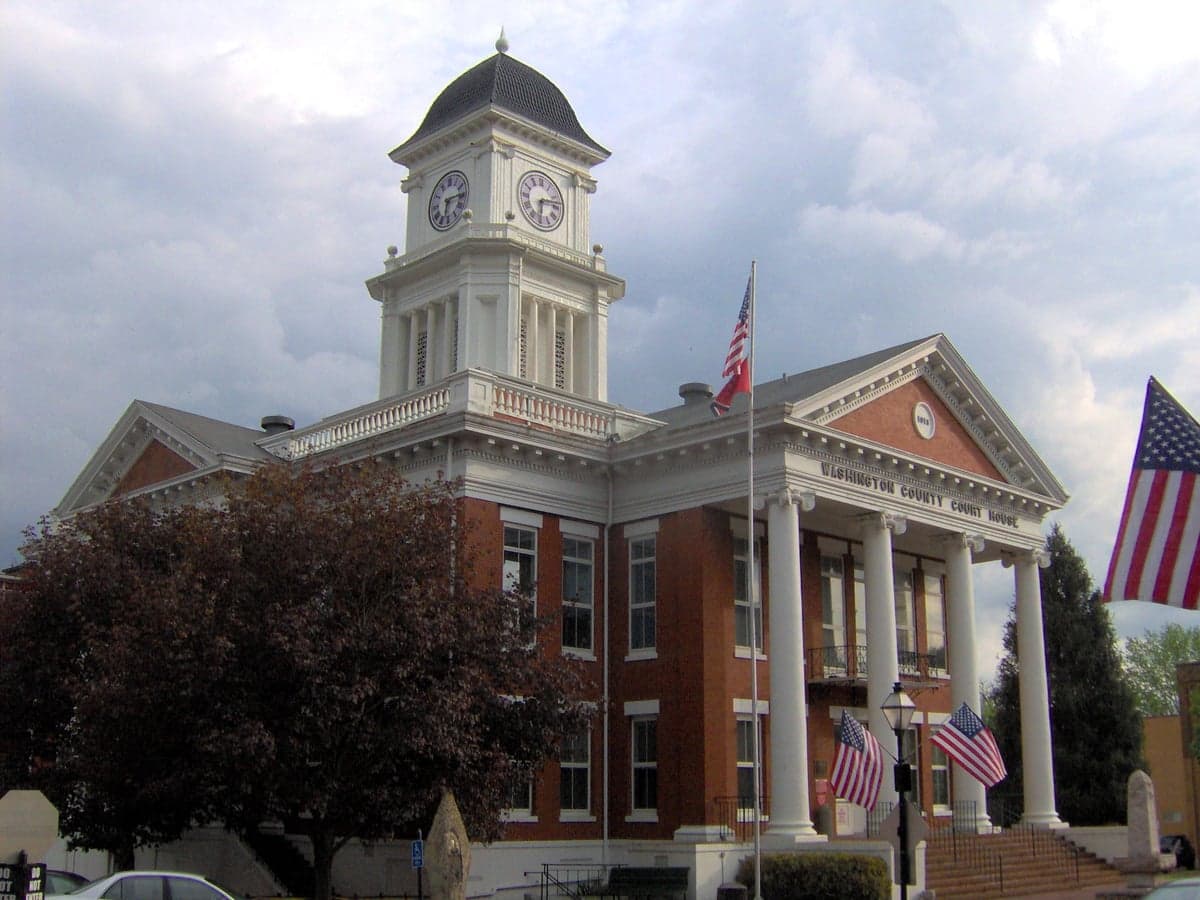
Photo: Wikipedia
Demographics of Washington County
Affluence Level in Washington County
A middle-class area roughly in line with national averages across income, home values, education, and employment.
People of Washington County
Washington County, Tennessee, is home to 134,693 residents who form a predominantly white (86.3%), native-born community with a distinctly Appalachian and Southern character. The population is notably less diverse than the national average, with a foreign-born share of just 1.9%, and the county retains a strong sense of historical continuity rooted in its early settlement patterns. Residents identify strongly with the region's frontier and Civil War heritage, and the county's political and cultural leanings reflect a conservative, family-oriented ethos centered around the twin anchors of Johnson City and Jonesborough.
Settlement & growth (pre-1960)
The human history of Washington County begins with the Cherokee and Creek peoples, who used the region as hunting grounds and maintained seasonal settlements along the Nolichucky and Watauga Rivers. European encroachment began in earnest in the 1760s, when Anglo-American settlers from Virginia and North Carolina crossed the mountains under the terms of the Watauga Association, a self-governing compact that predated the United States. These early pioneers were predominantly Scots-Irish Presbyterians and English yeoman farmers, drawn by the promise of cheap land and relative freedom from colonial authority. They established the first permanent settlements at Jonesborough (founded 1779), which became the county seat and the oldest town in Tennessee, and along the Buffalo Creek and Little Limestone Creek valleys.
The Scots-Irish remained the dominant ethnic group through the 19th century, shaping the county's religious landscape with a proliferation of Presbyterian, Baptist, and Methodist churches. The arrival of the East Tennessee and Virginia Railroad in the 1850s spurred the growth of Johnson City, which began as a railroad depot and quickly eclipsed Jonesborough as the commercial hub. The Civil War divided the county sharply, with East Tennessee's strong Unionist sentiment clashing against Confederate sympathies in the lower counties; Washington County sent soldiers to both sides, and the aftermath left a legacy of political conservatism and suspicion of federal authority. Post-Reconstruction, the county saw modest industrial development, with timber, milling, and textile factories drawing a small number of German and Irish immigrants, though the foreign-born population never exceeded 3% during this period. The Great Migration largely bypassed Washington County, as the region lacked the heavy industry that pulled Black Southerners northward; the Black population remained small and concentrated in Johnson City's southern neighborhoods.
The 1930s through the 1950s brought the New Deal's Tennessee Valley Authority (TVA) electrification and the expansion of East Tennessee State University (ETSU) in Johnson City, which began as a teachers' college and gradually attracted a professional class. The post-World War II era saw the construction of Interstate 81 and the growth of the medical sector, anchored by the Mountain Home VA Medical Center and what would become the Johnson City Medical Center. These institutions drew a steady stream of domestic migrants from rural Appalachia and the broader South, but the county remained overwhelmingly white and native-born, with little of the ethnic diversification seen in Tennessee's larger cities like Nashville or Memphis.
Modern era (post-1965)
The 1965 Hart-Cellar Act had a minimal impact on Washington County's demographics. Unlike the booming Sun Belt metros that attracted large numbers of immigrants from Latin America and Asia, Washington County's foreign-born population remained stagnant at roughly 2% through the 1990s and into the 2020s. The small Hispanic population (4.7%) is largely composed of Mexican and Central American families who arrived in the 1990s and 2000s to work in construction, landscaping, and poultry processing plants in and around Johnson City and Gray. These communities are dispersed rather than concentrated in a single ethnic enclave, though a cluster of Hispanic-owned businesses has emerged along West Market Street in Johnson City.
The Black population (3.7%) has remained stable, with most Black residents living in Johnson City's historically Black neighborhoods near the ETSU campus and along the Martin Luther King Jr. Boulevard corridor. The East/Southeast Asian population (1.2%) is small but visible, consisting primarily of Vietnamese and Korean families who arrived as professionals in the medical and academic sectors, along with a smaller number of Filipino nurses recruited by the region's hospitals. The Indian subcontinent population (0.3%) is even smaller, concentrated among faculty and graduate students at ETSU and medical professionals at the VA hospital. Domestic migration has been the primary driver of population change since 2000, with retirees and remote workers from Florida, California, and the Northeast drawn by the lower cost of living, the absence of state income tax, and the region's relatively mild four-season climate. These newcomers have fueled suburban growth in the communities of Gray, Sulphur Springs, and along the Boones Creek corridor, where new subdivisions and shopping centers have reshaped the landscape.
The future
Washington County is projected to grow modestly over the next decade, with the population likely reaching 145,000–150,000 by 2035. The county is becoming slightly more diverse, driven primarily by the growth of the Hispanic population, which is expected to rise to 6–7% as younger families settle in the area and birth rates among Hispanic residents outpace those of the white population. The East/Southeast Asian and Indian populations will likely grow slowly, remaining below 2% each, as ETSU and the medical sector continue to recruit internationally trained professionals. The white population will remain the overwhelming majority, though its share will decline gradually from 86.3% to the low 80s as the county's non-white populations increase. The most significant demographic trend is the continued influx of domestic migrants from high-cost states, which is accelerating suburbanization in the unincorporated areas around Johnson City and along the Interstate 81 corridor toward the Washington County–Sullivan County line. This growth is putting pressure on infrastructure and schools, particularly in the rapidly developing Gray and Boones Creek areas, and is gradually shifting the county's cultural identity from its Appalachian roots toward a more generic exurban Southern character.
For someone moving to Washington County today, the takeaway is clear: this is a stable, slow-growth community where the population is overwhelmingly native-born, white, and conservative, with a small but growing Hispanic presence and a professional class tied to the medical and educational sectors. The county offers a low-cost, family-oriented environment with strong schools in the Johnson City and Jonesborough districts, but newcomers should expect a culture that prizes tradition, self-reliance, and community ties over diversity or rapid change. The future will bring more suburban development and a gradual diversification, but Washington County will remain, for the foreseeable future, a distinctly Appalachian place shaped by its Scots-Irish and English foundations.

* Values derived from national, state, county, city and local statistics and may differ in a specific area. Last updated: 2026-07-12T03:40:16.000Z
Narrative content on this page is AI-generated and may contain mistakes. Verify any details that matter before acting on them.
ReloMaps may earn a commission from affiliate links at no extra cost to you.

