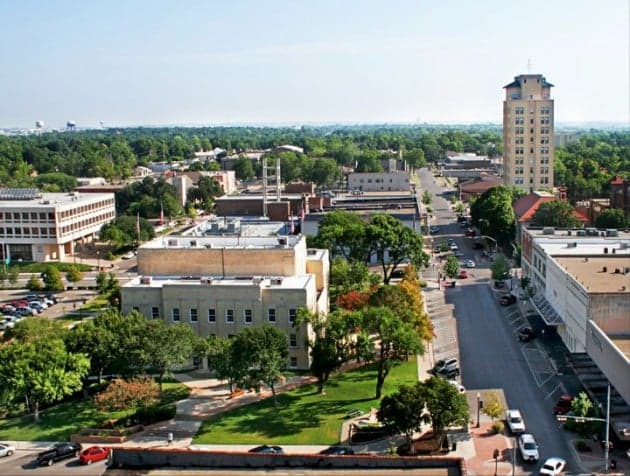
Photo: Wikipedia
Political ClimatePolitical Climate in Temple, TX
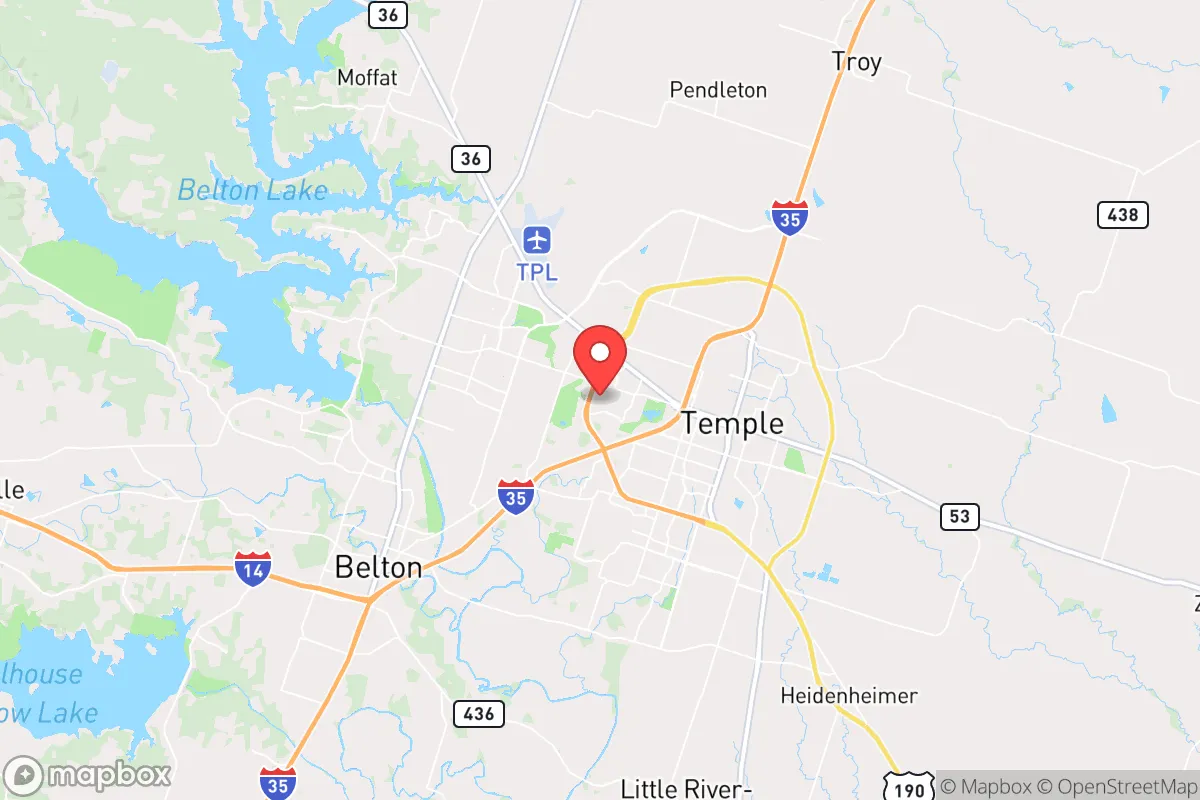
District shown is the primary district for this city’s centroid. Cities may span multiple districts.
Local Political AnalysisPolitical Analysis of Temple, TX
Temple sits squarely in deep-red Central Texas, and if you’ve spent any time here you know that’s not changing anytime soon. The Cook Partisan Voting Index (PVI) for the area is R+11, which is a full seven points more conservative than the state of Texas as a whole (R+4). That gap isn’t just a number—it shows up in local elections, school board races, and even the way people talk about politics at the coffee shop. Temple has been reliably Republican for decades, and while the city’s growth is bringing in new folks from bluer areas like Austin (about 65 miles southwest) and Dallas, the overall trajectory is still solidly rightward. You’ll hear more talk about property taxes and Second Amendment rights than about public transit expansions or rent control.
How it compares
Compared to Texas as a state, Temple is noticeably more conservative. The R+11 PVI means that in a typical statewide election, Republican candidates here outperform their statewide margin by about 7 points. For context, nearby Killeen (home to Fort Cavazos) leans slightly more moderate due to its diverse military population, while Belton and the smaller towns north along I-35 are even redder. Waco, about 40 miles north, has a similar R+10 PVI but a more pronounced urban-rural split. In Temple, the political culture is less about partisan fireworks and more about practical conservatism—low taxes, limited regulation, and a strong sense of local control. The state’s R+4 rating reflects a more competitive environment, especially in the suburbs of Houston, Dallas, and San Antonio, but Temple doesn’t have that kind of swing-voter energy. It’s a place where the Republican primary is often the real election.
What this means for residents
For conservative residents, Temple feels like home. You’ll find plenty of churches, gun-friendly policies, and a city council that generally keeps taxes low and development business-friendly. The local GOP is active but not extreme—think more “fiscal responsibility” than “culture war.” For liberal residents, life here is more about finding your niche than feeling isolated. There’s a small but growing progressive community, especially among younger professionals and healthcare workers at Baylor Scott & White. You won’t see many pride flags or “defund the police” signs, but you also won’t face open hostility in most neighborhoods. The practical reality is that both sides tend to get along day-to-day because the economy is strong and the cost of living is reasonable. Political arguments are more likely to happen over barbecue than at a city council meeting.
One cultural distinction worth noting: Temple’s politics are less about national trends and more about local priorities. The city has a strong “we take care of our own” ethos that crosses party lines. You’ll see conservative support for local bond measures that fund parks and roads, and liberal residents often find common ground on issues like veterans’ services and public school funding. The biggest policy difference from the state as a whole is probably the pace of change—Temple is slower to adopt new regulations or social policies, preferring to see how things play out elsewhere first. That’s changing a bit as the city grows, but for now, the political climate here is stable, predictable, and overwhelmingly conservative. If you’re moving to Temple, you’re moving to a place where the political temperature is warm but rarely boiling over.

State Political ClimatePolitical Climate in Texas
State Political AnalysisPolitical Environment in the State
Texas is a solidly Republican state with a Cook PVI of R+4, but that headline number masks a far more complex reality than it did a decade ago. The state’s dominant coalition is a mix of rural and suburban conservatives, business interests, and a growing number of Hispanic voters who lean right on economics and social issues. Over the last 20 years, Texas has shifted from a deep-red lock to a competitive battleground, driven by explosive growth in the blue-leaning metros of Austin, Dallas, Houston, and San Antonio, while the rural and exurban vote has hardened. The 2024 presidential race saw Donald Trump win the state by roughly 5.5 points, down from 9 points in 2016, and down from the 12-point margins of the 2000s. The trajectory is clear: Texas is trending purple, but the GOP still holds every statewide office and both legislative chambers.
Urban vs. rural divide
The political map of Texas is a tale of two landscapes. The big four metros — Houston, Dallas-Fort Worth, San Antonio, and Austin — are the engine of Democratic growth. Harris County (Houston) and Dallas County now vote blue by double digits, and Travis County (Austin) is one of the most liberal counties in the South. Bexar County (San Antonio) flipped to the Democrats in 2020 and has stayed there. Meanwhile, the sprawling suburbs that once anchored GOP dominance are splitting: Collin County (north of Dallas) and Fort Bend County (southwest of Houston) are now purple, with Democrats winning local races in 2024. The rural and small-town vote, from the Panhandle down through West Texas and into East Texas, is overwhelmingly Republican. Lubbock, Midland, and Tyler are GOP strongholds where margins often exceed 70%. The Rio Grande Valley, once a Democratic firewall, has shifted right — Starr County, which voted for Hillary Clinton by 60 points in 2016, went for Trump by 15 points in 2024. That realignment is the single biggest story in Texas politics right now.
Policy environment
Texas operates under a low-tax, low-service model that appeals to conservatives. There is no state income tax, and the state relies on property taxes and sales taxes, which are among the highest in the country. The regulatory posture is business-friendly: no state-level occupational licensing for many trades, and a tort-reform system that caps non-economic damages in medical malpractice cases. Education policy is dominated by the school choice debate — the 2023 legislative session saw a major push for education savings accounts (ESAs) that failed due to rural Republican opposition, but the issue is far from dead. Healthcare is a mixed bag: Texas has the highest uninsured rate in the nation, and the state has refused to expand Medicaid under the Affordable Care Act. Election laws have tightened: Senate Bill 1 (2021) restricted drive-through voting, added ID requirements for mail ballots, and banned 24-hour polling places. For a relocator, the practical effect is that voting in blue counties like Harris or Travis requires more planning than in red counties like Montgomery or Tarrant, where polling places are more plentiful.
Recent policy direction
The last five years have seen a sharp rightward turn on cultural and liberty issues, even as the state’s demographics shift left. On gun and self-defense law, Texas became a permitless carry state in 2021 (HB 1927), allowing anyone 21 or older who can legally possess a firearm to carry it openly or concealed without a license. On parental and education rights, the 2023 session passed HB 900, which requires book vendors to rate materials for "sexual content" and bans them from schools if deemed inappropriate — a law currently tied up in court. On speech and privacy, the state passed HB 20 in 2023, which prohibits social media platforms from moderating content based on viewpoint — also challenged in court. On medical and bodily autonomy, Texas has one of the strictest abortion bans in the nation (SB 8, 2021, and the trigger law that took effect in 2022), with no exceptions for rape or incest. On property rights, the state has strong eminent domain protections, but the 2023 session saw a push to limit local zoning authority — a flashpoint in Austin, where the city’s land-use rules are a perennial battleground. On taxation, the 2023 session passed a $18 billion property tax cut (Proposition 4), which was approved by voters. On voting and ballot access, the trend is toward restriction, as noted above. For a relocator, the key takeaway is that Texas is a state where individual liberty is broadly defined for gun owners and taxpayers, but narrowly defined for women seeking reproductive care and for voters in urban counties.
Civil unrest & political movements
Texas has a history of visible political activism on both sides. The 2020 protests in Austin over the murder of George Floyd were among the largest in the nation, leading to a city council vote to defund the police by $150 million — a decision that was partially reversed in 2023 after a spike in violent crime. On the right, the "constitutional sheriff" movement is strong in rural counties, and the state has seen a surge in secessionist rhetoric, with the Texas Nationalist Movement (Texit) gaining some traction, though it remains a fringe position. Immigration politics are a constant flashpoint: Governor Greg Abbott’s Operation Lone Star has bused over 100,000 migrants to Democratic-run cities since 2021, and the state has passed laws (SB 4, 2023) allowing state and local police to arrest people suspected of entering the U.S. illegally — a law currently blocked by federal courts. Election integrity controversies have been a fixture since 2020, with Republican officials in Harris County (Houston) facing repeated lawsuits over ballot access and polling place operations. A new resident in El Paso or the Rio Grande Valley will see border security as a daily reality; a resident in Dallas or San Antonio will see it as a political abstraction, but the rhetoric is inescapable.
Projection
Over the next 5-10 years, Texas will continue to trend purple, but the pace of that shift depends on two factors: the continued in-migration of voters from blue states (California, New York, Illinois) and the political allegiance of the growing Hispanic population. If the Hispanic shift toward the GOP continues at its current rate, Texas could remain a lean-Republican state for another decade. If it stalls or reverses, the state could become a true toss-up by 2032. The suburbs of Dallas, Houston, and San Antonio will be the decisive battlegrounds — places like Collin County and Fort Bend County are already purple, and their trajectory will determine the state’s future. On policy, expect continued fights over school choice, property tax reform, and abortion access, with the legislature likely to pass a near-total ban on abortion pills in the next session. A relocator moving in now should expect a state that is politically volatile, with a Republican supermajority in the legislature that is increasingly at odds with the growing urban and suburban electorate. The practical effect is that your vote will matter more in Texas than in a deep-red or deep-blue state, but the policy environment will remain conservative for the foreseeable future.
For a new resident, the bottom line is this: Texas offers a low-tax, business-friendly environment with strong gun rights and a conservative cultural tilt, but it also has high property taxes, a strained healthcare system, and a political climate that is increasingly polarized. If you’re a conservative, you’ll find a state government that largely aligns with your values, but you’ll also see the ground shifting under your feet. If you’re a liberal, you’ll find blue cities that feel like islands of progressive policy in a red sea, but you’ll face state-level restrictions on everything from voting to reproductive care. Either way, Texas is a state where politics is a constant, visible force — and that’s unlikely to change anytime soon.
* Values derived from national, state, county, city and local statistics and may differ in a specific area. Last updated: 2026-07-20T01:55:26.000Z
Narrative content on this page is AI-generated and may contain mistakes. Verify any details that matter before acting on them.
ReloMaps may earn a commission from affiliate links at no extra cost to you.

