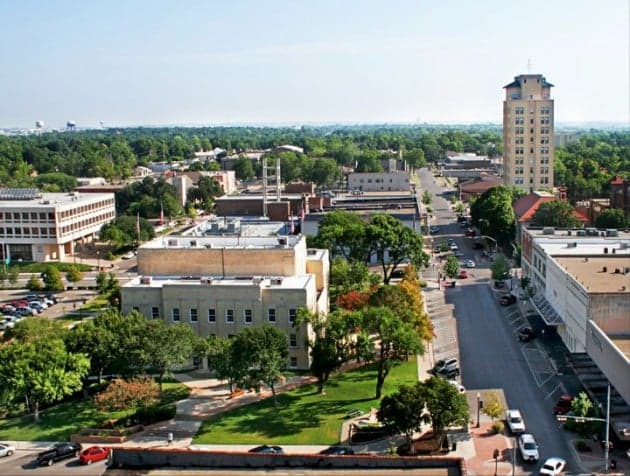
Photo: Wikipedia
Personal Sovereignty in Temple, TX
Strong independent fundamentals that actively favor personal liberty and low regulation.
What does Personal Sovereignty tell us?
Personal Sovereignty measures your capacity for self-reliance and independence with minimal government friction. Higher scores mean fewer barriers between you and the way you want to live... but it assumes you have the space you need and good neighbors.
What does this tell us?
Personal Sovereignty measures your capacity for self-reliance and independence with minimal government friction. Higher scores mean fewer barriers between you and the way you want to live... but it assumes you have the space you need and good neighbors.
State Policy
Energy independence: Net exporter (220% of energy produced in-state)
Personal Liberty
Homesteading

Personal Liberty Analysis
Temple, Texas, offers a personal sovereignty environment that is heavily shaped by the state's broad preemption laws and a local culture of self-reliance, but it is not a regulatory-free zone. The city operates within a framework where Texas law limits local government overreach in areas like gun rights, property use, and taxation, yet Temple's own municipal codes and zoning ordinances impose meaningful constraints on what residents can do with their land and homes. For a relocation-minded individual or family who prioritizes autonomy, the key is understanding that Temple provides a strong baseline of personal freedom—especially compared to states with more centralized control—but requires navigating local rules that can feel restrictive for those seeking maximum independence.
Tax burden and regulatory posture in Temple and Bell County
Texas has no state income tax, which immediately boosts personal sovereignty by leaving more money in residents' pockets. Temple's property tax burden is moderate for the state, with a combined city, county, and school district rate typically around 2.3% to 2.5% of assessed value—higher than some rural Texas counties but lower than major metros like Austin or Dallas. The city's regulatory posture is generally light-touch for businesses, with no local business license requirement for most sole proprietorships and a streamlined permitting process for home-based enterprises. However, Temple does enforce a citywide building code (based on the International Residential Code) and requires permits for structural changes, electrical work, and plumbing—a common municipal practice that limits full autonomy over one's property. The city also has a noise ordinance (quiet hours 10 p.m. to 7 a.m.) and restrictions on outdoor storage, which can chafe against a "do what you want" ethos. Compared to unincorporated Bell County, where zoning is minimal and property taxes are slightly lower, Temple's regulatory hand is heavier but still far lighter than in most suburban areas of California or the Northeast.
Self-defense and gun law specifics in Temple and Texas
Texas law provides strong self-defense protections, and Temple residents benefit from the state's constitutional carry (permitless carry) law, which allows any legal adult to carry a handgun openly or concealed without a license. The city does not impose its own gun restrictions beyond state law, meaning no local bans on magazine capacity, firearm types, or carry in parks. Temple's municipal code does prohibit discharging a firearm within city limits except on a shooting range or in lawful self-defense, which limits backyard target practice but is standard for urban areas. The state's "stand your ground" law applies in Temple, with no duty to retreat before using deadly force if a person reasonably believes it is necessary to prevent imminent harm. For those concerned about defensive use, Bell County's district attorney has a reputation for respecting self-defense claims, though no jurisdiction is immune to prosecutorial discretion. Gun owners should also note that Texas law preempts local firearm regulations, so Temple cannot pass its own ordinances that would restrict carry or ownership—a key sovereignty safeguard that prevents the patchwork of rules seen in states like Colorado or New York.
Self-reliance and homesteading viability: lot sizes, zoning, and off-grid feasibility
Within Temple's city limits, homesteading and off-grid living face significant practical barriers. The minimum lot size in most residential zones is 6,000 to 7,500 square feet, which limits space for large gardens, livestock, or extensive workshops. The city's zoning code explicitly prohibits keeping chickens, goats, or other farm animals on standard residential lots, though a few older neighborhoods with larger parcels may have non-conforming uses. Off-grid utilities are effectively impossible inside city limits: Temple requires connection to municipal water and sewer for any habitable structure, and the city's building code mandates compliance with the National Electrical Code, making solar-only systems difficult to permit without a grid-tie. For those seeking true self-reliance, the viable option is to look outside Temple in unincorporated Bell County or neighboring rural areas like Rogers, Little River-Academy, or the Holland area, where lot sizes of 1 to 5 acres are common, no municipal water hookup is required, and county zoning is minimal. Even there, the Texas Commission on Environmental Quality (TCEQ) regulates private wells and septic systems, but the process is straightforward and permits are routinely issued. The trade-off is that rural properties near Temple still have access to the city's amenities (hospitals, shopping, schools) while allowing far greater homesteading freedom.
Personal liberties: parental rights, medical autonomy, speech, and property
Texas law provides strong protections for parental rights, including the Parental Bill of Rights (Texas Family Code Chapter 151) that affirms parents' authority to direct their children's education, healthcare, and moral upbringing. Temple Independent School District (TISD) generally follows state law on parental notification for medical services and curriculum transparency, though specific policies vary by campus. Medical autonomy is robust: Texas does not require COVID-19 or other vaccine mandates for adults, and the state's ban on vaccine passports extends to local governments. However, private employers and healthcare facilities in Temple may still impose their own requirements, so individuals should verify policies with specific employers or providers. Free speech is protected under the Texas Religious Freedom Restoration Act (RFRA), which applies to local government actions, and Temple has no local ordinances restricting public speech or assembly beyond standard time, place, and manner rules. Property rights are strong, with Texas's private property rights law (Texas Government Code Chapter 2507) limiting eminent domain abuse and requiring compensation for regulatory takings. Temple's zoning board does have authority to deny variances, but the process is transparent and appeals are possible. Overall, the legal environment in Temple leans heavily toward individual liberty, with the main friction points being municipal zoning and building codes that prioritize uniformity over personal expression.
Compared to other Texas cities of similar size, Temple's personal sovereignty profile is solidly above average—stronger than in more regulated suburbs like Round Rock or Georgetown, but not as unconstrained as truly rural counties like Mills or San Saba. The city offers a practical balance: the legal framework of Texas provides a broad foundation of freedom (no income tax, constitutional carry, parental rights, property protections), while local ordinances impose moderate limits on land use and self-sufficiency. For a family or individual who values autonomy but also wants access to urban amenities, Temple is a strong choice. For those seeking maximum independence—off-grid living, unrestricted animal husbandry, or minimal building codes—the surrounding unincorporated areas of Bell County are a better fit, with the same state-level liberties and far fewer local constraints. The key takeaway is that Temple's sovereignty environment is defined by the tension between Texas's libertarian state laws and the practical necessities of municipal governance, and the smart relocation decision depends on how much of that tension a person is willing to accept.

* Values derived from national, state, county, city and local statistics and may differ in a specific area. Last updated: 2026-07-20T01:55:26.000Z
Narrative content on this page is AI-generated and may contain mistakes. Verify any details that matter before acting on them.
ReloMaps may earn a commission from affiliate links at no extra cost to you.

