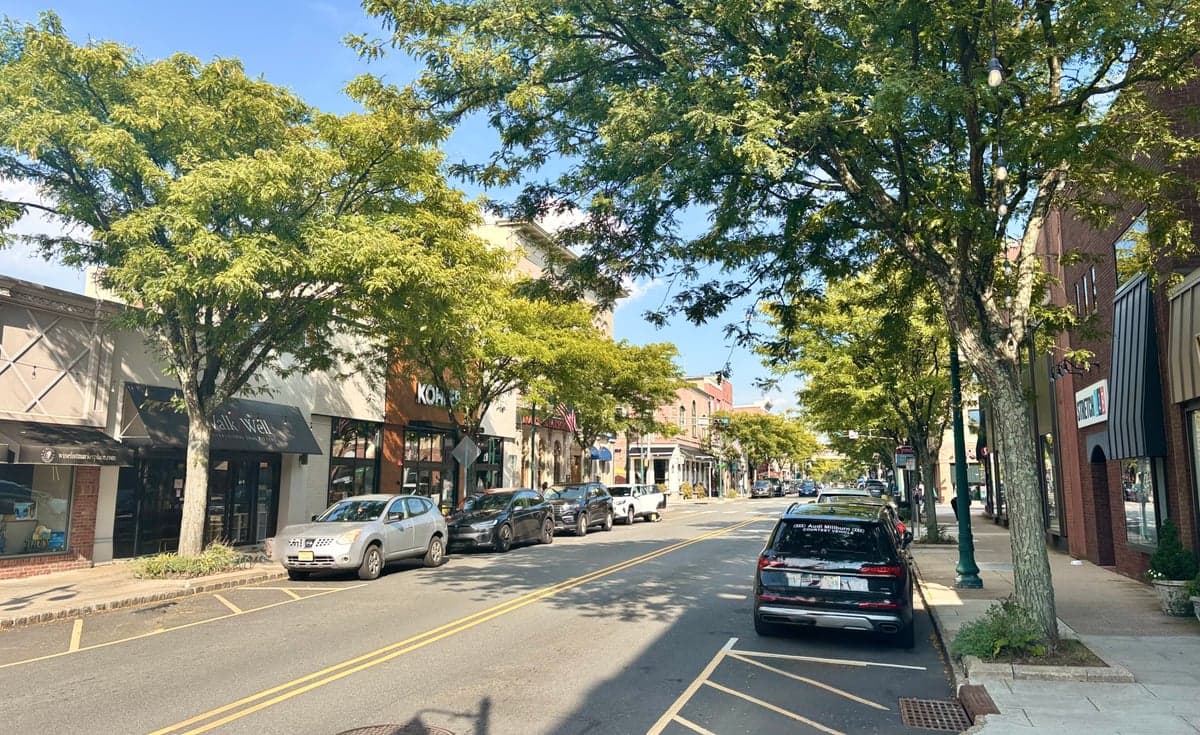
Photo: Wikipedia
Personal Sovereignty in Summit, NJ
Viable for self-reliance. Generally workable, though some barriers may limit total independence.
What does Personal Sovereignty tell us?
Personal Sovereignty measures your capacity for self-reliance and independence with minimal government friction. Higher scores mean fewer barriers between you and the way you want to live... but it assumes you have the space you need and good neighbors.
What does this tell us?
Personal Sovereignty measures your capacity for self-reliance and independence with minimal government friction. Higher scores mean fewer barriers between you and the way you want to live... but it assumes you have the space you need and good neighbors.
State Policy
Energy independence: Importer (17% of energy produced in-state)
Personal Liberty
Homesteading

Personal Liberty Analysis
Summit, New Jersey, presents a distinctly managed autonomy environment — one where personal sovereignty is framed less by what you can do without permission and more by the quality of the public systems you fund in exchange for that permission. For a relocation reader weighing individual freedom against institutional support, Summit sits firmly in the "high-regulation, high-service" quadrant of American municipalities. The city's governance assumes that collective solutions, administered through professional bureaucracy, deliver better outcomes than private initiative — a posture that shapes everything from your property tax bill to your ability to modify your own home.
Tax burden and regulatory posture: what you pay for the privilege
Summit's tax burden is among the heaviest in the nation, and it is the single most important sovereignty consideration for a prospective resident. The combined effective property tax rate in Union County consistently lands near 2.3% of assessed home value annually, meaning a $1 million home carries roughly $23,000 in yearly property taxes — before state income tax, which tops out at 10.75% for high earners. New Jersey's statewide average effective property tax rate of 2.23% is the highest in the country, and Summit's rates track closely to that figure. The trade-off is tangible: Summit's public schools are routinely ranked in the top 50 in New Jersey, and the city maintains its own police department, fire department, and a municipal electric utility that historically undercuts private power providers.
Regulatory posture in Summit is interventionist by design. The city operates under a Master Plan with strict zoning ordinances that govern lot coverage, building height, and even exterior paint colors in designated historic districts. Any exterior renovation requires a construction permit and, in many neighborhoods, approval from the Historic Preservation Commission. The state layer adds further constraints: New Jersey's COAH (Council on Affordable Housing) mandates require municipalities to zone for a state-calculated share of affordable housing, which has driven Summit to approve multi-family developments in areas that were previously single-family only. For a homeowner, this means your property is less a castle and more a regulated asset — you can improve it, but the city has a say in how, when, and at what density.
Self-defense and gun law specifics: the strictest regime in the region
New Jersey's firearm statutes are among the most restrictive in the United States, and Summit enforces them without local modification. The state requires a Firearms Purchaser Identification Card (FPID) for any handgun purchase, a process that involves fingerprinting, a background check, and a reference interview — typically taking 30 to 90 days. Handgun carry permits are "shall-issue" only after a demonstrated justifiable need, a standard that courts have narrowed but not eliminated post-Bruen. In practice, Summit residents who carry do so under a permit that requires a multi-hour training course, a psychological evaluation, and a $200+ fee cycle.
Self-defense law in New Jersey is equally constrained. The state has no "Stand Your Ground" statute; it operates under a "duty to retreat" rule, meaning you must attempt to escape a threat before using deadly force unless you are in your own home. Even inside the home, the Castle Doctrine applies only if the intruder has unlawfully entered and you reasonably believe they intend to cause serious bodily harm. Magazine capacity is capped at 10 rounds, and "assault weapons" — defined broadly to include many common semi-automatic rifles — are banned. For a sovereignty-minded reader, Summit is functionally a place where self-defense is delegated to the state's police apparatus rather than the individual. The city's crime rate is low — roughly 1.2 violent crimes per 1,000 residents annually — which mitigates the practical risk, but the legal framework leaves little room for personal armed response.
Self-reliance and homesteading viability: lot sizes, zoning, and off-grid feasibility
Homesteading in Summit is not viable in any meaningful sense. The city's median lot size is 0.18 acres, with most homes built on 40-foot-wide lots in grid-style neighborhoods. Zoning ordinances require minimum setbacks of 25 feet from the front property line and 10 feet from side lines, leaving little room for substantial food production. Chickens are permitted only with a $50 annual permit and are limited to hens — no roosters — with coops required to be at least 20 feet from any neighbor's dwelling. Larger livestock, beekeeping, and any agricultural activity beyond a "kitchen garden" are prohibited outright.
Off-grid feasibility is effectively zero. Summit's municipal electric utility, Summit Public Electric, has a monopoly on power distribution within city limits; installing solar panels requires interconnection approval and net-metering agreements, and battery storage systems must meet fire code restrictions that limit placement near property lines. Rainwater harvesting is legal but capped at 100 gallons per property, and composting is restricted to enclosed bins to mitigate odor complaints. The city's water supply comes from the Commonwealth Water Company, a private utility, so there is no well-drilling option. For a reader seeking energy independence or food self-sufficiency, Summit is the wrong geography — the regulatory environment assumes municipal provision of utilities and actively discourages private alternatives.
Personal liberties: parental rights, medical autonomy, speech, and property
Parental rights in Summit are exercised within a framework of strong state oversight. New Jersey mandates comprehensive sex education in public schools, requires vaccination for school attendance with only narrow medical exemptions (no philosophical or religious exemptions), and permits students to self-identify gender without parental notification in certain contexts. The Summit Public Schools district follows these state mandates without local deviation. For a parent who wants to opt out of specific curriculum elements, the state allows limited opt-outs for sex education, but the process requires a written request to the principal and is granted only for "moral or religious" reasons — not general objection.
Medical autonomy is similarly constrained. New Jersey has no parental consent requirement for minors to receive mental health counseling or substance abuse treatment — a minor aged 14 or older can consent to these services without parental knowledge. The state also mandates that health insurance plans cover abortion and contraception without cost-sharing, and it has codified abortion access into state law. For a sovereignty-minded reader, this means the state's definition of individual liberty extends to minors in ways that may conflict with parental authority. Speech and property rights are more conventional: Summit has no local ordinances restricting political signage beyond standard size limits, and the city's noise ordinance is enforced only on complaint, not proactively. Property rights, however, are curtailed by the state's rent control ordinance (applicable to multi-family buildings) and by the fact that New Jersey is one of the few states with no "right to farm" protections for residential agricultural activity.
Relative to other regions, Summit's sovereignty profile is a clear trade: you surrender significant individual latitude — in firearms, in property modification, in energy independence, in parental control over education and healthcare — in exchange for a municipal environment that is safe, well-run, and administratively predictable. For a relocation reader who prioritizes autonomy above all, this is a poor fit; for one who values institutional competence and is willing to operate within defined boundaries, Summit offers a stable, low-crime, high-service alternative to the more libertarian-leaning states of the South and Mountain West. The city's governance is not hostile to individual initiative — it simply assumes that initiative should be channeled through approved processes rather than exercised independently.

* Values derived from national, state, county, city and local statistics and may differ in a specific area. Last updated: 2026-11-09T06:05:59.000Z
Narrative content on this page is AI-generated and may contain mistakes. Verify any details that matter before acting on them.
ReloMaps may earn a commission from affiliate links at no extra cost to you.

