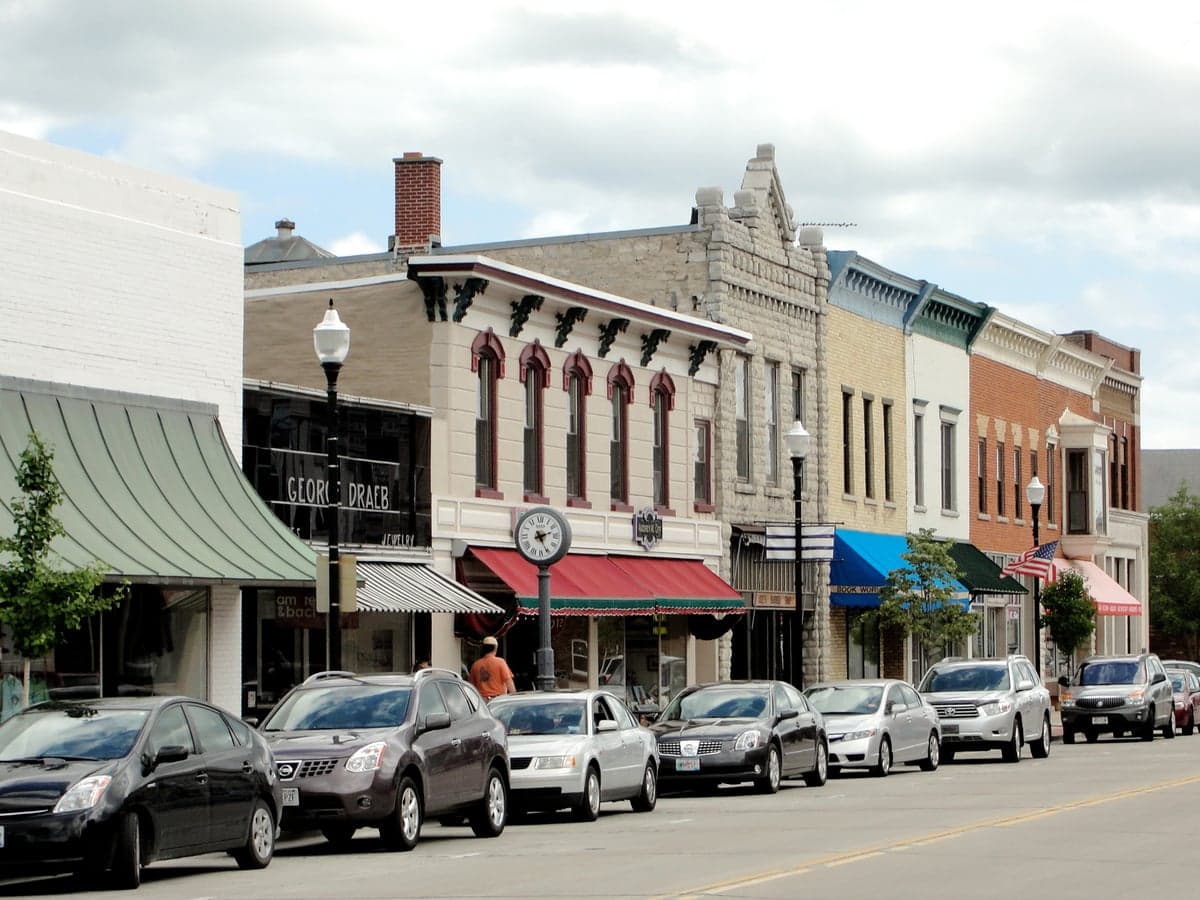
Photo: Wikipedia
Political ClimatePolitical Climate in Sturgeon Bay, WI
District shown is the primary district for this city’s centroid. Cities may span multiple districts.
Inherited from parent county — no local data available.
* Lean and PVI are calculated from Sturgeon Bay, WI’s own 2020 presidential results (precinct returns summed to the city), with 2024 estimated from the surrounding county’s 2020–2024 shift, Cook-style. Sources: state election offices; VEST 2020 precinct results (CC BY 4.0).
Political rankings in Wisconsin
- Most Conservative Cities in Wisconsin
- Most Liberal Cities in Wisconsin
- Best Liberal-Leaning Towns in the Midwest
- Safest Liberal-Leaning Towns in the Midwest
- Safest Conservative-Leaning Towns in the Midwest
- Affordable Small Towns for Conservatives
- Most Affordable Liberal-Leaning Small Towns in the U.S.
- Safest Conservative-Leaning Cities in the U.S.
- Most Conservative Counties in Wisconsin
- Most Liberal Counties in Wisconsin
Local Political AnalysisPolitical Analysis of Sturgeon Bay, WI
Sturgeon Bay is one of those places where the political label "purple" actually means something real, not just a talking point. The city itself leans slightly left, especially in local races, but the surrounding Door County countryside is deeply conservative, and the county as a whole has been trending redder in recent presidential cycles. The Cook PVI for both the city's congressional district and the state of Wisconsin is EVEN, which tells you this is a true battleground—neither party can take it for granted. If you've been around here long enough, you remember when Door County was reliably Republican, but the influx of retirees and second-home owners from Chicago and Milwaukee has shifted the local Democratic base, especially in the city and along the lakefront.
How it compares
Compared to the rest of Wisconsin, Sturgeon Bay is a microcosm of the state's larger political divide. The state as a whole is also rated EVEN by Cook, but that masks a sharp urban-rural split. In Sturgeon Bay, you can see that split play out in a single county: the city votes blue, while towns like Forestville and Brussels vote red by wide margins. Drive 30 minutes south to Green Bay, and you're in a more consistently Democratic-leaning area, but the rural towns between here and there are solidly Republican. The key difference is that Sturgeon Bay's political identity is more fluid than most places—it's not a deep-blue city like Madison or a deep-red rural county like neighboring Kewaunee. It's a place where a Republican county board member might live next door to a Democratic school board member, and they both show up for the same fish fry on Friday night.
What this means for residents
For conservatives living in Sturgeon Bay, the practical reality is that you're not in a hostile environment. Local government is often split, and conservative voices are well-represented on the county board and in the sheriff's office. You'll find plenty of like-minded neighbors, especially if you live outside the city limits. For liberals, the city itself feels comfortable—the local farmers market, the arts scene, and the progressive-leaning civic groups are active and visible. But you'll also encounter plenty of Trump signs in the fall, and the county-level politics can feel like an uphill battle. The real tension shows up in policy debates over land use, tourism development, and school funding, where the urban-rural divide within the county becomes concrete. Neither side gets everything it wants, which means compromise is more than a buzzword here—it's a survival skill.
Culturally, Sturgeon Bay stands apart from much of Wisconsin because of its strong tourism and second-home economy. That brings in people from outside the state who often lean left, which has softened some of the traditional conservatism around things like environmental regulation and public arts funding. You'll see more "coexist" bumper stickers here than in most of rural Wisconsin, but also more "let's keep taxes low" sentiment than in Madison or Milwaukee. The local paper, the Door County Advocate, covers both sides fairly, and the biggest political fights tend to be about local issues—like whether to expand the airport or how to manage shoreline development—rather than national culture wars. It's a place where your vote matters, but your neighbor's vote matters just as much, and everyone knows it.

State Political ClimatePolitical Climate in Wisconsin
State Political AnalysisPolitical Environment in the State
Wisconsin is the quintessential swing state, with a Cook PVI of EVEN that perfectly captures its knife-edge political balance. Over the last 20 years, the state has shifted from a reliably blue-leaning battleground (voting for Democrats in every presidential election from 1988 to 2012) to a true toss-up, decided by margins of less than 1% in both 2016 and 2020. The dominant coalitions are a deeply entrenched Democratic stronghold in the urban southeast anchored by Milwaukee and Madison, counterbalanced by a sprawling, increasingly Republican rural and exurban landscape that stretches from the Driftless Area in the west to the Northwoods. The trajectory is one of hardening polarization, where the statewide outcome is now determined by a shrinking pool of swing voters in the WOW counties (Waukesha, Ozaukee, Washington) and a handful of pivotal suburban and exurban precincts.
Urban vs. rural divide
The political map of Wisconsin is a study in stark contrasts. Milwaukee County delivers roughly 60% of the Democratic margin statewide, with the city itself voting over 75% Democratic in recent cycles. Madison (Dane County) is even more lopsided, routinely hitting 75-80% Democratic, driven by the University of Wisconsin campus and a booming tech and biotech sector. On the other side, the WOW counties — Waukesha, Ozaukee, and Washington — are among the most Republican suburban jurisdictions in the nation, often giving GOP candidates 60-65% of the vote. The rural western counties like Vernon and Crawford have trended sharply right since 2012, while the Northwoods counties (Vilas, Oneida, Forest) remain reliably red. The critical battlegrounds are the exurban and suburban ring around Milwaukee — places like Brookfield, Mequon, and Germantown — where college-educated voters have drifted leftward since 2016, while blue-collar and rural voters have hardened right. The Fox Valley (Appleton, Green Bay, Oshkosh) is a microcosm of the state: competitive, with a slight Republican lean that can flip depending on turnout in the paper mill and manufacturing towns.
Policy environment
Wisconsin’s policy environment reflects its divided government. The state has a flat income tax rate of 4.4% (down from 7.65% in 2011), with a sales tax of 5% that local counties can add up to 0.5%. Property taxes are moderate — median effective rate around 1.6% — but vary widely by school district. The state is a right-to-work state (passed in 2015) and has a Republican-controlled legislature that has consistently pursued tax cuts, deregulation, and school choice expansion. Act 10 (2011), which effectively ended collective bargaining for most public employees, remains a defining policy legacy and a flashpoint. Education policy is a mixed bag: Wisconsin has one of the oldest and largest school voucher programs in the nation (the Milwaukee Parental Choice Program, dating to 1990), but also has strong public school districts in the suburbs. Healthcare is dominated by two large systems (Froedtert & the Medical College of Wisconsin in Milwaukee, and UW Health in Madison), and the state did not expand Medicaid under the Affordable Care Act — a decision that has left a coverage gap for roughly 80,000 low-income adults. Election laws are moderately restrictive: voter ID is required, same-day registration is allowed, and absentee voting is available without excuse. The state uses a bipartisan commission (the Wisconsin Elections Commission) to administer elections, but it has been the subject of intense partisan conflict since 2020.
Recent policy direction
The last five years have seen Wisconsin lurch rightward on cultural and regulatory issues while maintaining a moderate fiscal posture. Act 169 (2023) made Wisconsin a permitless carry state for concealed firearms, joining the majority of states. Act 12 (2023) overhauled shared revenue for Milwaukee and other cities, tying increases to police staffing levels — a clear win for law-and-order advocates. On education, the 2023-25 state budget expanded the voucher program statewide and created a new "Education Savings Account" program for special needs students. Parental rights have been strengthened: Act 19 (2023) requires schools to notify parents if a student requests a name or pronoun change, and Act 20 (2023) banned instruction on gender identity and sexual orientation through fifth grade. On medical freedom, Wisconsin banned COVID-19 vaccine passports in 2021 and has not imposed any statewide mask or vaccine mandates since the emergency orders expired. Property rights are strong: the state has no statewide zoning, and counties have limited ability to regulate agricultural land use. On privacy, Wisconsin has a biometric data privacy law (one of the few in the nation) but no comprehensive data privacy statute. The state has not passed any abortion restrictions beyond the 1849 law that was effectively blocked by a 2023 court ruling — the issue remains in legal limbo pending a state Supreme Court decision expected in 2025.
Civil unrest & political movements
Wisconsin has a history of intense political activism. The 2011 Act 10 protests drew over 100,000 people to the state capitol in Madison — the largest labor protests in modern American history. The 2020 Kenosha unrest following the shooting of Jacob Blake saw two nights of rioting, arson, and the killing of two protesters by Kyle Rittenhouse, whose subsequent acquittal became a national flashpoint. The 2020 election produced a prolonged recount in Milwaukee and Dane counties, and the state was the subject of multiple lawsuits and a controversial "independent investigation" by former state Supreme Court Justice Michael Gableman. Organized activist groups are active on both sides: the Wisconsin Institute for Law & Liberty (WILL) is a powerful conservative legal advocacy group, while Indivisible and Wisconsin Voices coordinate progressive grassroots efforts. Immigration politics are relatively muted compared to border states — Wisconsin has no sanctuary cities, and the state's foreign-born population is only about 5% — but the issue flares up occasionally around agricultural labor shortages. A new resident will notice the ubiquity of political yard signs, the intensity of local news coverage of state government, and the fact that nearly every conversation about schools, taxes, or roads eventually circles back to partisan divides.
Projection
Over the next 5-10 years, Wisconsin is likely to remain a competitive swing state, but the demographic trends suggest a slow rightward drift. The state's population is aging (median age 40.3, above the national average), and the rural areas that lean Republican are growing slowly or shrinking, while the urban and suburban counties that lean Democratic are growing faster. However, the in-migration from Illinois — particularly to the Kenosha and Racine areas — has been a mixed bag: some of these newcomers are fiscally conservative but socially moderate, while others are fleeing high taxes and crime in Chicago and are reliably Republican. The state Supreme Court flipped to a 4-3 liberal majority in 2023, which will likely block the most aggressive conservative legislation on abortion and redistricting for the next decade. The 2024 presidential election will be a stress test: if Democrats continue to gain ground in the WOW county suburbs while losing more rural ground, the state could become a lean-Democratic version of Iowa. If Republicans can hold the suburbs and turn out the rural base, it remains a toss-up. For a relocator, the practical implication is that the state will continue to have divided government, meaning policy volatility on hot-button issues like abortion, education, and election law will persist.
For a new resident, the bottom line is that Wisconsin offers a genuinely competitive political environment where your vote actually matters — but that also means constant political noise and periodic legislative whiplash. If you're conservative, you'll find a state that has moved decisively right on gun rights, school choice, and union power, but you'll also face a Democratic governor (Tony Evers, elected 2018 and 2022) who can veto the most ambitious parts of the Republican agenda. If you're liberal, you'll find strong urban strongholds and a state Supreme Court that can protect abortion access and fair maps, but you'll be living under a legislature that is aggressively conservative on cultural issues. The best advice is to choose your community carefully: Waukesha County feels like a different country from Dane County, and the political culture of Green Bay is distinct from Eau Claire. Pick the area that matches your values, and you'll find Wisconsin to be a place where you can live comfortably regardless of your politics — just don't expect the state to stop arguing anytime soon.
* Values derived from national, state, county, city and local statistics and may differ in a specific area. Last updated: 2026-11-22T17:31:58.000Z
Narrative content on this page is AI-generated and may contain mistakes. Verify any details that matter before acting on them.
ReloMaps may earn a commission from affiliate links at no extra cost to you.

