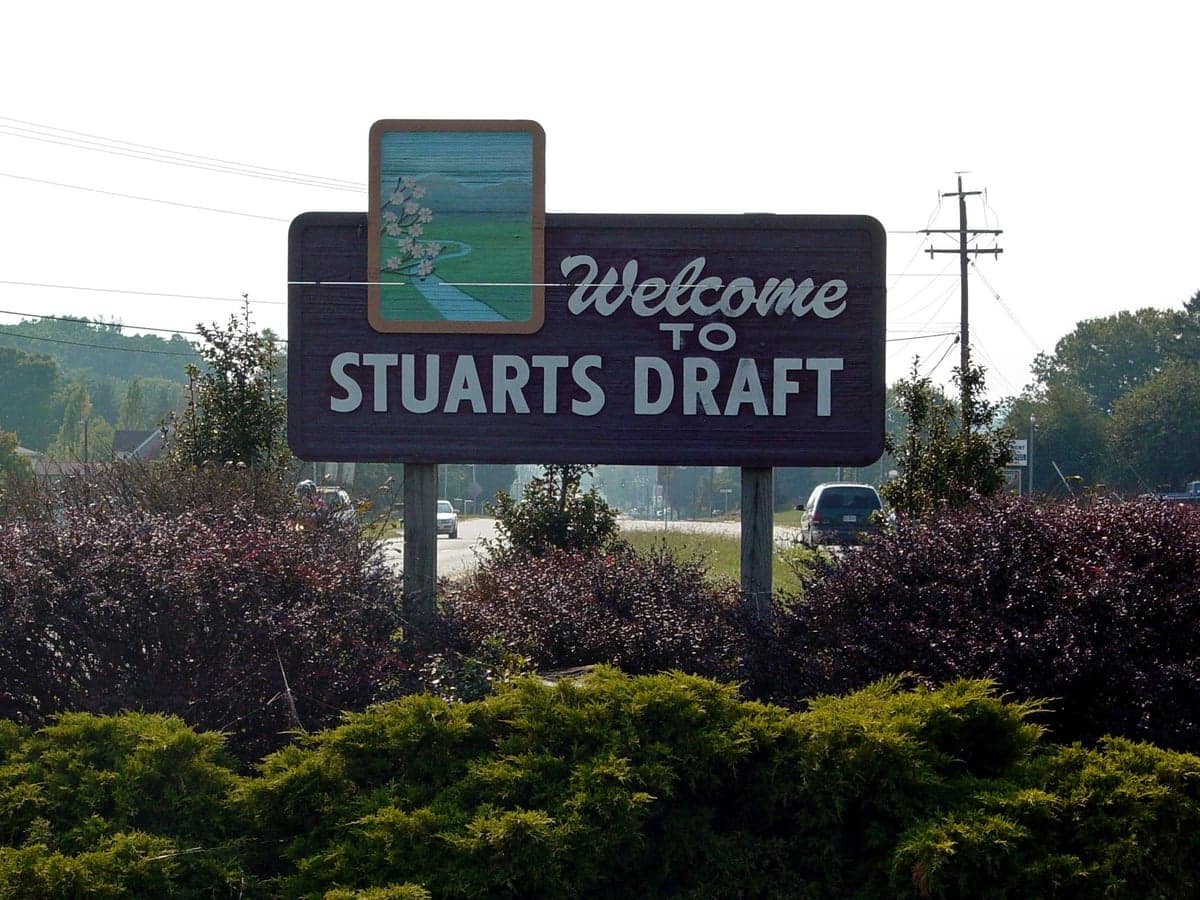
Photo: Wikipedia
Political ClimatePolitical Climate in Stuarts Draft, VA
District shown is the primary district for this city’s centroid. Cities may span multiple districts.
Inherited from parent county — no local data available.
* Lean and PVI are calculated from Stuarts Draft, VA’s own 2020 presidential results (precinct returns summed to the city), with 2024 estimated from the surrounding county’s 2020–2024 shift, Cook-style. Sources: state election offices; VEST 2020 precinct results (CC BY 4.0).
Political rankings in Virginia
- Most Conservative Cities in Virginia
- Most Liberal Cities in Virginia
- Best Liberal-Leaning Towns in the South
- Best Liberal-Leaning Towns in Appalachia
- Best Conservative-Leaning Towns in the Mid-Atlantic
- Safest Liberal-Leaning Towns in the South
- Safest Conservative-Leaning Towns in the South
- Safest Conservative-Leaning Towns on the East Coast
- Most Conservative Counties in Virginia
- Most Liberal Counties in Virginia
Local Political AnalysisPolitical Analysis of Stuarts Draft, VA
Stuarts Draft leans heavily Republican, with a Cook PVI of R+25 that places it among the most conservative pockets in Virginia. That’s a stark contrast to the state as a whole, which shifted to D+4 in recent cycles, driven by growth in Northern Virginia and the Richmond suburbs. Locally, the area has been reliably red for decades, and if anything, the margin has widened slightly since 2020 as surrounding Augusta County continues to vote +30 points or more for GOP candidates. You won’t find many competitive races here—most elections are decided in the primary.
How it compares
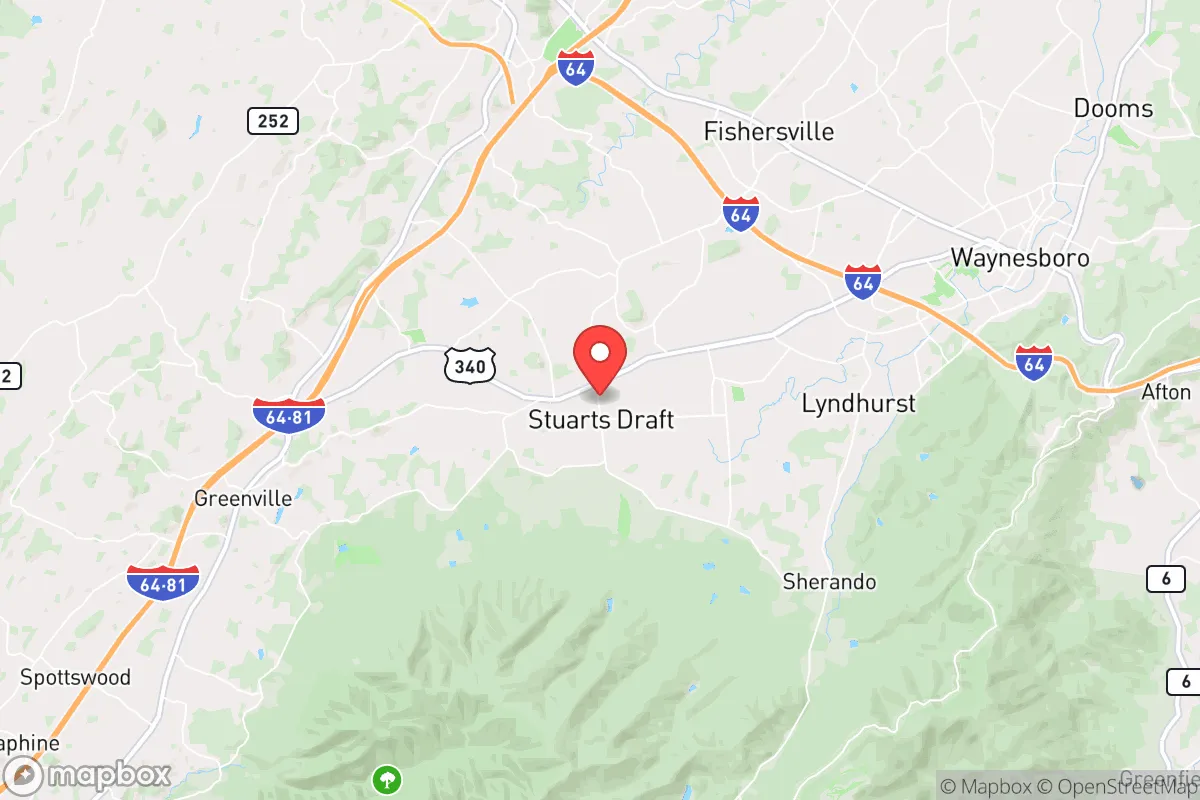
Virginia’s overall D+4 rating masks a deep urban-rural divide. Stuarts Draft sits in the Shenandoah Valley, where conservative values dominate, while places like Charlottesville (about 30 miles east) and Harrisonburg (20 miles north) are liberal-leaning college towns. Waynesboro, just 10 minutes away, is more moderate but still leans right. The contrast is sharp: drive 45 minutes east to Richmond, and you’re in a city that voted +30 for Biden in 2020. Stuarts Draft’s R+25 is actually more extreme than many rural Virginia areas—neighboring Rockingham County is R+18, and Greene County is R+20. This makes the Draft a bit of a outlier even in the conservative Valley, partly because of its older, more settled population and lack of a major university or tech employer.
What this means for residents
For conservative residents, the political climate is comfortable and affirming. Local government, school board, and sheriff’s office are reliably Republican, and policy debates tend to focus on taxes, land use, and Second Amendment rights. You’ll see Trump signs in yards year-round, and the local GOP is active. For liberal residents, it can feel isolating. There’s no organized progressive presence in Stuarts Draft itself—most left-leaning folks drive to Waynesboro or Staunton for community events. That said, the area is generally polite; political arguments are rare in public, and most people keep their views to themselves in casual settings. The trajectory suggests little change: the Valley’s population is growing slowly, and new arrivals tend to be retirees or remote workers who lean conservative. Unless a major employer like a tech campus moves in, Stuarts Draft will stay R+25 or deeper.
One cultural distinction worth noting: Stuarts Draft is part of the “Bible Belt” of Virginia, with a high density of evangelical churches and a strong pro-life, pro-gun culture. This isn’t just voting patterns—it shapes daily life, from what’s sold in stores to how local charities operate. The county government keeps taxes low and regulations light, which appeals to small business owners and farmers. For anyone moving here, the political reality is straightforward: you’ll be in a deep red bubble, but it’s a friendly one, and the nearest blue city is only a half-hour drive if you need a break from the homogeneity. That balance is likely to hold for the next decade, barring a major demographic shift.

State Political ClimatePolitical Climate in Virginia
State Political AnalysisPolitical Environment in the State
Virginia has shifted from a reliably purple swing state to a solidly blue-leaning one over the past two decades, carrying a Cook Partisan Voting Index of D+4. The transformation is dramatic: as recently as 2008, the state voted for Barack Obama by a narrow 6-point margin, but by 2020, Joe Biden won it by 10 points, and in 2024, Kamala Harris carried it by roughly 5 points. The driving force is the explosive growth of Northern Virginia’s Washington, D.C. suburbs—Fairfax, Loudoun, and Prince William counties—which now cast enough votes to outweigh the rest of the state. For a conservative relocator, this means you’re moving into a state where state-level power is held by Democrats, but where significant pockets of deep red territory still exist, especially south of the James River and in the Shenandoah Valley.
Urban vs. rural divide
The political map of Virginia is a study in stark contrasts. The blue stronghold is the D.C. exurbs: Arlington, Alexandria, and Loudoun County routinely vote 65-70% Democratic. The Richmond metro area, anchored by the city of Richmond and Henrico County, adds another deep-blue core. On the flip side, the rural south and west are deeply Republican. Roanoke and Lynchburg are conservative hubs, while counties like Lee, Wise, and Buchanan in far southwest Virginia vote 75-80% Republican. The real battlegrounds are the exurban and suburban counties that have been flipping: Chesterfield County (south of Richmond) voted for Trump in 2016 and 2020 but by shrinking margins, while Prince William County went from a 2012 Romney win to a 2020 Biden blowout. The Hampton Roads area (Virginia Beach, Norfolk, Chesapeake) is a genuine toss-up region—Virginia Beach itself leans slightly right, but the rest of the metro is competitive. For a conservative, the practical takeaway is that your vote matters most in the exurban crescent from Fredericksburg down to the North Carolina line, not in the deep-blue NoVa core.
Policy environment
Virginia’s state-level policy is shaped by a Democratic trifecta (governor, House, Senate) as of 2025, but with a moderate Democratic governor, Glenn Youngkin, who won in 2021 by threading the needle on education and economic messaging. The tax structure is relatively moderate: a flat 5.75% income tax rate, a state sales tax of 4.3% (plus local add-ons up to 7%), and property taxes set by localities—typically 0.8-1.2% of assessed value. There is no estate tax. The regulatory posture is business-friendly in the Richmond and Hampton Roads regions, but Northern Virginia imposes stricter land-use and environmental rules. Education policy is a flashpoint: Youngkin pushed for expanded school choice and parental notification policies, but the Democratic legislature blocked most of his agenda. The state has a "right-to-work" law, which keeps union influence low. Healthcare is a mixed bag: Virginia expanded Medicaid under the ACA in 2018, and the state runs its own exchange. Election laws are relatively accessible: no-excuse absentee voting, same-day voter registration, and early voting are all in place. For a conservative, the policy environment is a mixed bag—low taxes and right-to-work are pluses, but the education and election systems lean left.
Recent policy direction
The last five years have seen a clear leftward shift on several fronts. In 2020, the Democratic legislature passed the Virginia Clean Economy Act, mandating 100% carbon-free electricity by 2050 and effectively banning new natural gas plants. In 2021, they repealed the state’s "right-to-work" law for public-sector unions (though private-sector remains). On gun policy, the 2020 session passed a package including universal background checks, a "red flag" law (extreme risk protection orders), and a one-handgun-per-month limit. These were partially rolled back by a 2022 court ruling, but the red flag law remains. On education, the 2022 "Model Policies" on transgender students required schools to affirm student gender identity without parental notification—a policy that Youngkin replaced with a parental-notification rule in 2023, but which remains contested in court. On abortion, Virginia is an outlier in the South: abortion is legal up to 26 weeks, with no waiting period or mandatory counseling, and the state funds abortion through Medicaid. On property rights, the state has no statewide zoning preemption, meaning localities can impose rent control and inclusionary zoning. On voting, the 2021 Voting Rights Act restored preclearance for localities with a history of discrimination. For a relocator, the key takeaway is that Virginia is moving left on energy, guns, and social policy, but the pace is moderated by a Republican governor with veto power.
Civil unrest & political movements
Virginia has been a flashpoint for political activism on both sides. The 2017 "Unite the Right" rally in Charlottesville, which turned violent, remains a defining image of the state’s far-right fringe. In response, the state banned firearms at public demonstrations and strengthened hate crime laws. On the left, the 2020 racial justice protests in Richmond led to the removal of Confederate statues on Monument Avenue, and the city’s police department underwent significant reform. Immigration politics are less heated than in border states, but Prince William County was an early adopter of "sanctuary" policies in 2019, limiting cooperation with ICE. Election integrity has been a recurring issue: the 2020 election saw no major fraud in Virginia, but the state’s use of drop boxes and no-excuse absentee voting remains a point of contention among conservatives. The 2021 gubernatorial race saw Youngkin successfully tap into parental anger over school mask mandates and critical race theory, turning out rural and exurban voters. For a new resident, you’ll see the divide most visibly in yard signs and bumper stickers—"Parents Matter" vs. "Trans Rights" signs are common in the suburbs—but actual civil unrest is rare outside of organized protests in Richmond and Charlottesville.
Projection
Over the next 5-10 years, Virginia will likely continue its slow drift leftward, but not as fast as some predict. The key demographic driver is Northern Virginia’s growth: Loudoun County alone added 40,000 residents between 2020 and 2025, and those new arrivals are overwhelmingly young, college-educated, and left-leaning. However, the rest of the state is also growing—the exurban counties of Spotsylvania and Stafford are seeing an influx of conservatives fleeing D.C. and NoVa. The wild card is the 2030 redistricting cycle, which could shift the balance of power in the state legislature. Realistically, expect Virginia to remain a D+4 to D+6 state for presidential elections, with Democrats holding a narrow edge in the legislature. For a conservative moving in now, you should expect that state-level policy will continue to lean left on social issues and energy, but that your local government in a red county will remain conservative. The practical implication: if you’re a conservative, you’ll want to choose a county like Chesterfield or Spotsylvania where your vote carries weight, rather than Arlington or Alexandria where it’s effectively irrelevant.
For a new resident, the bottom line is that Virginia offers a genuine choice—you can live in a deep-red rural county with low taxes and conservative schools, or in a blue suburb with progressive policies. The state’s political climate is not monolithic, and your experience will depend heavily on which of the 95 counties you call home. If you value low taxes, right-to-work laws, and a strong economy, Virginia delivers. If you want a state where your vote consistently wins, you’ll need to look further south. But if you’re willing to engage in the fight, Virginia’s exurban battlegrounds are where the future of the commonwealth is being decided.
* Values derived from national, state, county, city and local statistics and may differ in a specific area. Last updated: 2026-11-22T13:57:50.000Z
Narrative content on this page is AI-generated and may contain mistakes. Verify any details that matter before acting on them.
ReloMaps may earn a commission from affiliate links at no extra cost to you.

