
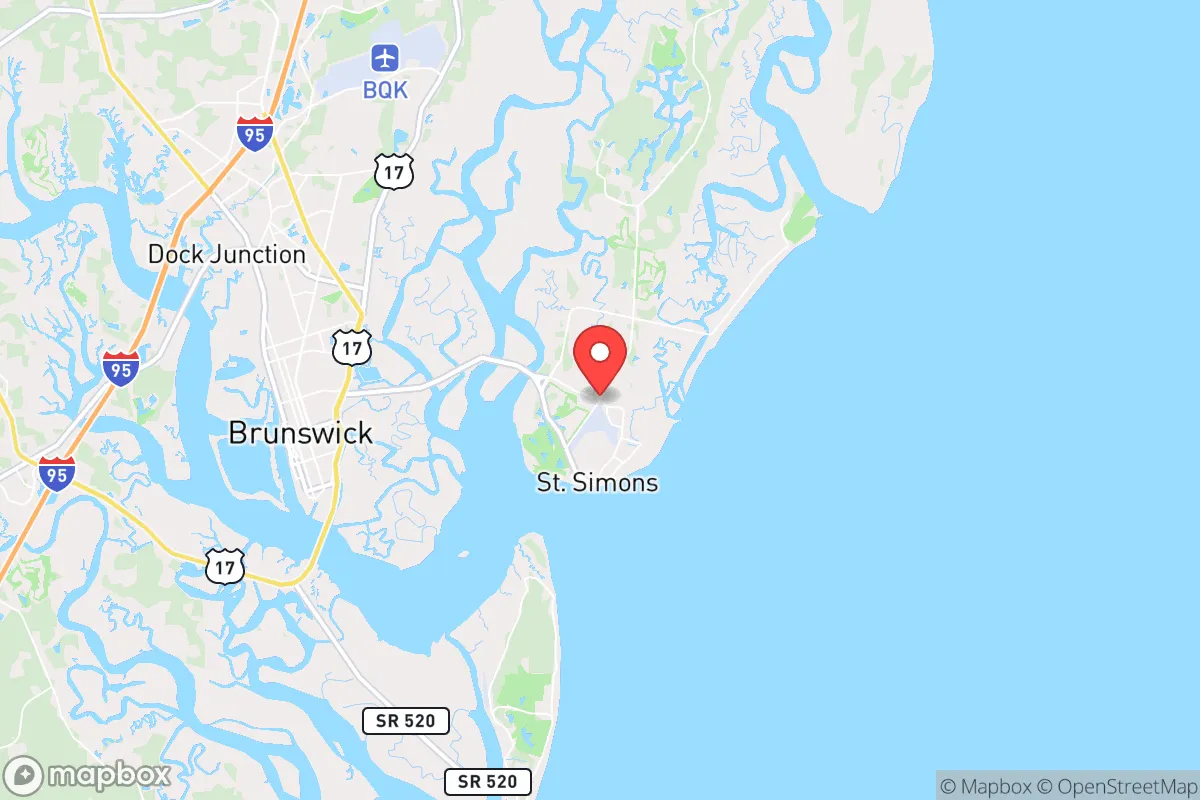
Photo: Wikipedia
Political ClimatePolitical Climate in St. Simons Island, GA
District shown is the primary district for this city’s centroid. Cities may span multiple districts.
Local Political AnalysisPolitical Analysis of St. Simons Island, GA
St. Simons Island has long been a reliably conservative pocket in coastal Georgia, with a Cook Partisan Voting Index of R+8, meaning it votes about eight points more Republican than the national average. That’s a solid red lean, but it’s not a monolith—the island’s politics are more nuanced than the raw number suggests. Over the past decade, the island has shifted slightly rightward as new retirees and second-home owners from more conservative inland areas have moved in, while younger, more liberal-leaning residents have been priced out of the housing market. The result is a place where Republicans dominate local elections, but where a vocal Democratic minority—often clustered in the historic village and among long-time island families—keeps the conversation from being one-sided.
How it compares
Compared to the rest of Georgia, St. Simons Island is noticeably more Republican than the state as a whole. Georgia’s overall Cook PVI is not publicly assigned, but the state has been a battleground in recent cycles—Joe Biden won it by 0.2% in 2020, and Donald Trump lost it by 0.2% in 2024. That razor-thin margin masks deep internal divides: metro Atlanta and its suburbs lean blue, while rural south Georgia and the coastal islands lean red. St. Simons sits in Glynn County, which voted for Trump by about 13 points in 2024, making it more conservative than the state average but less so than nearby inland towns like Brunswick (the county seat, which is more working-class and mixed politically) or Jesup and Waycross (deep-red rural communities to the west). The contrast is sharpest with Savannah, about 75 miles north, which is a Democratic stronghold in Chatham County. On St. Simons, you’ll hear more talk about property taxes and beach access than about state-level partisan fights, but the island’s R+8 lean means its state representatives and county commissioners are almost always Republicans.
What this means for residents
For conservative residents, the political climate is comfortable: local government tends to favor limited regulation, low taxes, and a business-friendly environment. The Glynn County Commission, which oversees the island, has consistently opposed new development restrictions and kept property tax rates among the lowest in coastal Georgia. For liberal residents, it means being in a clear minority, but not an isolated one—there’s an active Democratic Party chapter on the island, and issues like sea-level rise and conservation of the marshes get bipartisan attention. The practical effect is that most day-to-day decisions—zoning, school funding, police staffing—are made without much ideological drama. The real friction comes on cultural flashpoints: the island’s Confederate monument in Brunswick’s Hanover Square was a source of tension in 2020, and debates over short-term rental regulations often split along political lines. Still, the island’s small size (about 15,000 year-round residents) means most people know each other, and political disagreements rarely get personal.
Culturally, St. Simons Island stands apart from both the rest of Georgia and the broader South in a few key ways. The island’s economy is almost entirely driven by tourism and second-home ownership, which means local politics prioritize maintaining the “village” feel and protecting property values over industrial growth or agricultural interests. You won’t see the same kind of evangelical Christian influence that shapes politics in, say, Valdosta or Albany; the island’s churches are present but not dominant in civic life. Environmentalism, too, is more mainstream here—even conservative residents tend to support marsh preservation and limits on development, because the natural beauty is the island’s economic engine. The trajectory is toward a slightly more polarized future as the island becomes wealthier and older, but for now, St. Simons remains a place where you can have a Republican county commissioner and a Democratic neighbor who both care deeply about keeping the sea turtles nesting on the beach.

State Political ClimatePolitical Climate in Georgia
State Political AnalysisPolitical Environment in the State
Georgia has transformed from a reliably Republican stronghold into the nation’s most competitive swing state over the past two decades, driven by explosive growth in the Atlanta metro and a shifting coalition of suburban moderates, voters of color, and new arrivals. The state’s partisan lean is now a pure toss-up at the presidential level—Joe Biden won it by just 0.2% in 2020, and Donald Trump lost it by a similar margin in 2024—while state-level offices remain firmly in GOP hands, with Republicans controlling the governorship, both legislative chambers, and every statewide elected position except the Public Service Commission. This split reality means Georgia is simultaneously a battleground for national elections and a laboratory for conservative policy, creating a unique environment where the political temperature varies dramatically depending on whether you’re in downtown Atlanta, the exurbs of Forsyth County, or the rural Black Belt.
Urban vs. rural divide
The political map of Georgia is a story of three Georgias: the deep-blue urban core of Atlanta and its inner-ring suburbs, the rapidly purpling outer suburbs and exurbs, and the deeply red rural and small-town areas that still anchor Republican dominance. Atlanta itself, along with DeKalb, Fulton, and Clayton counties, delivers massive Democratic margins—often 70-80%—that are nearly impossible for Republicans to overcome without strong turnout elsewhere. The real action is in the suburbs: Cobb, Gwinnett, and Henry counties, once reliably red, have flipped blue in presidential elections since 2016, driven by an influx of diverse, college-educated professionals and transplants from other states. Meanwhile, exurban counties like Forsyth, Cherokee, and Paulding have held the line for Republicans, with Forsyth County voting +30 points for Trump in 2024 despite its rapid growth. Outside the Atlanta orbit, the state’s second-largest city, Columbus, leans Democratic thanks to its military and African American population, while Augusta and Savannah are competitive but trending blue. Rural south Georgia—places like Tifton, Valdosta, and the peanut-growing counties around Albany—remains deeply Republican, as does the mountainous north Georgia region around Dalton and Blue Ridge. The result is a state where the political conversation is dominated by Atlanta, but the electoral math still depends on turning out voters in the small towns and exurbs.
Policy environment
Georgia’s policy environment is a study in contrasts: a low-tax, low-regulation business climate paired with a robust set of conservative social laws that have been steadily tightened over the past decade. The state’s income tax is a flat 5.39%, with a scheduled reduction to 4.99% by 2029, and there is no state-level property tax—local governments handle that. Sales tax rates vary by county, typically landing between 7% and 8%. The regulatory posture is business-friendly, with Georgia consistently ranking in the top five for ease of doing business, thanks to a right-to-work law, weak unions, and a legal climate that caps non-economic damages in medical malpractice cases. On education, the state has a robust charter school system, a school choice program that includes tax-credit scholarships, and a new universal school voucher law passed in 2024 that allows any family to use public funds for private school tuition. Healthcare policy is more restrictive: Georgia did not expand Medicaid under the Affordable Care Act, leaving roughly 300,000 low-income adults in a coverage gap, though the state has a limited “Pathways to Coverage” waiver with work requirements. Election laws have been a flashpoint: the 2021 Election Integrity Act (SB 202) added voter ID requirements for absentee ballots, limited drop boxes, and restricted third-party ballot collection, while also expanding early voting hours in rural counties. The law has been both praised for security and criticized as a suppression measure, and it remains in effect after surviving court challenges.
Recent policy direction
The last three years have seen Georgia’s Republican supermajority push a full-spectrum conservative agenda that touches every liberty a relocator might care about. On gun rights, Georgia is a permitless carry state as of 2022 (HB 218), meaning anyone 21 or older who can legally possess a firearm can carry it concealed without a license, and the state has strong preemption laws that prevent local governments from enacting their own restrictions. On parental rights and education, the 2022 “Parents’ Bill of Rights” (HB 1178) requires schools to notify parents of any medical or counseling services provided to their children and to get parental consent before teaching about sexual orientation or gender identity in grades K-3. The 2024 school voucher law (SB 233) is the most expansive in the Southeast, offering $6,500 per student for private school expenses. On speech and privacy, Georgia has no broad shield law for journalists, but it does have a strong anti-SLAPP statute for public participation. Medical and bodily autonomy is sharply restricted: Georgia’s 2019 “Heartbeat Bill” (HB 481) bans abortion after a fetal heartbeat is detected, roughly six weeks, with no exceptions for rape or incest, though it includes a narrow exception for the life of the mother. The law was blocked by courts for two years but went into effect after the Dobbs decision in 2022. Property rights are strong, with no state-level rent control and a relatively straightforward eminent domain process. On voting and ballot access, the 2021 law shortened the runoff period from nine weeks to four, which some argue favors incumbents, but also expanded early voting in rural areas. The net direction is clear: Georgia is moving toward a more libertarian economic posture and a more socially conservative legal framework, with the legislature actively testing the boundaries of both.
Civil unrest & political movements
Georgia has been a focal point for political activism on both sides, with the 2020 election aftermath producing the most visible flashpoints. The “Stop the Steal” movement was particularly active in Georgia, with Trump’s phone call to Secretary of State Brad Raffensperger and the subsequent Fulton County election audit drawing national attention. In 2021, the state saw large protests against the election integrity law, with major corporations like Delta and Coca-Cola facing boycotts from both sides. The 2023 indictment of Trump and 18 co-defendants in Fulton County for election interference turned the state into a legal battleground, with daily protests outside the courthouse from both Trump supporters and anti-Trump activists. Immigration politics are less heated than in border states, but Georgia has a strict 2011 law (HB 87) that allows police to check immigration status during lawful stops and penalizes those who transport or harbor undocumented immigrants. There are no sanctuary cities in Georgia, and several local governments have passed resolutions affirming cooperation with ICE. The state has seen periodic protests over Confederate monuments, particularly in Atlanta and Savannah, but these have largely subsided. The most visible ongoing political movement is the growth of the “Georgia GOP” grassroots, which has pushed the party further right on election integrity and cultural issues, while the Democratic Party has been energized by Stacey Abrams’ voter registration efforts, which added hundreds of thousands of new voters between 2018 and 2022. A new resident would notice the intensity of political bumper stickers, yard signs, and local news coverage, but actual civil unrest is rare outside of organized protests in downtown Atlanta.
Projection
Over the next five to ten years, Georgia is likely to remain a competitive swing state, but the demographic trends favor a slow drift toward the center-left at the presidential level while state-level politics stay conservative. The Atlanta metro is adding roughly 100,000 new residents per year, many of them from blue states like California and New York, and these newcomers tend to be younger, more diverse, and more Democratic-leaning. However, the exurbs and rural areas are also growing, and the state’s Hispanic population—now 10% of the total—is not monolithic in its voting patterns, with many Cuban and Venezuelan Americans in the Gainesville area leaning Republican. The key battleground will be the “collar counties” around Atlanta: Cobb, Gwinnett, and Henry are likely to stay blue, but Forsyth, Cherokee, and Paulding could flip if Democratic turnout continues to rise. At the state level, the Republican supermajority is safe for at least the next two redistricting cycles, meaning the policy direction—lower taxes, school choice, gun rights, and abortion restrictions—will continue. The wild card is the 2026 gubernatorial election, which will test whether a Democrat can win statewide without Stacey Abrams on the ballot. A new resident moving in now should expect to live in a state where national elections are fiercely contested and state policy is reliably conservative, with the practical effect that your vote matters more in Georgia than almost anywhere else in the country.
For a new resident, the bottom line is that Georgia offers a low-tax, business-friendly environment with strong gun rights and school choice, but with a sharply restricted abortion law and a political climate that is constantly in the national spotlight. If you’re conservative, you’ll find a state government that largely aligns with your values and a growing network of like-minded communities in the exurbs and small towns. If you’re liberal, you’ll find a vibrant urban core in Atlanta and a Democratic Party that is competitive at the national level, but you’ll need to accept that state policy will be conservative for the foreseeable future. The practical takeaway: Georgia is a state where your political experience depends heavily on where you live, and where the national conversation is never far away.
* Values derived from national, state, county, city and local statistics and may differ in a specific area. Last updated: 2026-09-01T10:05:22.000Z
Narrative content on this page is AI-generated and may contain mistakes. Verify any details that matter before acting on them.
ReloMaps may earn a commission from affiliate links at no extra cost to you.

