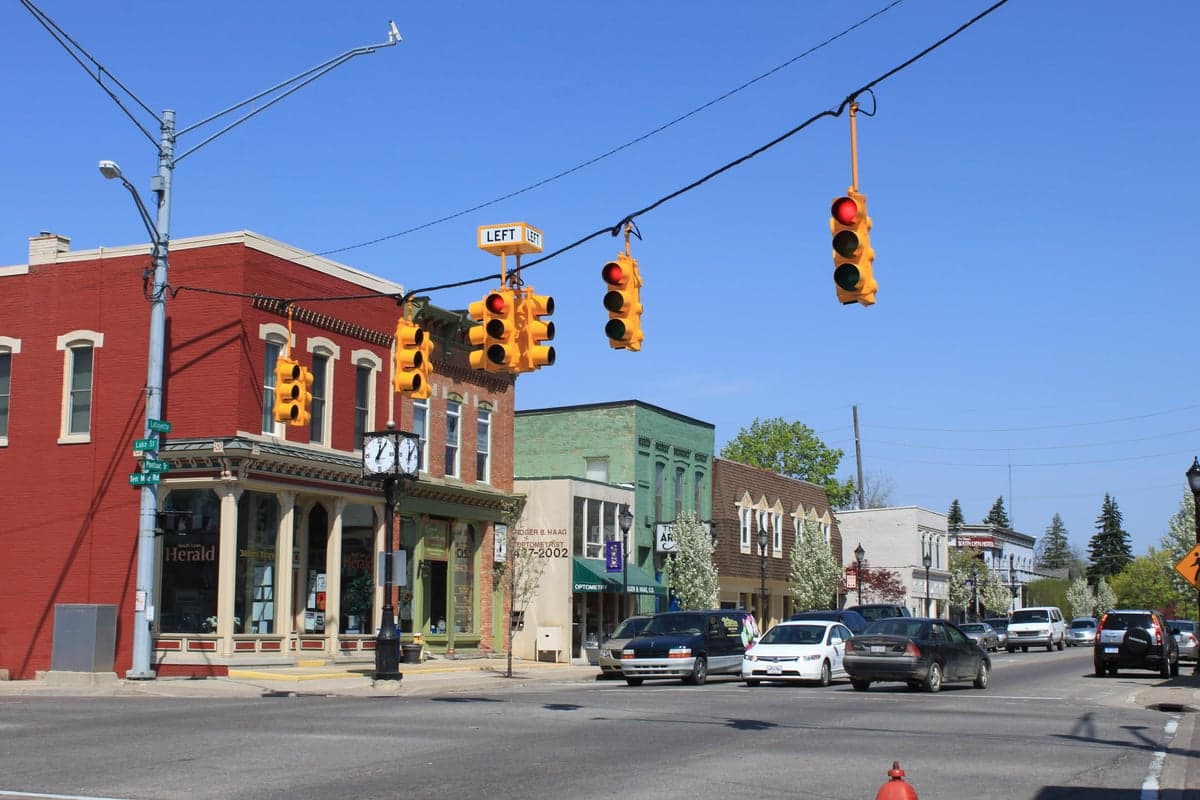
Photo: Wikipedia
Political ClimatePolitical Climate in South Lyon, MI
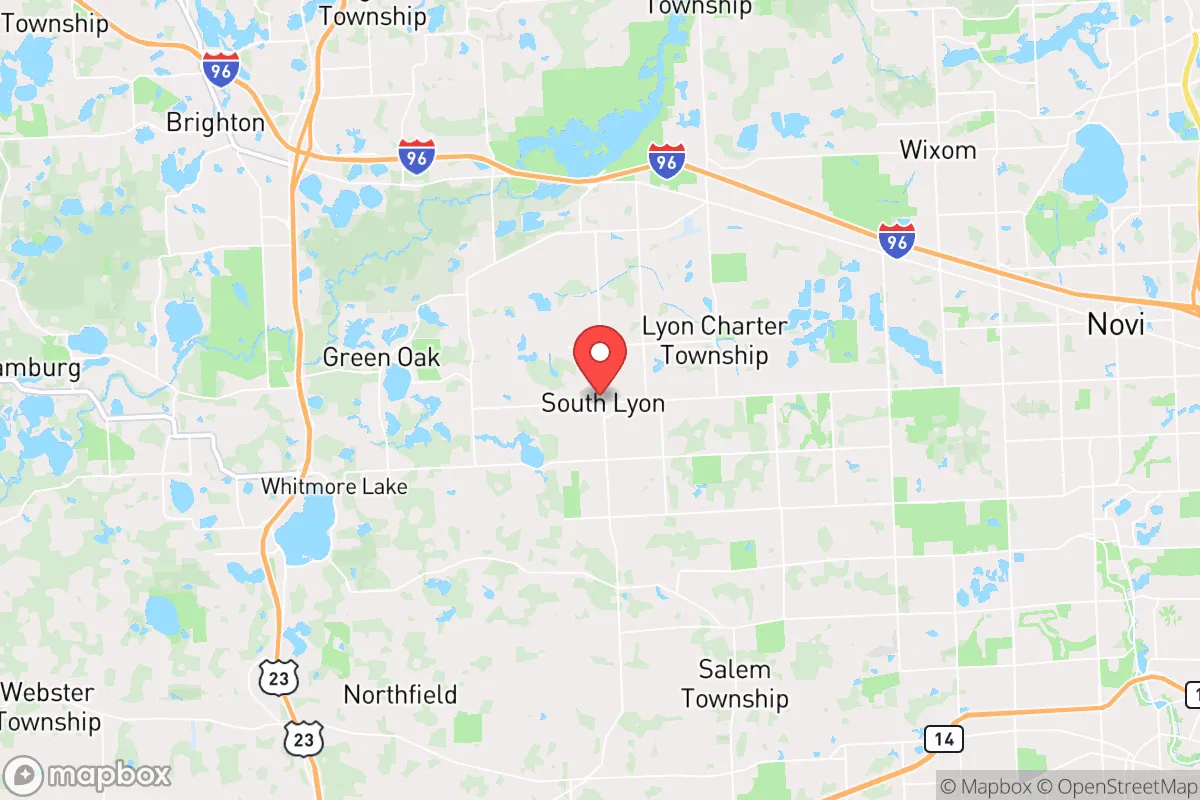
District shown is the primary district for this city’s centroid. Cities may span multiple districts.
Local Political AnalysisPolitical Analysis of South Lyon, MI
South Lyon sits in a political sweet spot that’s rare in Michigan: a Cook PVI rating of EVEN, meaning the area votes almost exactly in line with the national average. For a long time, this was a reliably conservative corner of Oakland County—think old farm families and auto workers who leaned Republican. But over the last decade, the influx of commuters from Ann Arbor and Detroit has nudged things toward the center. The 2020 and 2024 elections saw the city itself split nearly 50-50, while the surrounding Lyon Township still trends a few points redder. If you’re moving here, you’re landing in a place where the presidential race is genuinely competitive, not a foregone conclusion.
How it compares
Michigan as a whole also carries a Cook PVI of EVEN, so South Lyon mirrors the state’s overall swing-voter identity. But the comparison gets interesting when you zoom in. Head 15 minutes east to Novi or Northville, and you’ll find a more reliably Democratic tilt—those suburbs have shifted blue with the professional class. Drive 20 minutes west to Brighton or Howell, and you’re in solidly Republican Livingston County, where Trump won by double digits. South Lyon acts as a political buffer zone: it’s the place where the urban-liberal influence of Oakland County meets the rural-conservative culture of Livingston. Locals joke that the city council debates are the most civil in the region because nobody can assume a majority.
What this means for residents
For conservative residents, South Lyon still feels comfortable. The local schools and township board have a moderate Republican presence, and you won’t get side-eye for flying a Trump flag on your pickup. But you also won’t find the deep-red solidarity of Brighton—expect to have neighbors who canvassed for Biden. For liberal residents, the area is welcoming but not a bubble. You’ll find plenty of “In This House We Believe” signs, but the county-level politics (Oakland County is run by Democrats) can clash with local sentiment on issues like zoning and school funding. Practically, this means both sides get a fair hearing at town hall meetings. The city’s growth—new subdivisions, a downtown revitalization—has been managed with a pragmatic, non-ideological bent. Neither side gets everything it wants, but neither side feels silenced.
Culturally, South Lyon’s political balance shows up in small ways. The annual Founders Day parade features both the local Republican club float and the Democratic Women’s Caucus table. The school board elections are genuinely contested, not rubber-stamped. And the biggest policy fights in recent years—over a new roundabout and a proposed apartment complex—split along practical lines (traffic vs. density) rather than party lines. If you’re used to living in a place where everyone votes the same way, South Lyon will feel like a breath of fresh air—or a frustrating stalemate, depending on your temperament. Either way, it’s a place where your vote actually counts, and your neighbors will probably listen, even if they disagree.

State Political ClimatePolitical Climate in Michigan
State Political AnalysisPolitical Environment in the State
Michigan is the ultimate swing state, with a Cook PVI of EVEN that perfectly captures its knife-edge political reality. Over the past 20 years, the state has lurched from reliably blue (voting for Kerry in 2004) to a Trump pickup in 2016, then back to Biden in 2020, with razor-thin margins each time. The dominant coalitions are a shrinking but still potent union-and-urban Democratic base in the southeast versus a growing, energized conservative coalition in the exurbs and rural west and north. The trajectory is a slow, grinding realignment: the old auto-town Democratic strongholds are bleeding population, while conservative-leaning areas like the Grand Rapids suburbs and the northern Lower Peninsula are growing, making every election a coin flip.
Urban vs. rural divide
The political map is a tale of two peninsulas. Wayne County (Detroit) and Washtenaw County (Ann Arbor) are the Democratic engine room, delivering 70-75% of their votes to Democrats and accounting for nearly a third of the state's total vote. Oakland County, once a classic Republican suburban bastion, has flipped decisively blue over the past decade, driven by college-educated professionals moving from Detroit and a growing Asian-American population. Meanwhile, Kent County (Grand Rapids) is the conservative counterweight: Grand Rapids itself is trending purple, but its outer suburbs like Rockford and Caledonia are deeply red. The rural thumb and the entire Upper Peninsula, once reliably Democratic (the "Yooper Democrat" was a real thing), have swung hard right — Oscoda County voted for Trump by 40 points in 2020 after backing Obama by 20 in 2012. The Mackinac Bridge might as well be a political fault line: the U.P. is now solidly red, while the southern third of the Lower Peninsula is a battleground.
Policy environment
Michigan's policy landscape is a patchwork. The state income tax is a flat 4.25%, and property taxes are capped by Proposal A (1994), which limits annual increases to 5% or inflation, whichever is lower — a huge boon for long-term homeowners but a shock for new buyers who reset the taxable value. Sales tax is 6%, and there is no tax on groceries or prescription drugs. The regulatory posture is mixed: Michigan is a right-to-work state (the law was repealed in 2023, then a 2024 ballot initiative reinstated it — it's currently tied up in court). Education is locally funded, with wealthy suburbs like Birmingham and Northville spending $15,000+ per pupil while rural districts like Lake City scrape by on $9,000. Healthcare is dominated by Blue Cross Blue Shield of Michigan, and the state expanded Medicaid under the Healthy Michigan Plan. Election laws are moderately restrictive: voter ID is required (but a signed affidavit suffices if you don't have one), and absentee voting is no-excuse. The state has independent redistricting (a 2018 reform), which has produced competitive legislative maps.
Recent policy direction
The last three years under Governor Gretchen Whitmer and a Democratic trifecta (2023-2024) saw a sharp leftward lurch. Gun laws: universal background checks and safe storage requirements were passed in 2023, and a "red flag" law (extreme risk protection order) took effect in 2024. Parental and education rights: the state repealed its 1931 abortion ban and codified abortion rights via a 2022 ballot initiative (Prop 3), and a 2023 law banned conversion therapy for minors. Speech and privacy: no major changes, but the state's FOIA law still exempts the governor and legislature — a long-standing transparency gap. Medical and bodily autonomy: recreational marijuana is legal and taxed (10% excise tax), and the state has a robust medical marijuana program. Property rights: no statewide rent control (preempted by law), but some cities like Ann Arbor have passed local tenant protections. Taxation: the retirement tax was repealed in 2023, a major win for seniors. Voting and ballot access: early voting (9 days) and automatic voter registration were expanded in 2023. The overall direction is clearly left on social issues and gun control, but the state remains moderate on fiscal matters — no income tax hike has passed.
Civil unrest & political movements
Michigan has been a flashpoint. The 2020 Whitmer kidnapping plot (involving militia members from the Hastings area) and the armed protests at the Lansing Capitol over COVID restrictions put the state on the national map for political violence. The "Operation Gridlock" protest in April 2020 drew thousands of conservative activists to the Capitol, many openly carrying rifles. On the left, the 2020 George Floyd protests in Detroit and Grand Rapids saw significant property damage and clashes with police. Immigration politics are relatively quiet — Michigan is not a border state, and sanctuary policies are limited to a few cities like Detroit and Ann Arbor that limit cooperation with ICE. Election integrity remains a live issue: the 2020 results in Antrim County (a initial tabulation error that was quickly corrected) became a national conspiracy theory touchstone. The Michigan Republican Party is currently fractured between establishment and pro-Trump factions, with the state party chair facing a no-confidence vote in 2024. A new resident would notice the "Fuck Biden" flags flying from pickup trucks in the rural thumb and the "In This House We Believe" yard signs in Ann Arbor — the culture war is visible and loud.
Projection
Over the next 5-10 years, Michigan will remain a battleground, but the demographic trends favor a slight rightward shift. The Detroit exurbs (Livingston County, northern Oakland County) are growing fast with conservative-leaning families fleeing the city. The Grand Rapids metro is adding 10,000+ people a year, many from blue states, but they tend to be moderate Republicans or independents. The U.P. and northern Lower Peninsula are aging and losing population, which hurts the GOP's raw vote totals. The wild card is the Arab-American vote in Dearborn and Hamtramck — a traditionally Democratic bloc that has soured on the party over Gaza policy, potentially flipping a few thousand votes in a state decided by 154,000 in 2020. Expect the state to remain a presidential toss-up, with the legislature likely staying under divided control (the GOP holds the House as of 2025, the Dems the Senate). A new resident moving in now should expect a state where every election is a nail-biter, where policy whiplash is common (right-to-work on, off, on again), and where your neighbors will have very different yard signs.
For a new resident, the bottom line is this: Michigan offers a genuinely competitive political environment where your vote actually matters. If you're conservative, you'll find strong communities in the exurbs and rural areas, but you'll be living under a Democratic governor and potentially Democratic policies on guns and abortion. If you're liberal, the cities and inner suburbs are safe havens, but you'll be surrounded by a deeply entrenched conservative counterculture. The state's politics are a mirror of the nation's — divided, passionate, and unpredictable. Come for the lakes and the low cost of living, but be ready for the fight.
* Values derived from national, state, county, city and local statistics and may differ in a specific area. Last updated: 2026-10-08T08:47:51.000Z
Narrative content on this page is AI-generated and may contain mistakes. Verify any details that matter before acting on them.
ReloMaps may earn a commission from affiliate links at no extra cost to you.

