Photo: Wikipedia
Political ClimatePolitical Climate in Tripp County
Showing state-level results — no local-only data available.
Local Political AnalysisPolitical Analysis of Tripp County
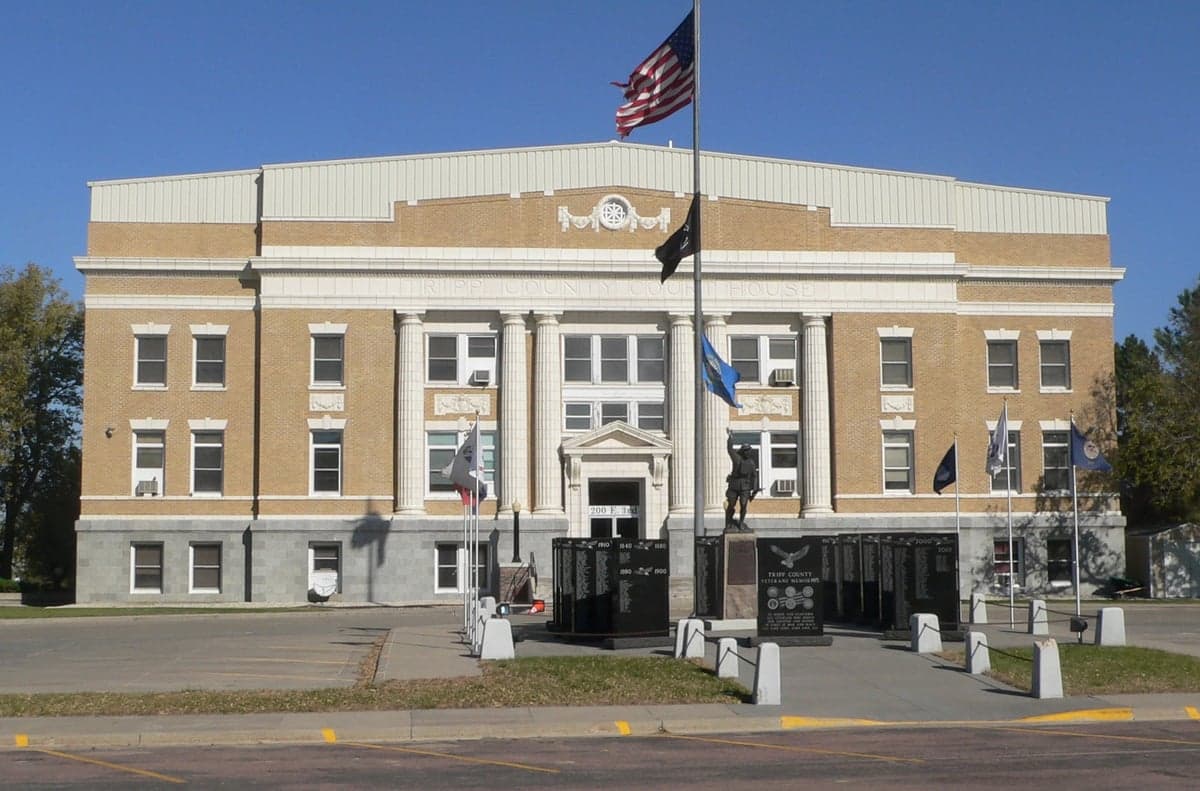
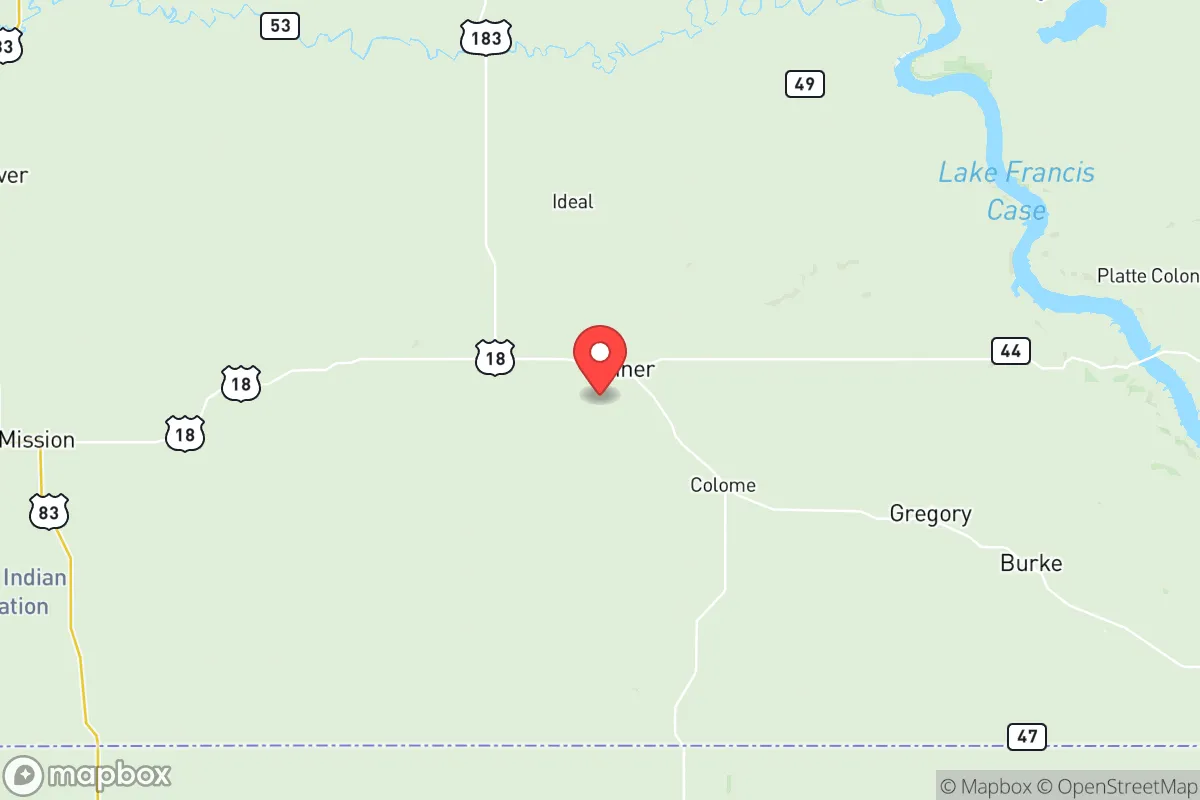
Tripp County, South Dakota, is a reliably conservative area with a Cook Partisan Voting Index (PVI) of R+15, meaning it votes about 15 points more Republican than the national average. This lean has been consistent for decades, though the margins have tightened slightly in recent presidential cycles as rural demographics shift. The county's political heart beats strongest in Winner, the county seat and largest town, where Republican candidates routinely carry 70-75% of the vote. Smaller communities like Colome and Witten also lean heavily red, while the unincorporated areas around the Keya Paha River valley show slightly more competitive numbers, often swinging within 5-10 points of the county average.
How it compares
Compared to South Dakota as a whole, Tripp County is noticeably more conservative. The state itself has a PVI of R+16, making it one of the most Republican states in the nation, but Tripp County's R+15 puts it slightly to the right of the state's average. In the 2024 presidential election, Tripp County voted for Donald Trump by a margin of 78% to 20%, while statewide Trump won by 63% to 34%. This gap is driven by the county's older, more rural population—median age here is 44, compared to the state's 37—and its heavy reliance on agriculture and energy extraction, industries that tend to favor limited government and low taxes. The only precinct that occasionally bucks the trend is the Winner city core, where a small but persistent Democratic bloc (around 15-20% of voters) turns out for local school board and county commission races, though it rarely affects national outcomes.
What this means for residents
For conservative residents, the political climate means their values are reflected in local policy: the county commission has consistently opposed new state-level gun restrictions, and property taxes remain among the lowest in the state, with a mill levy of about 18.5 per $1,000 of assessed value. Liberal residents, while a distinct minority, are not marginalized—they participate actively in local government, particularly in Winner where the Democratic-leaning precinct has elected a few progressive school board members over the years. The practical effect is that most political debates here are about local issues—road maintenance, school funding, and water rights—rather than national culture wars. The county's small population (about 5,600) means personal relationships often override party labels; a conservative rancher and a liberal teacher might disagree on national politics but work together on the volunteer fire department or the 4-H club.
Culturally, Tripp County stands apart from the more libertarian-leaning Black Hills region and the more moderate eastern part of the state. There's a strong sense of self-reliance here, reflected in the county's resistance to federal land management policies—the nearby Rosebud Sioux Tribe's reservation adds a layer of complexity, with tribal members often voting Democratic in state races but aligning with Republicans on issues like energy development. The trajectory is stable: younger residents leaving for Sioux Falls or Rapid City are slowly reducing the county's population, but those who stay tend to be deeply committed to the area's conservative traditions. For newcomers, the political climate is straightforward—if you're comfortable with a community that values tradition, low taxes, and local control, you'll fit in. If you're not, you'll still find plenty of neighbors willing to lend a hand, even if they disagree with your vote.

State Political ClimatePolitical Climate in South Dakota
State Political AnalysisPolitical Environment in the State
South Dakota has been a reliably Republican state for decades, with a partisan lean that has only deepened in recent years. The state hasn't voted for a Democratic presidential candidate since Lyndon B. Johnson in 1964, and in 2024, Donald Trump carried it by over 29 points. The dominant coalition is a mix of rural conservatives, evangelical Christians, and libertarian-leaning ranchers and farmers, with a growing contingent of out-of-state transplants drawn by low taxes and minimal regulation. Over the past 10-20 years, the state has shifted further right, driven by rapid growth in the Black Hills and the I-29 corridor, while the Democratic presence has shrunk to a few isolated pockets in tribal areas and the city of Sioux Falls.
Urban vs. rural divide
The political map of South Dakota is starkly divided between a handful of small urban centers and vast, deeply conservative rural expanses. Sioux Falls, the state's largest city and economic engine, is the only real blue dot—Minnehaha County voted for Joe Biden in 2020 by a slim margin, though it swung back to Trump in 2024. The city's growth has been fueled by finance, healthcare, and tech jobs, attracting a younger, more moderate workforce that keeps the area competitive. Rapid City and the surrounding Pennington County lean Republican but are less hardline than the countryside, with a mix of military families from Ellsworth Air Force Base and tourism workers. Brookings, home to South Dakota State University, is a classic college town—more liberal than its surroundings but still voting Republican in statewide races. The real red wall is everywhere else: counties like Harding, Perkins, and Jones routinely deliver 80-90% of their votes to GOP candidates. The Pine Ridge Indian Reservation in Shannon County is a notable exception, consistently voting over 70% Democratic, but its population is small and turnout is low. This urban-rural split means that while the state is solidly red, the growing metros—especially Sioux Falls—are slowly moderating the overall tilt.
Policy environment
South Dakota's policy environment is built around a low-tax, low-regulation philosophy that appeals strongly to conservative relocators. There is no state income tax, no corporate income tax, and no personal property tax on vehicles or business inventory. Property taxes are moderate, averaging about 1.1% of home value, and the state relies heavily on sales tax (4.5% state rate, plus local add-ons up to 2%). The regulatory posture is famously business-friendly—permitting for new construction or business licenses is often a matter of weeks, not months. Education policy is a mixed bag: the state has school choice through open enrollment and a small voucher program for special needs students, but public school funding per pupil is among the lowest in the nation. Healthcare is a flashpoint—South Dakota did expand Medicaid under the Affordable Care Act in 2023 after a ballot measure passed, but the state legislature has resisted further expansion of government-run programs. Election laws are restrictive by national standards: voter ID is required, same-day registration is not allowed, and absentee voting requires an excuse. The state also has a strict abortion ban (trigger law after Dobbs) with no exceptions for rape or incest, only to save the mother's life. For conservatives, this policy mix is a feature; for liberals, it's a significant barrier.
Recent policy direction
The last few years have seen South Dakota accelerate its conservative agenda, with Governor Kristi Noem leading the charge. In 2023, the legislature passed a near-total abortion ban (HB 1215), which was immediately challenged in court but remains in effect. Gun laws have been loosened further: constitutional carry (permitless carry) was enacted in 2019, and in 2024, the state passed a law prohibiting local governments from enforcing federal gun regulations (a "Second Amendment Sanctuary" measure). On education, the state enacted a Parents' Bill of Rights in 2022 (SB 127), requiring schools to notify parents of any curriculum involving sexuality or gender identity and allowing parents to opt their children out. A 2023 law (HB 1080) banned transgender girls from participating in girls' sports from K-12 through college. Property rights were strengthened with a 2023 law limiting eminent domain for carbon pipeline projects, a direct response to the controversial Summit Carbon Solutions pipeline. On voting, the state passed a 2021 law (SB 180) that tightened absentee ballot rules and banned private funding of election administration. Medical marijuana was legalized by ballot measure in 2020, but the legislature has repeatedly tried to restrict it, including a 2024 law capping THC potency. Recreational marijuana remains illegal, despite a 2022 ballot measure that was struck down by the state supreme court on procedural grounds. The overall direction is toward more individual liberty on guns and property, but less on bodily autonomy and social issues.
Civil unrest & political movements
South Dakota is not known for widespread civil unrest, but there have been notable flashpoints. The Dakota Access Pipeline protests in 2016-2017 drew national attention, with thousands of activists from the Standing Rock Sioux Tribe and allies clashing with law enforcement near the Cannon Ball area. The state government, under then-Governor Dennis Daugaard, supported the pipeline and deployed the National Guard. More recently, the Summit Carbon Solutions pipeline has sparked a quieter but intense land-rights battle, with landowners in counties like Brown and Spink organizing against eminent domain. On the left, groups like South Dakota Voices for Peace and Rural Organizing Project have pushed for immigrant rights and Medicaid expansion, but their influence is limited. On the right, the South Dakota Freedom Caucus has grown in the legislature, pushing for even stricter abortion bans and anti-LGBTQ+ policies. Immigration politics are relatively low-key—the state has a small immigrant population, and there are no sanctuary cities. Election integrity controversies flared in 2020 when then-AG Jason Ravnsborg faced criticism for his handling of a fatal car crash, but no widespread fraud claims took hold. The most visible flashpoint for a new resident would likely be the ongoing debate over carbon pipelines, which pits property rights against climate goals and has become a defining issue in rural counties.
Projection
Over the next 5-10 years, South Dakota's political trajectory points toward continued conservatism, but with a subtle moderation driven by demographic shifts. The Sioux Falls metro area is growing fast—projected to add another 50,000 residents by 2030—and many of those newcomers are from more moderate states like Minnesota and Iowa. This could slowly turn Minnehaha County into a swing county, though the rest of the state will remain deeply red. The Black Hills region, including Rapid City and Spearfish, is also growing, attracting retirees and remote workers who tend to be fiscally conservative but socially moderate. The rural population will continue to shrink, which could amplify the political power of the growing metros. On policy, expect more battles over property rights (especially around pipelines and renewable energy projects), continued resistance to federal mandates on guns and education, and a likely push for a recreational marijuana ballot measure in 2026 or 2028. The abortion ban is unlikely to be softened unless the state supreme court or federal courts intervene. For someone moving in now, the state will likely be even more conservative in 2034 than it is today, but the edge may be less sharp in the cities.
For a new resident, the bottom line is that South Dakota offers a deeply conservative environment with low taxes, strong gun rights, and a hands-off government—but also limited social services, a restrictive abortion law, and a political culture that can feel insular. If you're a conservative family looking for a place where your values align with state policy, you'll find a welcoming home. If you're a liberal or moderate, you'll need to be comfortable being in the minority, especially outside of Sioux Falls or Brookings. The state's trajectory is clear: more of the same, but with a growing urban counterweight that may eventually shift the conversation. Come for the freedom, stay for the wide-open spaces—just know what you're signing up for.
* Values derived from national, state, county, city and local statistics and may differ in a specific area. Last updated: 2026-07-15T03:38:39.000Z
Narrative content on this page is AI-generated and may contain mistakes. Verify any details that matter before acting on them.
ReloMaps may earn a commission from affiliate links at no extra cost to you.

