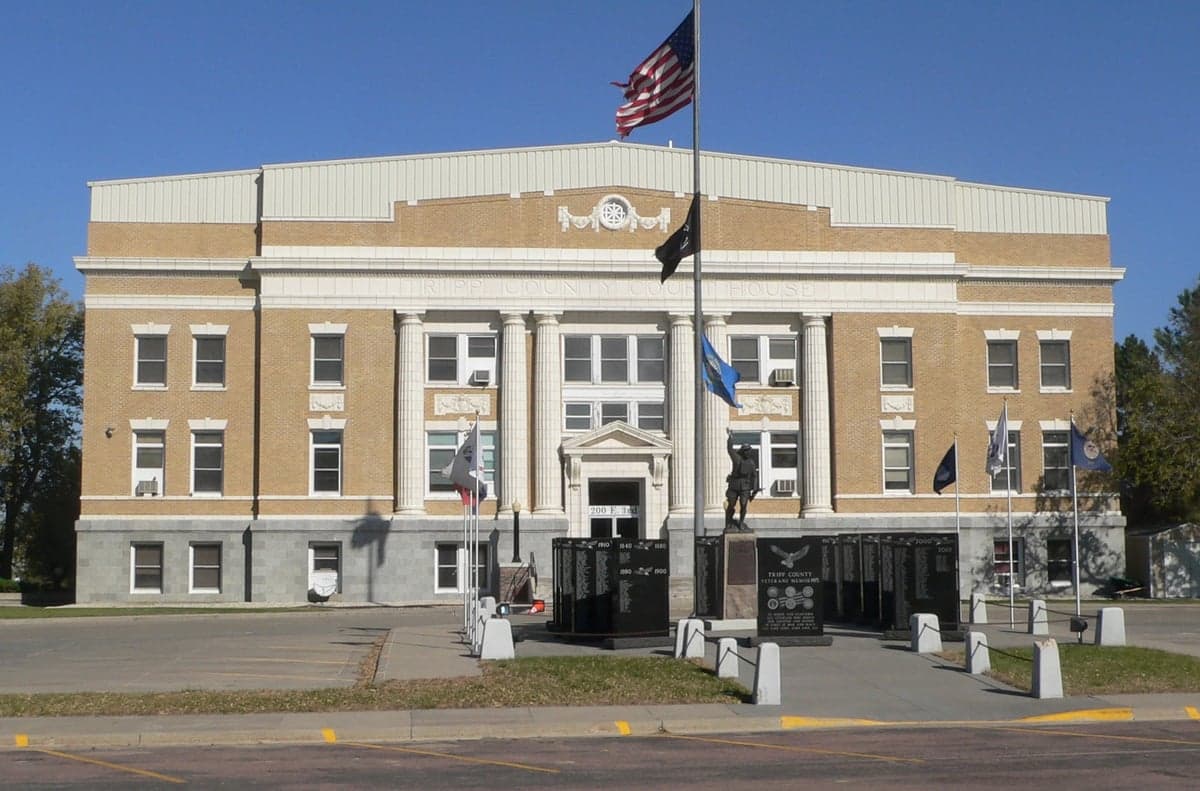
Photo: Wikipedia
Personal Sovereignty in Tripp County
Viable for self-reliance. Generally workable, though some barriers may limit total independence.
What does Personal Sovereignty tell us?
Personal Sovereignty measures your capacity for self-reliance and independence with minimal government friction. Higher scores mean fewer barriers between you and the way you want to live... but it assumes you have the space you need and good neighbors.
What does this tell us?
Personal Sovereignty measures your capacity for self-reliance and independence with minimal government friction. Higher scores mean fewer barriers between you and the way you want to live... but it assumes you have the space you need and good neighbors.
State Policy
Energy independence: Importer (35% of energy produced in-state)
Personal Liberty
Homesteading

Personal Liberty Analysis
Tripp County, South Dakota, offers a notably high degree of personal sovereignty, grounded in the state’s historically limited government approach and a local culture that prizes self-reliance. For individuals and families seeking to minimize external interference in their daily lives—from tax policy to self-defense choices—this rural county presents a legal and regulatory environment that is among the most permissive in the nation. The county seat, Winner, and smaller communities like Colome and Witten serve as practical hubs where this autonomy is exercised daily, though the specific feasibility of certain lifestyle choices varies by location within the county.
Tax burden and regulatory posture: How South Dakota’s policies apply locally
South Dakota’s absence of a state income tax is the cornerstone of its low-tax reputation, and Tripp County residents benefit directly. There is no personal or corporate income tax, no state inheritance tax, and no tax on Social Security benefits. Property taxes in Tripp County are moderate relative to national averages, with the county’s mill levy typically falling below the state median. For a $200,000 home, annual property taxes often range between $2,000 and $2,500, depending on the specific township and school district. The regulatory posture at the county level is deliberately light. Tripp County has no county-wide zoning ordinance, meaning that in unincorporated areas—the vast majority of the county’s land—property use is governed primarily by state law and minimal local health and safety codes. This contrasts sharply with incorporated towns like Winner, which does have basic zoning for residential and commercial districts, but even there, the regulatory burden is far lower than in urban South Dakota counties like Minnehaha or Pennington. Business licensing is straightforward, with no county-level occupational taxes or complex permitting processes for most small enterprises. The state’s right-to-work law and lack of collective bargaining mandates further reduce regulatory friction for employers and self-employed individuals.
Self-defense and gun law specifics: Constitutional carry and castle doctrine in practice
Tripp County is located in a state with some of the most expansive self-defense laws in the country. South Dakota is a constitutional carry state, meaning no permit is required to carry a concealed firearm for any law-abiding adult 18 or older. The state also has a strong castle doctrine, with no duty to retreat in any place where a person has a lawful right to be, including one’s vehicle. Tripp County’s sheriff’s office, based in Winner, is known for a pro-Second Amendment stance, and local gun culture is deeply embedded. Shooting ranges are informal and common on private land, and there are no county-level restrictions on firearm types, magazine capacities, or ammunition sales. For those who wish to obtain a concealed carry permit for reciprocity with other states, the Tripp County Sheriff’s Office processes applications efficiently, typically within 30 days. Stand-your-ground protections apply statewide, and the county’s rural nature means that law enforcement response times can be 15-30 minutes in outlying areas, making personal firearm ownership a practical self-defense consideration for many residents. In towns like Colome and Witten, gun ownership is near-universal, and local businesses rarely post no-firearm signage.
Self-reliance and homesteading viability: Lot sizes, zoning, and off-grid feasibility
The viability of a self-reliant, off-grid lifestyle in Tripp County is exceptionally high, but it varies by location. In unincorporated areas, there are no county-level restrictions on rainwater collection, solar panel installation, composting toilets, or alternative building materials. The county does not enforce the International Residential Code on owner-built dwellings, though basic electrical and septic permits are required through the state. Lot sizes for homesteading are flexible: agricultural parcels of 40 acres or more are common and affordable, with raw land prices often between $500 and $1,500 per acre. Smaller hobby farms of 5-20 acres are available near Winner and around the community of Hamill. Off-grid living is legally straightforward, as the county does not mandate connection to municipal water or power grids. However, in the town of Winner, municipal ordinances require connection to city water and sewer if available, and the town has basic building codes. For those seeking maximum autonomy, the unincorporated areas around Witten and the Keya Paha River valley offer the least regulatory friction. The county’s low population density—roughly 3 people per square mile—means that neighbors are distant, and land-use disputes are rare. The state’s lack of a building permit requirement for owner-occupied structures under a certain size further reduces barriers to self-built homes.
Personal liberties: Parental rights, medical autonomy, speech, and property
South Dakota’s legal framework strongly supports parental rights in education and healthcare. The state has a Parents’ Bill of Rights that affirms parents’ authority to direct their children’s upbringing, education, and medical care. Tripp County’s public schools, including Winner School District and Colome Consolidated School, operate with a conservative cultural ethos, and parental involvement in curriculum decisions is standard. Medical autonomy is limited by state law: South Dakota has a near-total ban on abortion, with exceptions only for the life of the mother, and the state does not require insurance coverage for contraception or gender-transition procedures. For those who prioritize medical freedom, the state has no vaccine mandate for adults and allows religious and philosophical exemptions for school vaccine requirements. Freedom of speech and assembly are robustly protected, with no local ordinances restricting public protest or expression. Property rights are strongly defended under state law, with eminent domain limited to public utilities and transportation projects. Tripp County has no county-level rent control or landlord licensing, and property owners have wide latitude to use their land for agricultural, recreational, or residential purposes. The county’s small population—around 5,500 residents—means that local governance is highly accessible, with county commission meetings open to the public and decisions often made by consensus rather than bureaucratic process.
Overall, Tripp County ranks among the most sovereignty-friendly areas in the Great Plains. Its combination of no state income tax, constitutional carry, minimal zoning, and strong parental rights creates an environment where personal autonomy is the default rather than the exception. For individuals and families comparing relocation options, Tripp County offers a level of self-determination that is difficult to find in more densely populated or heavily regulated regions of the country. The practical trade-off is limited access to specialized healthcare, retail, and entertainment, but for those who prioritize freedom over convenience, the county’s legal and cultural landscape is a clear match.

* Values derived from national, state, county, city and local statistics and may differ in a specific area. Last updated: 2026-07-15T03:38:39.000Z
Narrative content on this page is AI-generated and may contain mistakes. Verify any details that matter before acting on them.
ReloMaps may earn a commission from affiliate links at no extra cost to you.

