Photo: Wikipedia
Demographics of Tripp County
Affluence Level in Tripp County
A middle-class area roughly in line with national averages across income, home values, education, and employment.
People of Tripp County
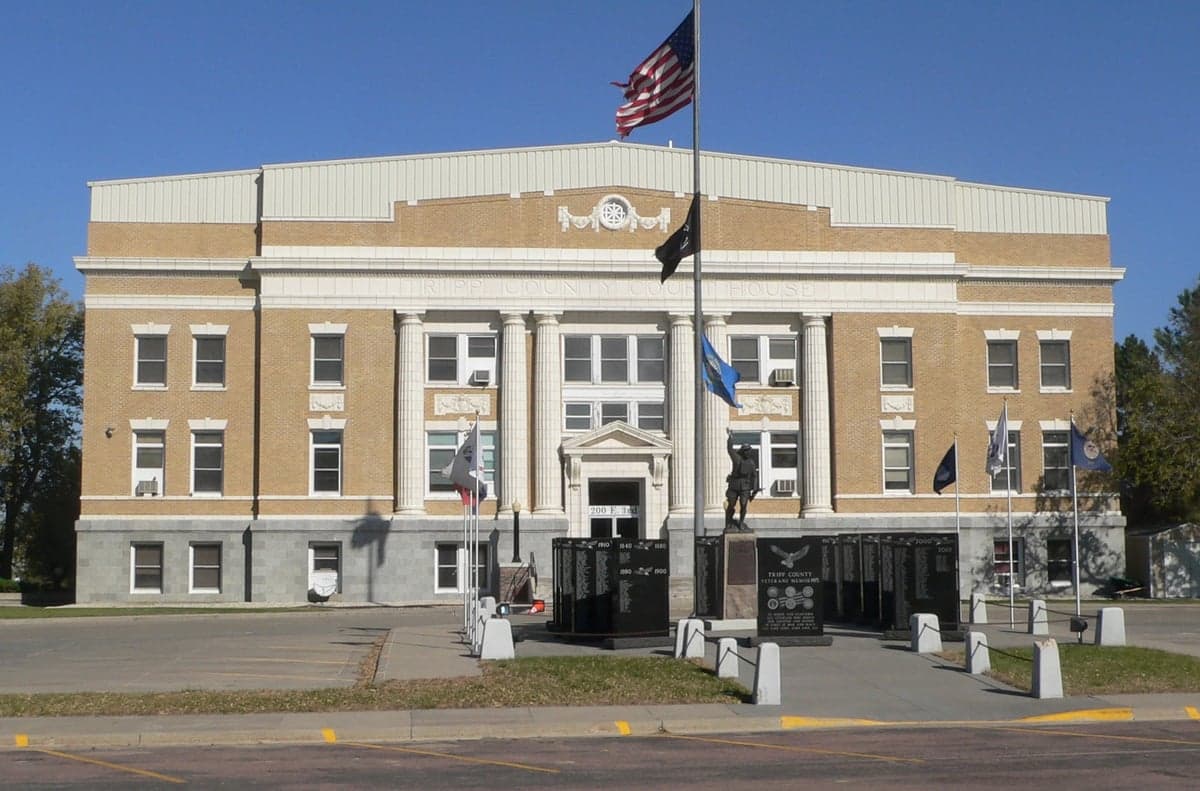
The people of Tripp County, South Dakota, today number roughly 5,600, making it one of the state’s more sparsely populated counties, with a population density of just over three people per square mile. The county is overwhelmingly white (80.7%) and native-born (98.8% U.S.-born), with a small Hispanic community (1.6%) and tiny Asian (0.9%) and Black (0.6%) populations. Its character is rooted in rural, agricultural life, with the county seat of Winner serving as the primary commercial and social hub, and a cultural identity shaped by generations of German-Russian and Czech settlers who arrived in the late 19th and early 20th centuries.
Settlement & growth (pre-1960)
Before American settlement, the area that is now Tripp County was part of the traditional territory of the Lakota people, particularly the Sicangu (Brulé) band, who followed bison herds across the rolling plains. The 1868 Fort Laramie Treaty formally recognized this land as part of the Great Sioux Reservation, but the U.S. government’s subsequent land seizures—culminating in the 1889 Act that broke up the reservation—opened the region to non-Native homesteaders. The county was officially organized in 1909, carved from the former Rosebud Indian Reservation, and named after a state senator.
The first major wave of settlers arrived between 1900 and 1915, drawn by the Enlarged Homestead Act of 1909, which offered 320 acres per claim in semi-arid regions. These homesteaders were predominantly of German-Russian descent—ethnic Germans who had lived in the Volga River region of Russia for generations before emigrating to the Great Plains. They brought with them a tradition of dryland wheat farming and a strong communal work ethic. Many settled in and around Winner, the county seat founded in 1910, which quickly became a railroad town on the Chicago, Milwaukee, St. Paul and Pacific line. A smaller but significant Czech community also arrived in the same period, concentrating in the northern part of the county near Wewela and Hamill, where they established Catholic parishes and Czech-language newspapers.
By 1920, the county’s population had peaked at roughly 8,800, as the homestead boom drew families from the Midwest and Northern Europe. The Dust Bowl of the 1930s hit Tripp County hard, with severe drought and wind erosion forcing many farmers to abandon their claims. The population declined steadily through the 1930s and 1940s, as mechanization reduced the need for farm labor and younger generations moved to cities like Rapid City or Sioux Falls. A small number of Lakota families remained on the county’s southern edge, near the Rosebud Reservation boundary, but the county’s Native American population never rebounded to pre-1900 levels. By 1960, the population had fallen to about 6,600, and the county’s demographic character was firmly set: white, rural, and agricultural, with German-Russian and Czech surnames dominating local phone books.
Modern era (post-1965)
The 1965 Hart-Cellar Act, which dramatically reshaped U.S. immigration, had almost no direct effect on Tripp County. The foreign-born population today stands at just 1.2%, far below the national average of roughly 14%. The county did not experience the post-1965 waves of immigration from Latin America, Asia, or Africa that transformed urban and suburban America. Instead, the dominant demographic trend since the 1960s has been out-migration of young adults and a gradual aging of the remaining population.
Domestic migration patterns have been similarly muted. Unlike the Sun Belt counties that boomed with Rust Belt transplants, Tripp County has seen a slow, steady population decline from 6,600 in 1960 to 5,607 today. The county’s economy—centered on cattle ranching, corn and soybean farming, and a few small manufacturing plants in Winner—has not attracted significant new residents. The Hispanic population, at 1.6%, is largely composed of a small number of families who moved in during the 1990s and 2000s to work in meatpacking or agricultural processing, but no sizable enclave has formed. The Asian population (0.9%) is mostly tied to a handful of professionals in healthcare and education in Winner, such as doctors at the Winner Regional Healthcare Center or teachers in the Winner School District.
Suburbanization, as understood in metropolitan areas, does not exist in Tripp County. The only incorporated town of any size is Winner (population roughly 2,900), which serves as a retail and service center for a vast, sparsely populated hinterland. Smaller communities like Colome (population 296) and Ideal (population 88) have seen their populations shrink as schools consolidate and local businesses close. The county’s racial composition has remained remarkably stable: white share has declined only slightly from 97% in 1990 to 80.7% today, with the difference largely accounted for by a small increase in multiracial and Hispanic residents, not by any large-scale immigration.
The future
Tripp County’s population is projected to continue its slow decline over the next 10–20 years, driven by an aging demographic profile and limited economic opportunities for young adults. The median age is already above 45, and the county’s birth rate is below replacement level. The small Hispanic and Asian communities are likely to grow modestly, as agricultural and healthcare sectors recruit workers from outside the region, but they will remain small minorities. The county is not becoming more diverse in any transformative sense; rather, it is slowly becoming slightly less homogeneously white as a handful of new residents from different backgrounds settle in Winner and Colome.
Cultural identity is likely to remain rooted in the county’s German-Russian and Czech heritage, celebrated at events like the annual Czech Days in Wewela and the Tripp County Fair in Winner. The county’s political leanings are strongly conservative, with Republican candidates routinely winning 75–80% of the vote in presidential elections. For someone moving in now, Tripp County offers a quiet, rural lifestyle with strong community ties, low crime, and affordable land—but also limited job diversity, few entertainment options, and a population that is both aging and shrinking.
Tripp County is becoming a quieter, older version of its 20th-century self—a place where the descendants of German-Russian homesteaders still farm the same sections, where the high school graduating class shrinks a little each year, and where the future depends on whether the next generation chooses to stay or leave. For a family or individual seeking a low-cost, low-crime, deeply traditional rural life, it remains a viable choice; for those seeking diversity, career growth, or urban amenities, it is unlikely to satisfy.

* Values derived from national, state, county, city and local statistics and may differ in a specific area. Last updated: 2026-07-15T03:38:39.000Z
Narrative content on this page is AI-generated and may contain mistakes. Verify any details that matter before acting on them.
ReloMaps may earn a commission from affiliate links at no extra cost to you.

