Photo: Wikipedia
Political ClimatePolitical Climate in Pennington County
Showing state-level results — no local-only data available.
Local Political AnalysisPolitical Analysis of Pennington County
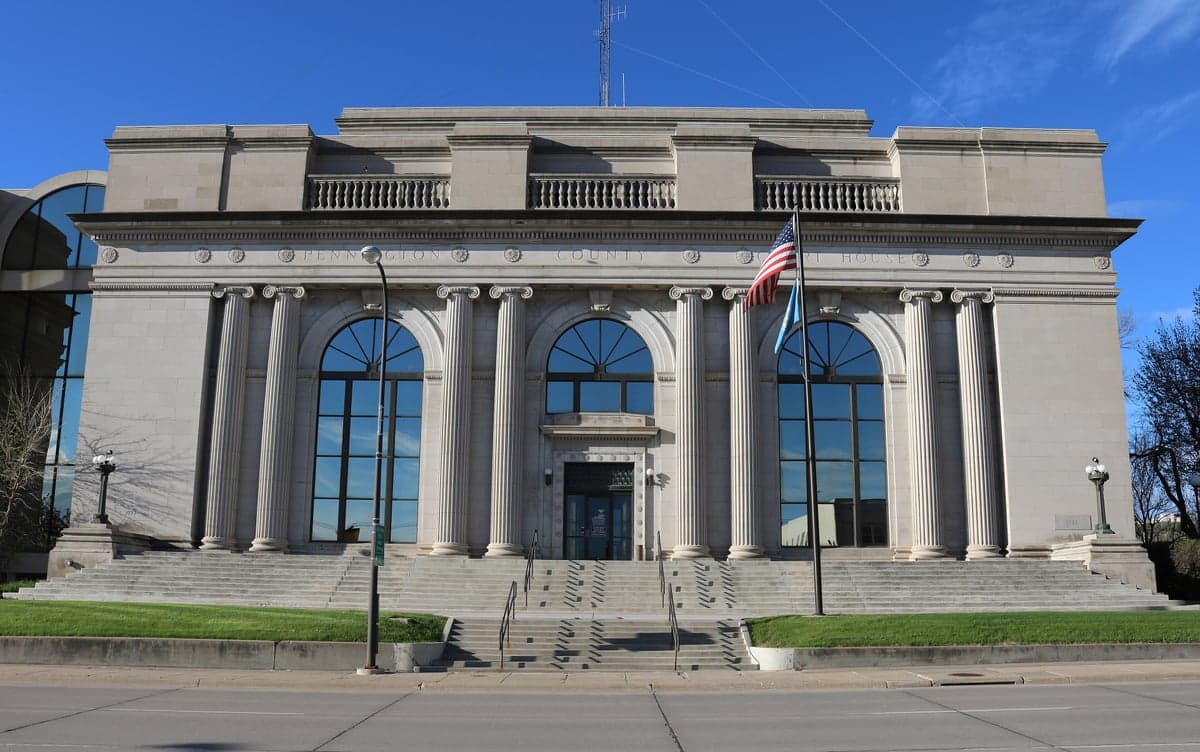
Pennington County, home to Rapid City and the eastern slope of the Black Hills, has long been a reliably Republican stronghold, but its trajectory is more nuanced than a simple red-county label suggests. In the 2024 presidential election, the county voted for Donald Trump by a margin of roughly 58% to 39%, a solidly Republican result that nonetheless shows a slight softening compared to 2020, when Trump carried it by about 22 points. The real story here is the growing urban-rural split within the county: Rapid City itself is becoming more competitive, while the outlying towns and unincorporated areas remain deeply conservative. This shift mirrors national trends but has a distinctly local flavor, driven by an influx of remote workers, a growing Native American electorate, and a younger demographic in the city's core.
How it compares to South Dakota as a whole
Pennington County is slightly less conservative than the rest of South Dakota, but not by much. The state as a whole voted for Trump by a 30-point margin in 2024, meaning Pennington's 19-point margin is about 11 points more moderate. The difference is almost entirely driven by Rapid City, which contains the county's only reliably blue precincts—specifically around the downtown core, the South Dakota School of Mines & Technology campus, and the historically Democratic-leaning neighborhoods near the Lakota community of Lakota Homes. In contrast, towns like Box Elder, Hill City, and Keystone vote Republican by margins exceeding 70%. The swing precincts are in the suburban sprawl of Rapid Valley and Black Hawk, where growth is fastest and voters are more pragmatic than ideological. Statewide, Pennington's political center of gravity is a bit more purple than, say, Minnehaha County (Sioux Falls), but it's still a long way from being a battleground.
What this means for residents
For conservative residents, Pennington County remains a comfortable place to live politically. Local offices—from the county commission to the state legislature—are dominated by Republicans, and policy debates tend to focus on property rights, gun access, and keeping taxes low. The county's Republican Party is active but not factionalized, so primaries are usually about personality rather than ideology. For liberal residents, the picture is more mixed. You can find like-minded neighbors in Rapid City's core, and the city council has a few Democrats, but county-level elections are an uphill climb. The practical effect is that progressive priorities—like expanding public transit or affordable housing initiatives—often stall at the county level, even if they have city support. That said, the growing Native American vote, concentrated in precincts around Pine Ridge Village and Oglala (though technically on the reservation, many voters live in Rapid City), is slowly shifting the county's needle on issues like tribal sovereignty and criminal justice reform.
Culturally, Pennington County is more libertarian than deeply religious, which sets it apart from the more evangelical eastern part of the state. You'll see a lot of "Don't Tread on Me" flags alongside the occasional pride flag in downtown Rapid City. The county's economy—tourism, mining, and the Ellsworth Air Force Base—tends to produce a pragmatic, live-and-let-live attitude. The biggest policy distinction from the rest of South Dakota is the county's relationship with the federal government: because so much land is managed by the U.S. Forest Service and the National Park Service, local Republicans are often more critical of federal land policies than their counterparts in farm country. If you're moving here, expect a place where politics is important but not all-consuming—most people care more about the cost of living and access to the outdoors than the latest culture war. The trajectory is toward a slow, modest shift to the center, driven by Rapid City's growth, but don't expect Pennington County to turn blue anytime soon.

State Political ClimatePolitical Climate in South Dakota
State Political AnalysisPolitical Environment in the State
South Dakota is a deeply red state, with Republicans holding every statewide office and supermajorities in both legislative chambers, but its politics are more nuanced than a simple party label suggests. The state has voted for the Republican presidential candidate by margins of 20 to 30 points in every election since 2008, and the GOP’s grip has only tightened over the last decade as rural voters have consolidated and the state’s small urban centers have remained reliably conservative. That said, the political climate here is defined less by partisan bickering and more by a practical, low-tax, limited-government ethos that appeals to both conservative families and libertarian-leaning individuals looking for a place where government stays out of daily life.
Urban vs. rural divide
The political map of South Dakota is straightforward: the state’s two small metro areas, Sioux Falls and Rapid City, are the population centers and both lean Republican, though Sioux Falls has a slightly more moderate suburban wing. Minnehaha County, home to Sioux Falls, voted for Trump by about 12 points in 2020, while Pennington County (Rapid City) went for him by 18 points. The real engine of the state’s red tilt is the vast rural expanse — counties like Harding, Perkins, and Campbell routinely deliver 80-90% Republican margins. The only notable blue dot is Brookings, home to South Dakota State University, which has voted Democratic in recent presidential cycles by narrow margins, driven by faculty and younger voters. Vermillion, home to the University of South Dakota, also leans slightly left but doesn’t have the population to shift the state map. Outside of these college towns, the political culture is uniformly conservative, with an emphasis on agriculture, gun rights, and local control.
Policy environment
South Dakota’s policy environment is defined by its absence of a state income tax, a flat property tax structure, and a regulatory climate that actively courts businesses and second-home buyers. The state has no personal or corporate income tax, which is a major draw for relocators from high-tax states like California or Illinois. Sales tax is 4.5% at the state level, with local options that can push it to 6.5% in some cities. Education policy is locally controlled, with school choice limited to charter schools in certain districts and a robust homeschooling community that faces minimal state oversight. Healthcare is a mixed bag: the state expanded Medicaid in 2023 via a ballot initiative, overriding years of legislative resistance, but the system remains strained in rural areas. Election laws are straightforward — voter ID is required, same-day registration is not available, and absentee voting is allowed without an excuse. The state has no ballot initiative process for constitutional amendments, but statutory initiatives are possible, as seen with the Medicaid expansion and recent marijuana legalization votes that were later overturned by the legislature.
Recent policy direction
Over the past five years, South Dakota has moved aggressively on several fronts that matter to relocators. In 2023, Governor Kristi Noem signed a permitless carry law, allowing any adult who can legally possess a firearm to carry it concealed without a permit — a move that solidified the state’s reputation as one of the most gun-friendly in the nation. On education, the legislature passed a Parents’ Bill of Rights in 2022, requiring schools to notify parents about curriculum changes and allowing them to opt their children out of certain materials. The state also banned transgender girls from participating in girls’ sports in 2022, a law that has been challenged in court but remains in effect. On medical and bodily autonomy, South Dakota has one of the most restrictive abortion laws in the country, with a near-total ban that took effect after the Dobbs decision, including no exceptions for rape or incest — only to save the mother’s life. Property rights are strongly protected, with no state-level rent control and a homestead exemption that shields a portion of home equity from creditors. Privacy and surveillance are less protected: the state has no comprehensive data privacy law, and law enforcement can access cell phone location data with a warrant but not without. Voting access is stable but not expanding — no same-day registration, no automatic voter registration, and a voter ID law that requires a photo ID or a signed affidavit.
Civil unrest & political movements
South Dakota is not a hotbed of civil unrest, but it has seen its share of political flashpoints. The most visible in recent years was the Standing Rock protests in 2016-2017, which drew thousands of activists from across the country to oppose the Dakota Access Pipeline. While the protests were centered in North Dakota, the spillover into South Dakota’s tribal lands — particularly the Pine Ridge and Rosebud reservations — energized Native American activism and led to ongoing tensions over pipeline safety and tribal sovereignty. On the right, the state has seen a rise in county-level “constitutional sheriff” movements, with some sheriffs publicly refusing to enforce certain state or federal gun laws. Election integrity has been a recurring topic, with the legislature passing a 2021 law requiring absentee ballots to be returned by Election Day (previously they could arrive later) and banning private funding of election administration. Immigration politics are muted — South Dakota has a very small foreign-born population (about 4%), and there are no sanctuary cities. The state’s largest city, Sioux Falls, has seen a growing refugee resettlement program, which has been generally accepted by the business community but has drawn occasional opposition from conservative activists. Overall, political activism is low-key compared to coastal states, and most residents are more concerned with weather, taxes, and school quality than with protest politics.
Projection
Over the next 5-10 years, South Dakota’s political trajectory is likely to remain deeply conservative, but with some subtle shifts driven by in-migration. The state is attracting a steady stream of relocators from blue states, particularly to the Black Hills region around Rapid City and the eastern corridor near Sioux Falls. These newcomers tend to be conservative or libertarian-leaning, so they reinforce the existing political culture rather than challenging it. The biggest wild card is the growing Native American population, which votes heavily Democratic but faces significant turnout barriers; if tribal voting rights litigation succeeds, it could shift a few legislative districts but not the statewide balance. The state’s demographic profile — aging, white, and rural — means that the Republican base will remain strong, but the urbanizing areas around Sioux Falls may become more moderate over time, especially on economic issues like infrastructure spending and education funding. Expect continued fights over abortion access, with potential ballot initiatives to soften the ban, and ongoing debates over marijuana legalization, which voters have approved twice only to see the legislature roll it back. For a new resident, the bottom line is that South Dakota will remain a low-tax, gun-friendly, socially conservative state for the foreseeable future, with a political culture that values individual liberty and local control over government expansion.
For someone moving to South Dakota, the practical takeaway is that you’ll be living in a state where your taxes are low, your gun rights are broad, and your government is small — but you’ll also have limited access to abortion, a public school system that varies widely by district, and a political environment that is overwhelmingly Republican. If you’re a conservative family or a libertarian individual, you’ll find a welcoming culture and a government that mostly stays out of your way. If you’re a liberal, you’ll be in a clear minority, but you’ll find like-minded communities in Brookings, Vermillion, and parts of Sioux Falls, and you’ll benefit from the state’s low cost of living and outdoor lifestyle. Either way, the politics here are stable, predictable, and unlikely to surprise you — which is exactly what most people moving here are looking for.
* Values derived from national, state, county, city and local statistics and may differ in a specific area. Last updated: 2026-10-23T20:17:50.000Z
Narrative content on this page is AI-generated and may contain mistakes. Verify any details that matter before acting on them.
ReloMaps may earn a commission from affiliate links at no extra cost to you.

