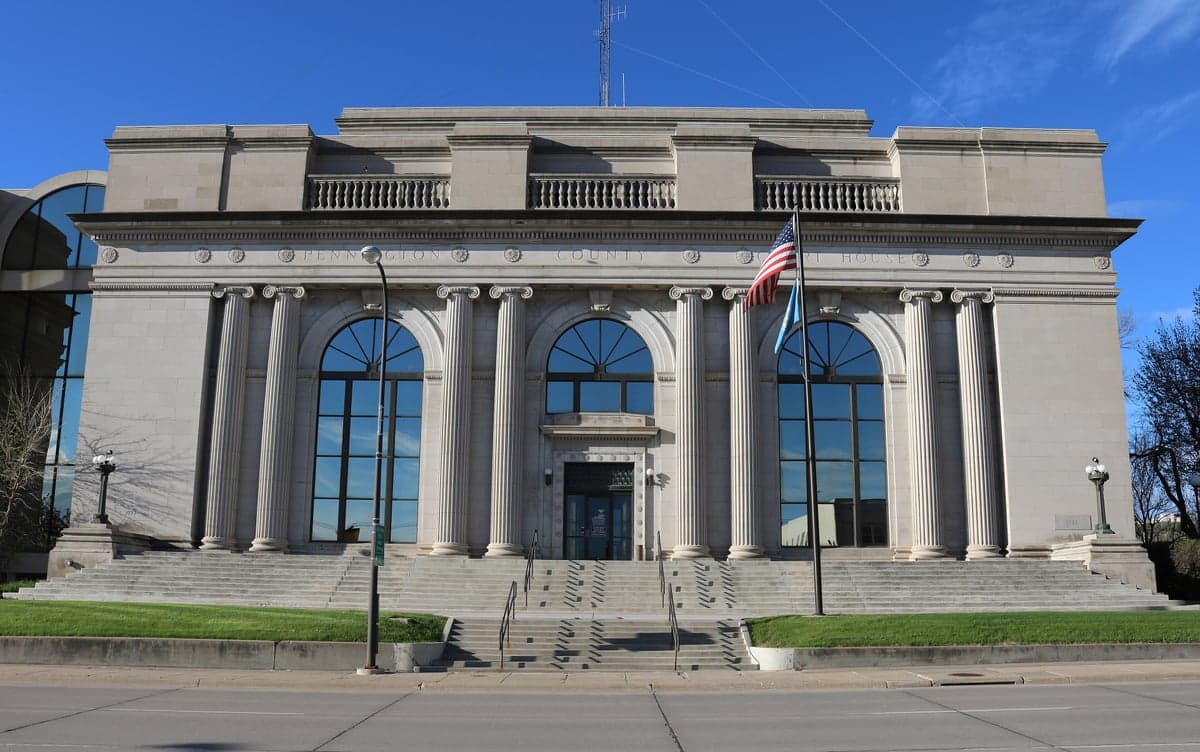
Photo: Wikipedia
Personal Sovereignty in Pennington County
Viable for self-reliance. Generally workable, though some barriers may limit total independence.
What does Personal Sovereignty tell us?
Personal Sovereignty measures your capacity for self-reliance and independence with minimal government friction. Higher scores mean fewer barriers between you and the way you want to live... but it assumes you have the space you need and good neighbors.
What does this tell us?
Personal Sovereignty measures your capacity for self-reliance and independence with minimal government friction. Higher scores mean fewer barriers between you and the way you want to live... but it assumes you have the space you need and good neighbors.
State Policy
Energy independence: Importer (35% of energy produced in-state)
Personal Liberty
Homesteading

Personal Liberty Analysis
Pennington County, South Dakota, offers one of the strongest personal sovereignty environments in the Upper Midwest, characterized by a state-level commitment to low taxation, minimal regulation, and broad individual liberties that directly shape daily life for residents. The county’s autonomy posture is anchored in South Dakota’s constitutional and statutory framework, which consistently ranks among the most freedom-oriented in the nation according to indices like the Cato Institute’s Freedom in the 50 States. For single individuals and families relocating here, the practical result is a legal and fiscal landscape where personal choice—whether in self-defense, medical decisions, or property use—is the default, not the exception. This analysis breaks down the key pillars of that sovereignty across tax burden, gun law, homesteading viability, and personal liberties, with specific attention to how conditions vary within the county’s diverse geography, from the urban core of Rapid City to the rural expanses of Hill City, Keystone, Wall, and the Black Hills National Forest areas.
Tax burden and regulatory posture: How South Dakota’s light-touch framework affects Pennington County residents
Pennington County operates under South Dakota’s famously low-tax regime, which includes no state income tax—neither personal nor corporate—and no state-level inheritance or estate taxes. The primary revenue sources are a 4.5% state sales tax (with local jurisdictions adding up to 2%, bringing Rapid City’s combined rate to 6.5%) and property taxes that average about 1.1% of assessed value countywide, among the lowest in the nation. For a family earning $80,000 annually, the absence of income tax alone saves roughly $4,000–$6,000 compared to a median-tax state. Regulatory posture is equally light: South Dakota has no state-level occupational licensing for over 100 low-to-moderate-income occupations, and Pennington County’s zoning is largely confined to incorporated areas. In Rapid City, the county seat, zoning and building codes exist but are less onerous than in comparably sized cities elsewhere—permits for accessory dwelling units or home-based businesses are straightforward. In unincorporated areas like the rural stretches near Hill City or Keystone, county oversight is minimal, with no county-wide building code for single-family homes outside fire-prone zones. The state’s right-to-work law and absence of a state minimum wage above the federal $7.25 further reduce regulatory friction for entrepreneurs and small business owners. However, note that the Black Hills National Forest area imposes federal land-use restrictions that can limit development, so property buyers should verify whether a parcel is under U.S. Forest Service jurisdiction.
Self-defense and gun law specifics: Constitutional carry, permit reciprocity, and local culture in Pennington County
South Dakota is a constitutional carry state, meaning that as of 2019, any legal resident 18 or older may carry a concealed firearm without a permit. Pennington County’s sheriff’s office, led by an elected sheriff, issues permits for those who still want reciprocity with other states—the process is shall-issue with no discretionary denial, and permits cost $10 for a five-year term. No firearm registration, waiting periods, or magazine capacity restrictions exist at the state or county level. The county’s gun culture is robust: Rapid City hosts multiple indoor and outdoor ranges, and the annual Sturgis Motorcycle Rally (just east in Meade County) reinforces a firearms-friendly ethos. In practice, this means that in Rapid City, open carry is common and socially accepted, while in smaller towns like Wall or Keystone, it is virtually unremarkable. The state’s Castle Doctrine and Stand Your Ground laws provide strong legal protection for self-defense in the home, vehicle, or any place where a person has a right to be. For relocating families, the key takeaway is that Pennington County offers one of the most permissive self-defense legal environments in the country, with no local ordinances that override state preemption—a critical point, as some South Dakota municipalities attempted local gun restrictions before a 2021 state law explicitly barred them.
Self-reliance and homesteading viability: Lot sizes, zoning, and off-grid feasibility across Pennington County
Homesteading and off-grid living are genuinely viable in Pennington County, but feasibility varies sharply by location. In unincorporated areas, no county-wide minimum lot size exists for residential use, though subdivision regulations apply for parcels under 40 acres. This means that in rural zones near Hill City or Rapid Valley, a family can purchase a 5- or 10-acre parcel and build a home with few bureaucratic hurdles. Off-grid systems—solar panels, wind turbines, rainwater collection, and composting toilets—are legal statewide, with no state-level prohibition on rainwater harvesting. Pennington County does not require a permit for solar installations on single-family homes, though grid-tied systems must meet utility interconnection standards. The Black Hills region has abundant groundwater, but well permits are required from the state Department of Agriculture and Natural Resources; the process is straightforward, with a typical approval in 30–60 days. Zoning in Rapid City’s extraterritorial jurisdiction (ETJ) is more restrictive, requiring minimum lot sizes of 1–2 acres in some areas and adherence to the city’s building code. For those seeking maximum autonomy, the rural townships of Wasta or New Underwood offer the least regulatory friction, with no zoning at all and county oversight limited to septic system permits. The trade-off is access to services: off-grid properties in these areas may be 20–30 minutes from the nearest grocery store or hospital, so self-reliance in transportation and emergency preparedness is essential.
Personal liberties: Parental rights, medical autonomy, speech, and property protections in Pennington County
South Dakota’s legal framework strongly favors parental rights, medical freedom, and property protections. The state’s Parental Rights in Education statutes give parents broad authority over their children’s education, including the right to opt out of any curriculum or activity without penalty. Homeschooling is deregulated: parents need only file a notification with the local school district, with no standardized testing or curriculum approval requirements. Pennington County has a robust homeschooling community, with co-ops and support groups active in Rapid City and Hill City. Medical autonomy is similarly broad: South Dakota has no state-level vaccine mandate for adults or children (though schools require standard immunizations for attendance, with medical and religious exemptions available), and the state’s 2023 law prohibits discrimination based on COVID-19 vaccination status. No state-level mask mandates or business closure orders have been enacted since 2021, and the legislature has passed laws limiting emergency powers of governors. Property rights are protected by a strong eminent domain statute that requires just compensation and a public purpose test; Pennington County has not seen controversial takings in recent years. Free speech is protected under the state constitution, which explicitly guarantees the right to peacefully assemble and petition the government. The practical effect for residents is a legal environment where personal choices—in healthcare, education, and expression—are presumed permissible unless explicitly restricted, rather than the reverse.
Overall, Pennington County ranks among the top 10–15% of U.S. counties for personal sovereignty, combining South Dakota’s structural freedoms with a local culture that values self-reliance. The absence of income tax, constitutional carry, deregulated homeschooling, and minimal zoning in rural areas create a baseline of autonomy that is rare outside the Mountain West or Alaska. For families and individuals who prioritize freedom over convenience—who are willing to drive 20 minutes for groceries or maintain their own septic system—the county offers a legal and fiscal environment where personal sovereignty is not just tolerated but actively supported. The key differentiator within the county is geography: Rapid City provides urban amenities with moderate regulation, while Hill City, Keystone, Wall, and the rural townships offer near-total autonomy at the cost of isolation. For the relocation researcher, Pennington County represents a compelling option for those seeking a high-sovereignty lifestyle within a stable, low-tax state with a proven track record of protecting individual liberties.

* Values derived from national, state, county, city and local statistics and may differ in a specific area. Last updated: 2026-10-23T20:17:50.000Z
Narrative content on this page is AI-generated and may contain mistakes. Verify any details that matter before acting on them.
ReloMaps may earn a commission from affiliate links at no extra cost to you.

