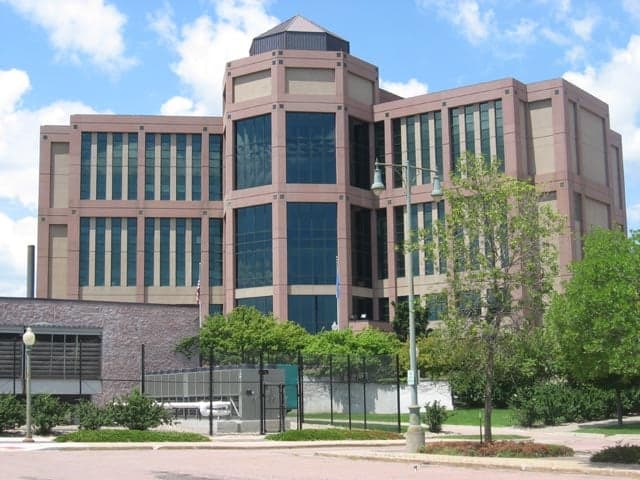
Photo: Wikipedia
Political ClimatePolitical Climate in Minnehaha County
Showing state-level results — no local-only data available.
Local Political AnalysisPolitical Analysis of Minnehaha County
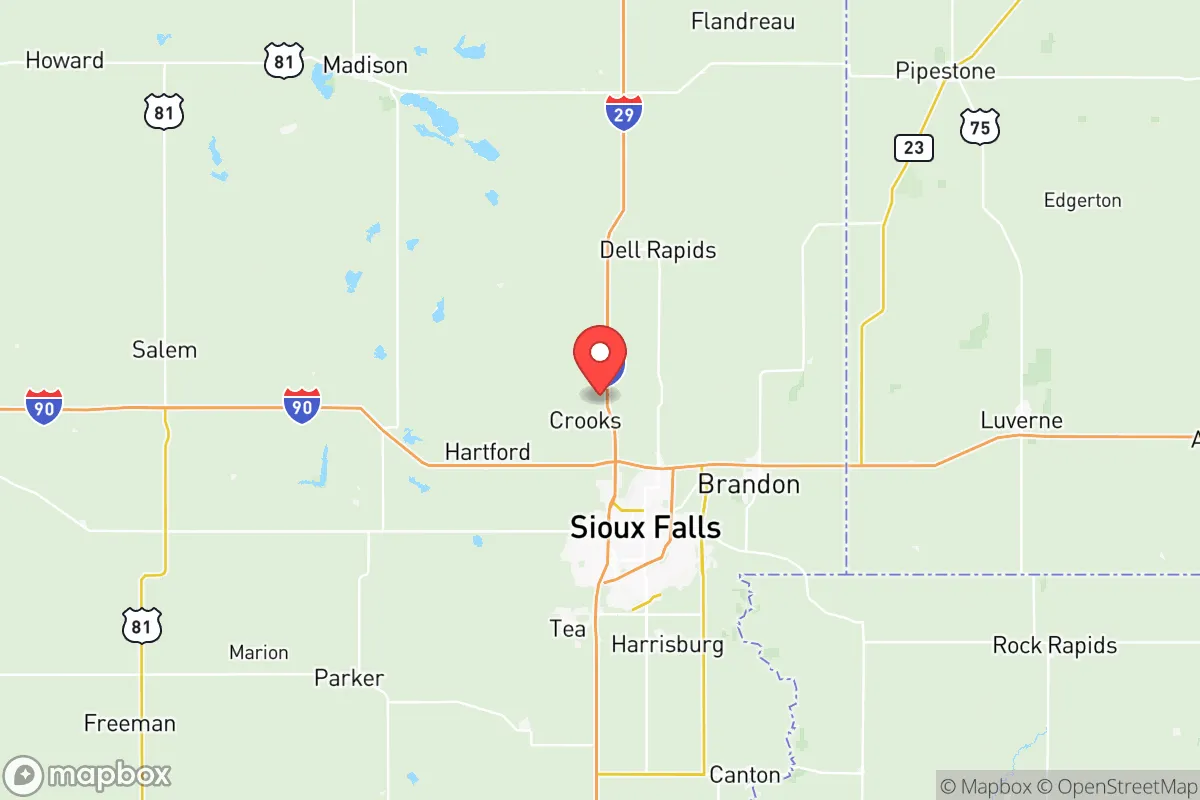
Minnehaha County, home to Sioux Falls and the state's largest population center, is a reliable Republican stronghold with a Cook PVI of R+15, meaning it votes about 15 points more Republican than the national average. That said, the county isn't a monolithic red bloc — it's a place where the urban core of Sioux Falls has been slowly shifting leftward over the past decade, while the surrounding small towns and rural townships remain deeply conservative. If you're moving here, the political reality is that Republicans dominate local and state elections, but the growing diversity of Sioux Falls is starting to create a more visible, if still outnumbered, Democratic presence.
How it compares
Compared to the rest of South Dakota, Minnehaha County is actually slightly less conservative than the statewide average. The state as a whole has no official Cook PVI, but it's widely considered R+16 or R+17 based on presidential results — meaning Minnehaha County is a hair more competitive than places like Pennington County (Rapid City) or the vast rural counties west of the Missouri River. The real contrast, though, is internal. Within Minnehaha County, you can drive 15 minutes and go from a precinct that voted 60% Democratic to one that voted 80% Republican. Sioux Falls' central neighborhoods — around downtown, the Whittier area, and near the university — are the blue pockets, often voting 55-60% for Democrats in recent cycles. Meanwhile, Brandon, Hartford, and Crooks are reliably red, often pushing 70-75% Republican. The swing precincts are in the newer suburban developments on Sioux Falls' far east and south sides, where growth is fastest and voters are more mixed — think places like the area around 57th Street and Southeastern Avenue.
What this means for residents
For conservative residents, Minnehaha County is a comfortable place to live politically. Local government, the county commission, and the state legislature delegation are all Republican-controlled, and conservative policy priorities — lower taxes, gun rights, school choice — generally advance without much opposition. For liberal residents, the picture is more nuanced. You'll find like-minded neighbors in central Sioux Falls, and the city itself has a Democratic mayor (Paul TenHaken, though he's a moderate Republican who often works across the aisle) and a city council that includes some progressive voices. But at the county and state level, progressive policy goals face steep odds. The practical effect is that liberal residents tend to focus their energy on local issues — housing, downtown development, public transit — where they can have more impact, rather than on state-level fights they're unlikely to win.
Culturally, the county's political divide shows up in everyday life. Sioux Falls is a growing, diversifying city with a vibrant arts scene, craft breweries, and a visible immigrant community (especially from Sudan, Ethiopia, and Myanmar). The smaller towns in the county are more traditional — think church potlucks, county fairs, and a slower pace of life. One notable policy distinction: Minnehaha County has been a flashpoint in debates over library content and LGBTQ+ rights, with the Sioux Falls library system facing periodic challenges from conservative groups. The county also leans heavily into "no new taxes" rhetoric, which has kept property taxes relatively low compared to neighboring Minnesota counties but has also led to infrastructure strains as the population booms. If you're moving here, expect a place where politics is present but not all-consuming — most people get along fine across party lines, especially in the context of work, school, or youth sports.

State Political ClimatePolitical Climate in South Dakota
State Political AnalysisPolitical Environment in the State
South Dakota has been a reliably Republican state for decades, with a partisan lean that has only deepened over the last 10-20 years. In the 2024 presidential election, Donald Trump carried the state by over 30 points, and Republicans hold every statewide office and supermajorities in both legislative chambers. The dominant coalition is a mix of rural conservatives, libertarian-leaning ranchers, and a growing number of out-of-state transplants drawn by low taxes and a hands-off regulatory environment. While the state has always leaned right, the shift has accelerated since 2010, driven by population growth in conservative-leaning areas and a steady exodus of younger, more moderate residents from rural counties.
Urban vs. rural divide
The political map of South Dakota is starkly divided between a few small urban centers and vast, deeply conservative rural expanses. Sioux Falls, the state's largest city and economic engine, is the only real blue-leaning area, though even it votes Republican by a modest margin — Minnehaha County went for Trump by about 12 points in 2024. Rapid City and Pennington County are more conservative, reliably voting red by 20+ points. The real Republican strongholds are the rural counties west of the Missouri River, where Harding County and Butte County routinely deliver 80-90% of the vote to GOP candidates. The divide is less about culture war and more about economics: Sioux Falls is a growing hub of finance, healthcare, and tech, while the western part of the state depends on agriculture, tourism, and energy. Brookings, home to South Dakota State University, leans slightly more moderate but still votes Republican, while Vermillion and Spearfish show small pockets of liberal influence due to their college populations.
Policy environment
South Dakota's policy environment is defined by a low-tax, low-regulation philosophy that appeals strongly to conservative and libertarian-leaning residents. There is no state income tax, and sales tax is capped at 4.5%, though local municipalities can add up to 2%. Property taxes are moderate, and the state offers a homestead exemption for primary residences. The regulatory posture is business-friendly, with few occupational licensing barriers and a right-to-work law. Education policy is locally controlled, with school choice options including charter schools and a growing number of private and homeschool families. Healthcare policy is limited: the state did not expand Medicaid until 2023, following a voter-approved ballot measure in 2022. Election laws are among the most accessible in the region — same-day voter registration is allowed, and no-excuse absentee voting is available. Voter ID is required but with a broad list of acceptable forms. The state also has a robust initiative and referendum process, giving citizens direct lawmaking power.
Recent policy direction
Over the past five years, South Dakota has moved aggressively on a range of policy fronts that matter to relocators. On gun and self-defense law, the state enacted constitutional carry in 2019, allowing permitless concealed carry for anyone 18 or older who can legally possess a firearm. Stand-your-ground laws are on the books, and there is no state-level red flag law. On parental and education rights, the 2023 "Parents' Bill of Rights" (HB 1056) requires schools to notify parents of any curriculum involving sexuality or gender identity and to obtain parental consent before students can use a different name or pronoun. On speech and privacy, the state has no broad surveillance programs, but local law enforcement cooperates with federal agencies. On medical and bodily autonomy, South Dakota has one of the most restrictive abortion laws in the country — a near-total ban with exceptions only to save the mother's life, enacted via trigger law after Dobbs. The state also prohibits gender-affirming care for minors (2023). On property rights, the state has strong eminent domain protections and no statewide rent control. On taxation, the trend is toward further cuts: the 2024 legislative session reduced the sales tax on groceries from 4.5% to 4.2%, with a phase-out planned. On voting and ballot access, the state has resisted restrictive laws seen elsewhere, maintaining same-day registration and no-excuse absentee voting, though a 2023 law tightened signature verification for ballot initiatives.
Civil unrest & political movements
South Dakota is not a hotbed of civil unrest, but it has seen notable political movements. The Noem administration has been a flashpoint, particularly around the governor's use of state aircraft and her 2020 decision to send the state's National Guard to the Texas border. Protests have been small and localized — the 2020 Black Lives Matter demonstrations in Sioux Falls drew a few hundred people, and the 2021 "Freedom Rally" in Pierre attracted a similar number of anti-mask and anti-vaccine mandate activists. Immigration politics are less visible than in border states, but the state has no sanctuary policies and local law enforcement cooperates with ICE. There is no serious secession or nullification movement, though some rural counties have passed symbolic resolutions asserting local control over federal lands. Election integrity controversies have been minimal, with no major fraud cases and widespread acceptance of the state's voting system. The most visible flashpoint for a new resident would likely be the ongoing debate over medical marijuana — voters approved it in 2020, but the legislature has repeatedly attempted to restrict dispensaries and home cultivation, leading to ongoing court battles.
Projection
Over the next 5-10 years, South Dakota's political trajectory will be shaped by demographic shifts and in-migration patterns. The state is growing slowly but steadily, with most growth concentrated in Sioux Falls and the Black Hills region around Rapid City. These areas are attracting younger, more moderate residents, which could gradually soften the state's hard-right edge. However, the rural counties that drive the state's Republican supermajorities are losing population, which may actually intensify their conservatism as they become more insular. The biggest wildcard is the Noem factor — if she runs for national office and wins, her influence could reshape the state's GOP for a generation. If she fades, the legislature may become more libertarian and less culturally combative. On policy, expect continued tax cuts, further restrictions on abortion and gender-affirming care, and a slow expansion of school choice. The state's initiative process will remain a pressure valve for liberal and libertarian causes, as seen with medical marijuana and Medicaid expansion. A new resident moving in now should expect a state that remains deeply conservative but with a growing urban-liberal minority that will have more influence in Sioux Falls and Brookings than in the rest of the state.
For someone choosing South Dakota, the bottom line is straightforward: if you value low taxes, minimal regulation, and a government that stays out of your personal life on most fronts, you'll find a lot to like. If you're on the left, you'll be in a clear minority, but you'll have a few friendly enclaves in Sioux Falls, Brookings, and Vermillion. The state's political climate is stable, predictable, and unlikely to shift dramatically in the next decade — but the growing urban centers will slowly pull the state toward a more moderate, suburban-style conservatism rather than the rural populism that dominates today.
* Values derived from national, state, county, city and local statistics and may differ in a specific area. Last updated: 2026-07-04T13:28:05.000Z
Narrative content on this page is AI-generated and may contain mistakes. Verify any details that matter before acting on them.
ReloMaps may earn a commission from affiliate links at no extra cost to you.

