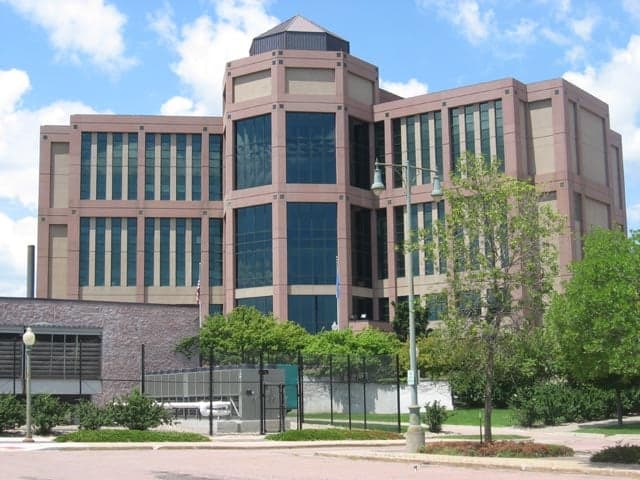
Photo: Wikipedia
Demographics of Minnehaha County
Affluence Level in Minnehaha County
A middle-class area roughly in line with national averages across income, home values, education, and employment.
People of Minnehaha County
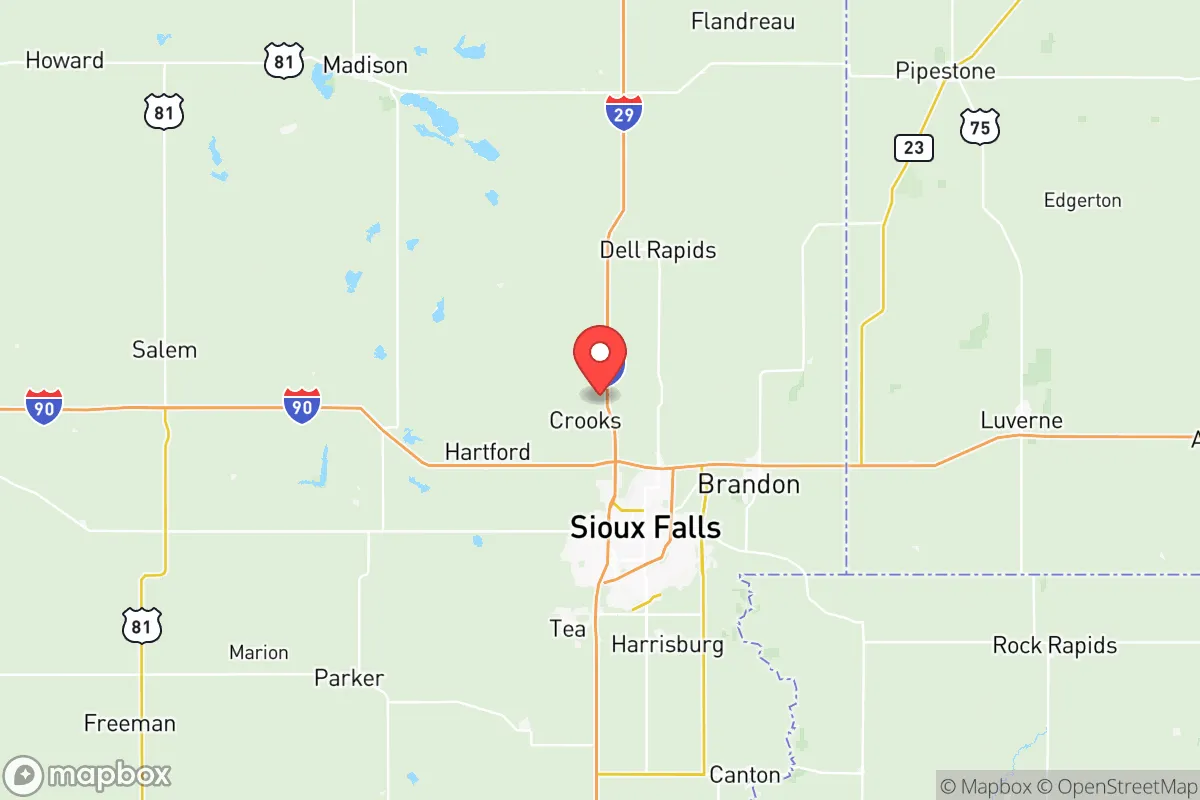
Today, Minnehaha County is home to roughly 200,689 residents, making it the most populous county in South Dakota and the economic and cultural heart of the Sioux Falls metropolitan area. The population is predominantly white (79.1%), with a foreign-born share of just 4.1%, though the county is gradually diversifying through modest growth in Hispanic (6.4%), Black (6.5%), and East/Southeast Asian (1.1%) communities. The county’s identity is shaped by a blend of historic Scandinavian and German settlement, a strong work ethic tied to agriculture and finance, and a growing suburban and exurban character that appeals to families and conservative-leaning professionals. Minnehaha County feels like a place where traditional Midwestern values meet steady, managed growth — not a boomtown, but a quietly expanding hub.
Settlement & growth (pre-1960)
Before European settlement, the area that is now Minnehaha County was part of the traditional territory of the Oceti Sakowin (Sioux) peoples, particularly the Yankton and Sisseton-Wahpeton bands. The name "Minnehaha" itself is derived from the Dakota language, meaning "waterfall" or "laughing waters," a reference to the falls of the Big Sioux River that later drew Euro-American settlers. The land was ceded by the Sioux through a series of treaties in the 1850s, opening the region to homesteading under the 1862 Homestead Act.
The first permanent Euro-American settlement began in the late 1850s, with the founding of Sioux Falls in 1856 at the site of the falls. The town was abandoned during the Dakota War of 1862 but was re-established in 1865, growing slowly as a frontier outpost. The arrival of the railroad in the 1870s and 1880s transformed the county, bringing waves of settlers from the Upper Midwest and Northern Europe. Norwegian and German immigrants were the dominant groups, drawn by cheap land and the promise of farming on the fertile prairies. Towns like Dell Rapids (founded 1871) and Garretson (founded 1888) were platted as agricultural service centers, with strong Norwegian Lutheran and German Catholic communities that remain visible in local church affiliations and surnames today.
By the early 20th century, the county's economy had diversified beyond grain farming into quarrying (the famous Sioux Quartzite), milling, and meatpacking. Baltic (founded 1881) and Colton (founded 1880) grew as railroad towns serving the surrounding farm country. The population remained overwhelmingly native-born white, with small pockets of Irish and Czech settlers. The Dust Bowl and Great Depression of the 1930s hit the region hard, but the county's population held relatively steady as Sioux Falls emerged as a regional trade and medical hub. By 1960, the county had about 86,000 residents, still overwhelmingly white and rural in character, though Sioux Falls was beginning to industrialize with the growth of the John Morrell meatpacking plant and the expansion of the Sioux Falls Regional Airport.
Modern era (post-1965)
The 1965 Hart-Cellar Act had a relatively muted immediate effect on Minnehaha County compared to coastal regions, but it did open the door for a slow, steady diversification. The most significant demographic shift came not from immigration but from domestic migration: the growth of Sioux Falls as a regional financial and healthcare center drew professionals from across the Upper Midwest, particularly from rural Minnesota, Iowa, and Nebraska. This domestic inflow reinforced the county's white, Midwestern character while adding a layer of college-educated professionals (34.6% of residents now hold a bachelor's degree or higher).
The county's Hispanic population began to grow in the 1990s and 2000s, driven by labor demand in meatpacking, construction, and agriculture. Today, Sioux Falls has a visible Hispanic community, concentrated in the central and northeastern parts of the city, with a growing number of Mexican and Central American families. The Black population, now 6.5% of the county, grew primarily through refugee resettlement programs: Sioux Falls became a major destination for Sudanese, Somali, and Ethiopian refugees starting in the 1990s, as well as more recent arrivals from the Democratic Republic of Congo and Myanmar. These communities are concentrated in Sioux Falls, particularly in the central and southern neighborhoods near the city's refugee resettlement agencies and low-income housing.
The East/Southeast Asian population (1.1%) is smaller and more dispersed, with roots in Vietnamese and Lao refugees who arrived in the 1970s and 1980s, followed by a smaller number of Korean and Chinese professionals working in healthcare and technology. The Indian subcontinent population (0.6%) is a very recent addition, largely composed of tech and medical professionals who have arrived since 2010, and is concentrated in Sioux Falls and the newer subdivisions of Harrisburg and Tea. Suburbanization has been the dominant geographic trend since the 1990s: towns like Harrisburg (population roughly 7,000), Tea (population roughly 5,500), and Brandon (population roughly 10,000) have grown rapidly as bedroom communities for Sioux Falls commuters, attracting families seeking newer housing, lower taxes, and good schools. These suburbs remain overwhelmingly white and politically conservative.
The future
Minnehaha County is projected to continue growing at a moderate pace, driven by Sioux Falls' expanding economy in finance (Sanford Health, Citibank, Wells Fargo), healthcare, and logistics. The population is likely to become slightly more diverse, but the pace of change will be slow compared to national trends. The Hispanic and Black shares will grow gradually through both natural increase and continued refugee resettlement, while the white share will decline slowly. The East/Southeast Asian and Indian populations will remain small but may grow if the tech and medical sectors continue to expand. The most significant geographic trend will be continued suburban and exurban sprawl: Harrisburg, Tea, and Brandon will absorb most of the new growth, while the rural townships and small towns like Dell Rapids and Garretson will see slower growth or slight decline. The county's cultural identity will remain broadly Midwestern and conservative, but with increasing internal diversity in Sioux Falls itself, where younger, more liberal residents are creating a modest urban counterweight to the suburban majority.
For someone moving in now, Minnehaha County offers a stable, growing economy with a relatively low cost of living and strong public schools, set within a social environment that is still predominantly white and traditional. The county is not undergoing a rapid transformation, but it is slowly becoming more varied — a place where a family can find a new subdivision in Harrisburg or a historic farmhouse near Dell Rapids, and where the biggest changes over the next decade will be more strip malls and traffic lights, not a fundamental shift in who lives there.

* Values derived from national, state, county, city and local statistics and may differ in a specific area. Last updated: 2026-07-04T13:28:05.000Z
Narrative content on this page is AI-generated and may contain mistakes. Verify any details that matter before acting on them.
ReloMaps may earn a commission from affiliate links at no extra cost to you.

