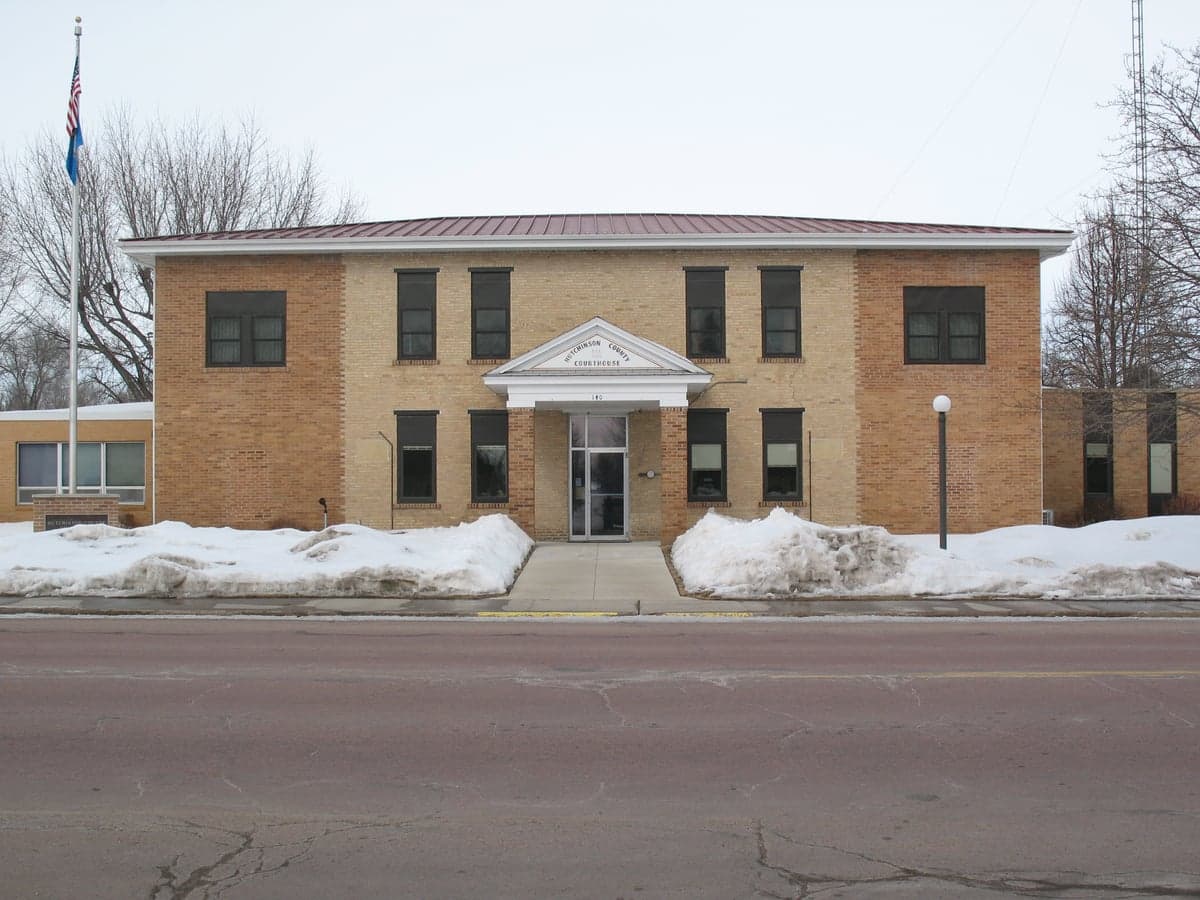
Photo: Wikipedia
Political ClimatePolitical Climate in Hutchinson County
Showing state-level results — no local-only data available.
Local Political AnalysisPolitical Analysis of Hutchinson County
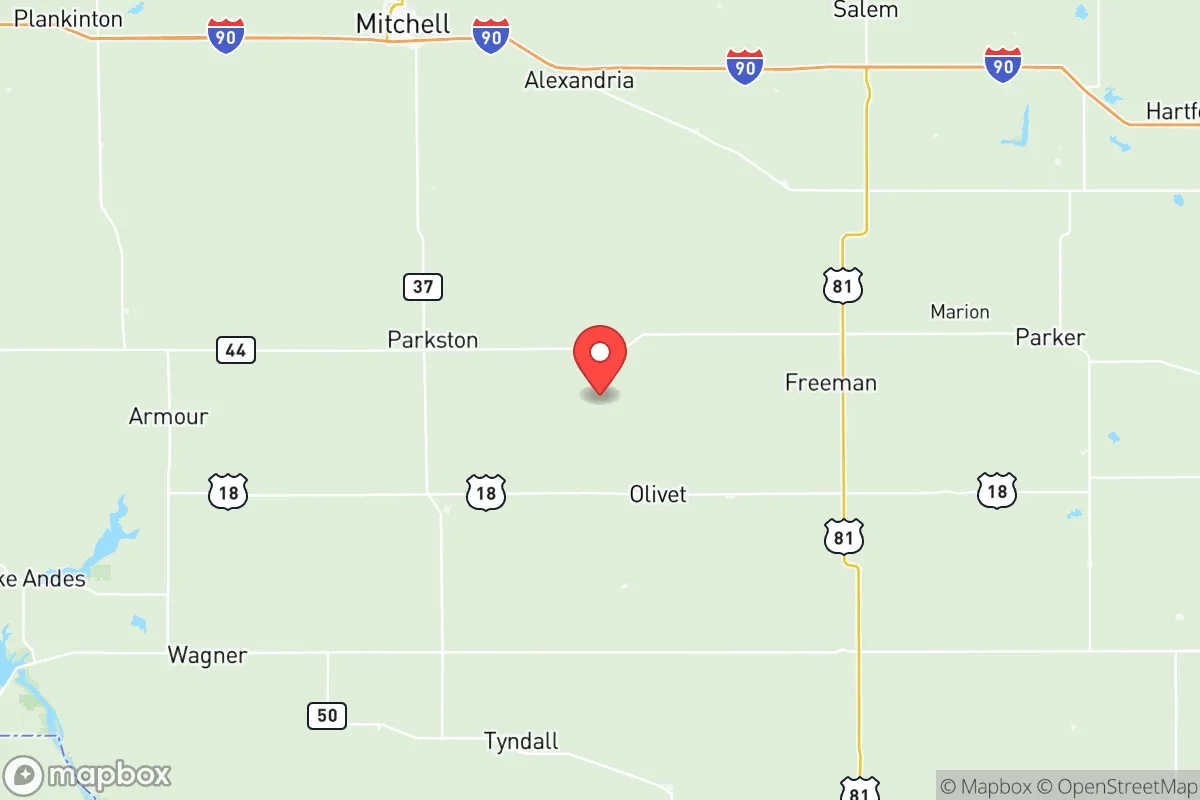
Hutchinson County, South Dakota, is a reliably Republican stronghold with a Cook Partisan Voting Index (PVI) of R+15, meaning it votes about 15 points more Republican than the national average. This isn't a recent shift; the county has been consistently red for decades, with local elections often decided in the GOP primary. While the state of South Dakota as a whole is also deeply conservative, Hutchinson County sits firmly on the rightward edge of that spectrum, with a political culture that feels more like the rural, agricultural core of the state than the more moderate eastern counties or the tourist-driven Black Hills region.
How it compares
Compared to South Dakota as a whole, Hutchinson County is noticeably more conservative. The state's overall PVI is unknown, but it's widely considered a safe Republican state, with a strong libertarian streak and a history of electing moderate Republicans like former Senator Larry Pressler. Hutchinson County, however, is a different animal. Its R+15 rating places it among the most Republican counties in the state, alongside neighbors like Turner and Yankton counties. This isn't just about presidential elections; it shows up in state legislative races, where the county's representatives are almost always among the most conservative in the Pierre chamber. The county's political identity is deeply tied to its agricultural economy, strong Evangelical Lutheran and Catholic heritage, and a general skepticism of federal government overreach. While the state has seen some urban growth in Sioux Falls and Rapid City, Hutchinson County's population has remained stable and rural, reinforcing its conservative character.
What this means for residents
For conservative residents, living in Hutchinson County means their values are the default. Local government, school boards, and county commissions are almost entirely composed of like-minded individuals, and policy debates tend to focus on how to best implement conservative principles rather than whether to do so. For liberal or moderate residents, the reality is more complex. They are a distinct minority, and their views are often not represented in local government or public discourse. This can lead to a sense of isolation, but it also means that political disagreements are often handled with a degree of civility and personal respect that can be absent in more polarized areas. The county's small population and tight-knit communities mean that personal relationships often transcend political differences, at least in day-to-day life. However, national political issues can still create friction, especially around topics like gun rights, abortion, and federal land management.
One of the most distinctive cultural features of Hutchinson County is its strong Czech and German heritage, which is celebrated in towns like Olivet, Parkston, and Freeman. This heritage influences local politics in subtle ways, fostering a sense of community self-reliance and a preference for local control over state or federal mandates. The county is also home to a significant Mennonite population, particularly around Freeman, which adds a layer of religious conservatism that is more pacifist and community-oriented than the broader national conservative movement. This means that while the county votes overwhelmingly Republican, the flavor of that conservatism is distinct: it's less about culture war rhetoric and more about practical issues like property taxes, school funding, and agricultural policy. The county's political trajectory is stable, with no signs of shifting leftward. If anything, the growing influence of national conservative media and the decline of local newspaper readership may be making the county's politics even more uniformly Republican, though the local flavor of that conservatism remains strong.

State Political ClimatePolitical Climate in South Dakota
State Political AnalysisPolitical Environment in the State
South Dakota has been a reliably Republican state for decades, with a partisan lean that has only deepened in recent years. The state hasn't voted for a Democratic presidential candidate since Lyndon B. Johnson in 1964, and in 2024, Donald Trump carried the state by roughly 30 points. The dominant political coalition is a mix of rural conservatives, libertarian-leaning ranchers, and a growing number of out-of-state transplants drawn by low taxes and minimal regulation. Over the past 10-20 years, the state has shifted further right, driven by rapid growth in the more moderate Minneapolis exurbs and a simultaneous exodus of younger, more liberal residents from rural counties. The result is a state that is more uniformly conservative than it was two decades ago, even as its population has become slightly more diverse.
Urban vs. rural divide
The political map of South Dakota is a classic story of a few blue islands in a deep red sea. The largest metro, Sioux Falls, is the state's economic engine and its most politically competitive area. While the city itself leans Republican, it's home to a sizable Democratic minority, particularly in the older neighborhoods near downtown and around the university. The surrounding Minnehaha County has been trending slightly more Democratic in recent cycles, though it still votes red. Rapid City, the state's second-largest city, is more conservative than Sioux Falls, with a strong military and ranching influence that keeps it solidly Republican. The real political divide, however, is between these two metros and the vast rural expanse. Counties like Ziebach and Shannon (now Oglala Lakota) on the reservations vote overwhelmingly Democratic, but their populations are small. Meanwhile, counties like Harding and Perkins in the northwest routinely deliver 85-90% of their votes to Republican candidates. The I-29 corridor from Sioux Falls north to Watertown is the state's most moderate region, while the Black Hills area around Rapid City and Spearfish is reliably conservative but with a growing libertarian streak.
Policy environment
South Dakota's policy environment is defined by a deep commitment to low taxation and limited government. There is no state income tax, and the state sales tax is a relatively low 4.5%, though local municipalities can add their own on top. Property taxes are moderate, with agricultural land taxed at a fraction of its market value. The regulatory posture is business-friendly, with few zoning restrictions outside of Sioux Falls and Rapid City. Education policy is a hot topic: the state has a robust school choice movement, with a new Education Savings Account (ESA) program passed in 2024 that allows parents to use public funds for private school tuition. Healthcare is a mixed bag; the state expanded Medicaid in 2023 after years of resistance, but rural hospital closures remain a serious concern. Election laws are among the most restrictive in the nation: voter ID is required, same-day registration is not allowed, and absentee voting requires an excuse. The state also has a strict photo ID law for voting, which has been a point of contention.
Recent policy direction
The last few years have seen a flurry of legislation that signals where the state is headed. On gun rights, South Dakota passed constitutional carry in 2019, allowing anyone who can legally own a firearm to carry it concealed without a permit. In 2023, the legislature passed a law prohibiting the enforcement of any federal gun laws that don't exist under state law, a direct challenge to federal authority. On parental and education rights, the state enacted a Parents' Bill of Rights in 2022, requiring schools to notify parents of any curriculum related to sexual orientation or gender identity. A 2024 law banned the teaching of "divisive concepts" related to race in public schools. On medical and bodily autonomy, South Dakota has one of the most restrictive abortion bans in the country, with no exceptions for rape or incest, only for the life of the mother. A 2023 law also banned gender-affirming care for minors. On property rights, the state has a strong eminent domain protection law, and a 2024 law made it easier for landowners to challenge carbon pipeline projects on their land. On voting and ballot access, the state has resisted efforts to expand early voting or mail-in voting, and a 2024 law tightened the rules for ballot initiatives, making it harder to get citizen-led measures on the ballot.
Civil unrest & political movements
South Dakota is not a hotbed of civil unrest, but there have been notable flashpoints. The Dakota Access Pipeline protests in 2016-2017 were centered in North Dakota, but they had a significant spillover effect in South Dakota, particularly on the reservations. The Cheyenne River Sioux Tribe was a vocal opponent of the pipeline, and the issue remains a source of tension. More recently, the debate over carbon capture pipelines has become a major political flashpoint, with landowners in eastern South Dakota organizing against the proposed Summit Carbon Solutions pipeline. This has created a rare alliance between conservative property rights advocates and environmental activists. On the left, there is an active Indigenous rights movement, particularly around voting access and missing and murdered Indigenous women. On the right, the state has seen a rise in constitutional sheriff movements, with some sheriffs publicly stating they will not enforce certain state or federal laws. The state's election integrity debate has been relatively quiet compared to other states, but there have been calls for hand-counting ballots in some rural counties. A new resident would notice that political activism is less visible than in coastal states, but it's very much alive in local county commission meetings and school board elections.
Projection
Over the next 5-10 years, South Dakota's political trajectory is likely to continue its rightward drift, but with some interesting nuances. The Sioux Falls metro is growing rapidly, attracting younger, more diverse residents from Minnesota and Iowa. This could slowly moderate the state's politics, but the effect will be muted by the fact that many of these newcomers are themselves conservative-leaning, drawn by the low taxes and business climate. The Black Hills region is likely to remain a conservative stronghold, but with a growing libertarian influence as remote workers and retirees move in. The rural areas will continue to lose population, which will concentrate political power in the metros. The biggest wild card is the carbon pipeline debate, which could reshape the state's political coalitions. If the pipeline goes through, it could strengthen the hand of business interests; if it's blocked, it could empower a populist, anti-corporate wing of the Republican Party. The state's Native American population is growing and becoming more politically active, which could slowly shift the balance in some legislative districts. Overall, someone moving in now should expect a state that remains deeply conservative, but with a more active and contentious political landscape than the quiet, homogeneous image it projects.
For a new resident, the bottom line is this: South Dakota offers a political environment that is highly predictable if you're conservative, and challenging if you're not. The low taxes and minimal regulation are genuine, but they come with a social and cultural landscape that is overwhelmingly traditional. If you value a hands-off government, strong gun rights, and a community that shares your values, you'll find a lot to like. If you're more liberal, you'll find a small but active community in Sioux Falls and on the reservations, but you'll also face a state government that is actively hostile to many of your priorities. The state is not politically diverse, but it is politically engaged, and the debates that matter—over land use, education, and the role of government—are happening in every county commission and school board meeting. It's a place where your vote counts, but only if you're on the winning side.
* Values derived from national, state, county, city and local statistics and may differ in a specific area. Last updated: 2026-07-17T16:34:51.000Z
Narrative content on this page is AI-generated and may contain mistakes. Verify any details that matter before acting on them.
ReloMaps may earn a commission from affiliate links at no extra cost to you.

