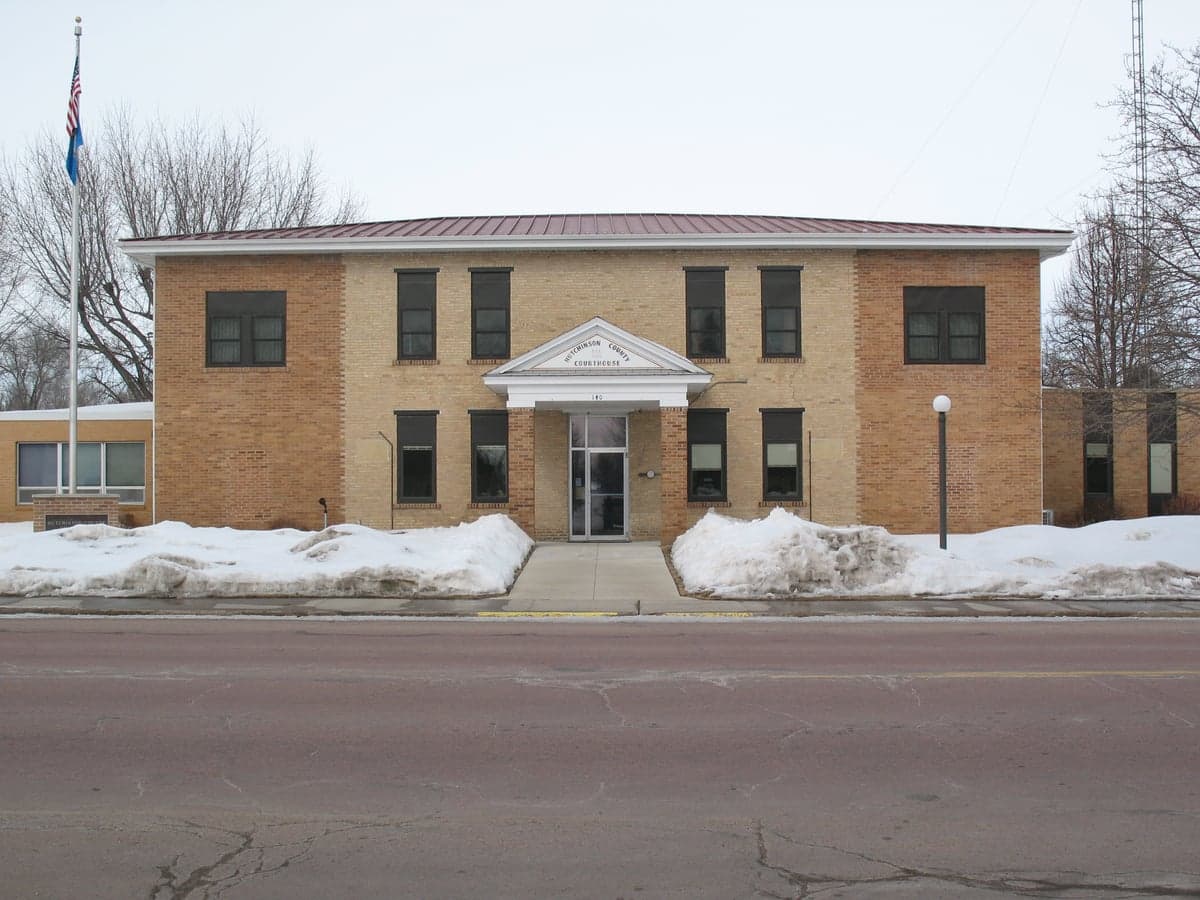
Photo: Wikipedia
Demographics of Hutchinson County
Affluence Level in Hutchinson County
A middle-class area roughly in line with national averages across income, home values, education, and employment.
People of Hutchinson County
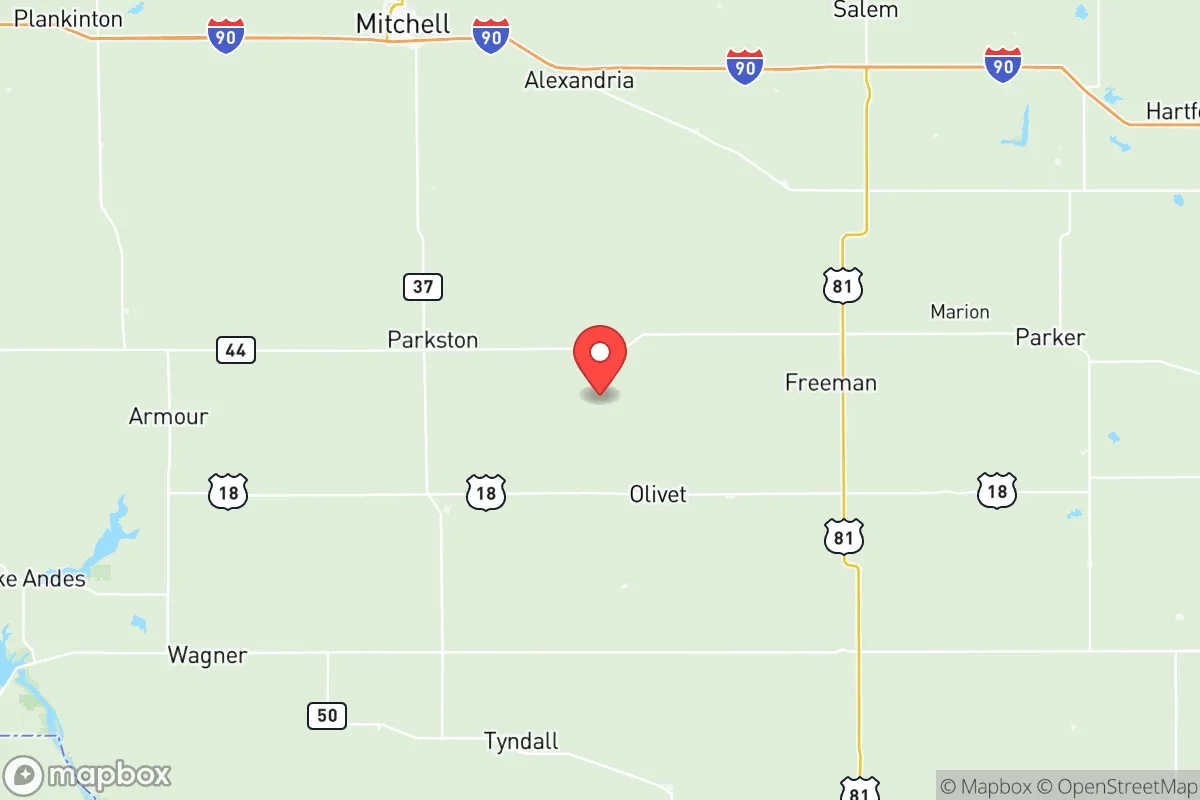
The people of Hutchinson County, South Dakota, today form a remarkably stable, predominantly white, and aging population of 7,393, concentrated in small towns like Parkston, Freeman, Menno, Tripp, and the county seat of Olivet. With a foreign-born share of just 0.5% and a population that is 91.2% white and 2.6% Hispanic, the county retains a strong cultural identity rooted in its 19th-century immigrant founding, particularly from German-Russian and Czech communities. The area is characterized by a quiet, rural lifestyle, a strong work ethic tied to agriculture, and a social fabric woven through local churches, schools, and community events, making it a place where family history and local tradition run deep.
Settlement & growth (pre-1960)
Before American settlement, the land that is now Hutchinson County was part of the traditional territory of the Yankton Sioux (Nakota) people, who followed bison herds across the vast prairies. The area was ceded to the United States through a series of treaties in the mid-19th century, most notably the 1858 Treaty of Washington, which opened the region for white settlement. The first permanent American settlers arrived in the 1860s and 1870s, primarily of Yankee (English-descended) stock from the Upper Midwest, who established homesteads along the James River and founded the earliest towns like Olivet (the county seat, established 1872) and Milltown.
The defining demographic wave, however, came in the 1870s and 1880s with the arrival of German-Russian Mennonites. Fleeing religious persecution and military conscription in the Russian Empire, these families brought with them advanced dry-farming techniques and a strong communal ethos. They established the town of Freeman in 1879, which quickly became the cultural and religious heart of the Mennonite community in the region. The town of Menno, founded in 1881, was also named in their honor and became another key settlement. Simultaneously, Czech (Bohemian) immigrants, drawn by the promise of cheap, fertile land, began arriving in the 1880s, settling primarily around Tabor and Tyndall (just south of the county line), with a significant concentration in the area that became Kaylor. These groups were followed by smaller numbers of German Catholics and Lutherans from the Volga region, who founded Parkston in the 1880s. The railroad's arrival in the 1880s and 1890s spurred further growth, connecting these agricultural communities to national markets. The population peaked at around 12,000 in the 1910s and 1920s, sustained by a thriving farm economy and large families, before the Great Depression and the mechanization of agriculture began a long, slow decline.
Modern era (post-1965)
The post-1965 era, marked nationally by the Hart-Cellar Act, had a negligible direct impact on Hutchinson County's demographics. The county's foreign-born population remains minuscule at 0.5%, and there are no significant immigrant enclaves from the new waves of Asian, Latin American, or African immigration that reshaped urban America. Instead, the dominant demographic story of the last 60 years has been out-migration and aging in place. Young adults, seeking educational and employment opportunities beyond agriculture, have steadily left for larger cities like Sioux Falls and Yankton, as well as out of state. This has led to a population decline from roughly 9,000 in 1970 to the current 7,393. The county's racial composition has remained extraordinarily stable, with the white population share holding above 90%. The small Hispanic population (2.6%) is a recent and modest development, largely consisting of families working in agricultural processing and livestock operations, with a small concentration in Parkston and Freeman. The East/Southeast Asian (0.3%) and Indian subcontinent (0.1%) populations are negligible, likely tied to a handful of professionals in healthcare or education. The most significant cultural shift has been internal: the gradual consolidation of Lutheran and Catholic parishes, the closure of some small-town schools, and the strengthening of a few regional hubs like Freeman and Parkston as service centers, even as the most remote hamlets like Clayton and Milltown have dwindled to near-ghost towns.
The future
Hutchinson County's population is projected to continue its slow decline, with the median age (already over 45) rising further. The county is becoming less diverse in terms of age and economic activity, even as its racial makeup remains static. The small Hispanic population may grow incrementally as agricultural labor demands persist, but the county lacks the economic dynamism to attract large numbers of new domestic or international migrants. The cultural identity is likely to become even more strongly defined by its German-Russian and Czech heritage, preserved in local museums, annual festivals like Schmeckfest in Freeman, and the continued use of the Plautdietsch dialect among older Mennonites. The next 10-20 years will likely see further consolidation of schools and services into Freeman and Parkston, while the smallest towns face existential questions about their viability. For a newcomer, this is a place that offers deep roots, safety, and community, but also limited economic opportunity and a very homogenous social environment.
Hutchinson County is becoming a quieter, older, and more culturally insular version of itself, a place where the past is deeply present and the future is one of gentle contraction rather than transformation. For someone moving in now, it offers a stable, safe, and deeply rooted community life, but one that requires a willingness to integrate into a tight-knit, culturally specific world with limited economic diversity and a population that is slowly shrinking.

* Values derived from national, state, county, city and local statistics and may differ in a specific area. Last updated: 2026-07-17T16:34:51.000Z
Narrative content on this page is AI-generated and may contain mistakes. Verify any details that matter before acting on them.
ReloMaps may earn a commission from affiliate links at no extra cost to you.

