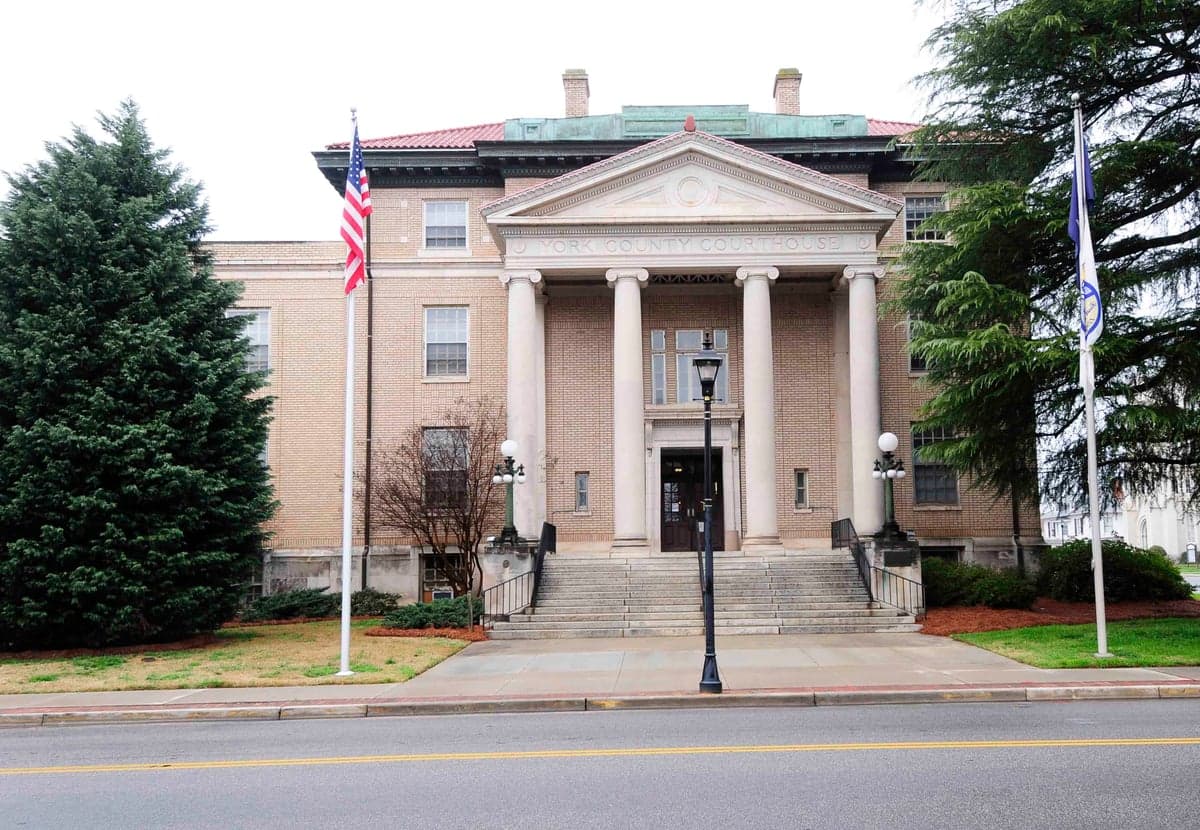
Photo: Wikipedia
Political ClimatePolitical Climate in York County
Showing district-level results — no local-only data available.
Local Political AnalysisPolitical Analysis of York County
York County has a solidly Republican political lean, with a Cook PVI of R+11, making it noticeably more conservative than South Carolina as a whole, which sits at R+8. But that county-wide number hides a more interesting local reality: the political landscape is shifting fast, especially in the northern part of the county, as Charlotte's suburban sprawl pushes south across the state line. The old guard of rural conservatism still holds firm in places like Hickory Grove and Sharon, but the fast-growing towns of Fort Mill, Tega Cay, and Lake Wylie are becoming more politically mixed, with a growing number of Democratic-leaning precincts that would have been unthinkable a decade ago.
How it compares
Compared to the rest of South Carolina, York County is both more Republican and more politically dynamic. The state's R+8 rating reflects a reliably red electorate, but York County's R+11 is driven by the deeply conservative rural and exurban areas in the southern and western parts of the county. However, the real story is the divergence within the county itself. Fort Mill and Tega Cay now have several precincts that lean Democratic or are true swing areas, particularly around the Baxter and Springfield neighborhoods, where transplants from the Northeast and Midwest have settled. Meanwhile, Rock Hill, the county's largest city, is a genuine battleground: its downtown and college-adjacent precincts near Winthrop University vote blue, while the outer edges of the city vote red. York, Clover, and the rural towns remain deeply Republican, often voting 65-70% for GOP candidates. This internal split means York County's overall R+11 rating is a composite of two very different political worlds.
What this means for residents
For conservative residents, the county remains a comfortable place politically. Local offices, from the county council to the school board, are dominated by Republicans, and the tax and regulatory environment reflects that. For liberal residents, the picture is more nuanced. You can find like-minded neighbors in Fort Mill's newer subdivisions or in Rock Hill's Old Town, and the proximity to Charlotte means access to a much more liberal city just 20 minutes away. But at the county level, progressive policy priorities rarely gain traction. The practical effect is that property taxes remain relatively low compared to Mecklenburg County, NC, but public services and infrastructure spending often lag behind the pace of population growth, a common tension in fast-growing red suburbs.
Culturally, York County still feels distinctly Southern in its small towns and rural areas, but the northern suburbs are increasingly a blend of Southern tradition and Charlotte's corporate transplant culture. You'll see Trump signs next to Harris signs in Fort Mill, and the local school board meetings have become flashpoints over curriculum and library books, mirroring national divides. The county's trajectory is toward more political competition over the next decade, especially if growth continues in the northern corridor. For now, it's a place where the Republican majority is real but no longer monolithic, and where the old political certainties are slowly giving way to a more contested future.

State Political ClimatePolitical Climate in South Carolina
State Political AnalysisPolitical Environment in the State
South Carolina has been a reliably Republican state for a generation, with a Cook Partisan Voting Index of R+8, meaning it votes about eight points more Republican than the nation as a whole. The dominant coalition is a mix of traditional conservatives in the Upstate and Lowcountry, evangelical voters in the Midlands and Pee Dee, and a growing but still outnumbered Democratic base concentrated in the urban corridor from Charleston to Columbia to Greenville. Over the last 20 years, the state has shifted rightward in presidential races — George W. Bush won by 17 points in 2004, while Donald Trump carried it by 12 in 2016 and by 11 in 2020 — but the margin has tightened slightly as the suburbs of Charleston and Greenville have grown more diverse and professional. The state legislature, however, remains deeply Republican, with supermajorities in both chambers that have only grown more conservative over the past decade.
Urban vs. rural divide
The political map of South Carolina is a textbook study in the urban-rural split. The state's three major metros — Charleston, Columbia, and Greenville — are the only places where Democrats can compete. Charleston County has trended blue for a decade, driven by the city's tourism economy, port growth, and an influx of out-of-state professionals; it voted for Joe Biden by 14 points in 2020. Richland County, home to Columbia and the state's largest public university, is similarly Democratic, voting Biden by 18 points. Greenville County, once a Republican stronghold, has become a battleground: the city of Greenville itself is now reliably Democratic, while the surrounding suburbs and exurbs remain deeply red. Outside these three metros, the state is overwhelmingly Republican. The Pee Dee region around Florence and Myrtle Beach, the Lowcountry counties like Beaufort and Hilton Head, and the entire Upstate outside Greenville — places like Spartanburg, Anderson, and Easley — routinely vote 60-70% Republican. The rural Black Belt counties in the Lowcountry, such as Allendale and Williamsburg, are Democratic but have shrinking populations, limiting their statewide influence.
Policy environment
South Carolina's policy environment is shaped by a Republican supermajority that prioritizes low taxes, limited regulation, and conservative social policy. The state has a flat income tax rate of 6.4%, which is being phased down to 6.0% by 2026, and no state property tax on vehicles or business inventory. Sales tax is 6% at the state level, with local options that can push it to 9% in some counties. There is no statewide property tax on primary residences; instead, school funding comes from a mix of local millage and state appropriations. Education policy has been a flashpoint: the state passed a universal school voucher program in 2023, allowing any family to use public funds for private or homeschool expenses, and it has one of the strongest charter school laws in the Southeast. On healthcare, South Carolina did not expand Medicaid under the Affordable Care Act, leaving roughly 200,000 low-income adults in the coverage gap. Election laws have tightened: the state requires photo ID to vote, has restricted absentee ballot drop boxes, and passed a law in 2021 that limits early voting hours and prohibits unsolicited mail-in ballot applications. Abortion is banned after six weeks, with no exceptions for rape or incest, following the state's 2023 "Fetal Heartbeat Act."
Recent policy direction
The last three years have seen South Carolina's legislature move aggressively on several fronts that relocators should weigh carefully. On gun and self-defense law, the state became a "constitutional carry" state in 2024, allowing permitless carry of concealed handguns for anyone 18 or older who can legally possess a firearm. On parental and education rights, the 2023 school voucher law (the "Education Scholarship Trust Fund") is the most expansive in the South, and a 2022 law requires schools to post all instructional materials online for parental review. On speech and privacy, the state has no broad shield law for journalists, and a 2023 law restricts the teaching of "divisive concepts" in public schools and state agencies, though it has been challenged in court. On medical and bodily autonomy, the six-week abortion ban is among the strictest in the country, and the state has not expanded Medicaid or legalized medical marijuana despite repeated legislative efforts. On property rights, South Carolina is a "Dillon's Rule" state, meaning local governments have only the powers explicitly granted by the state, which limits local zoning and rent control ordinances. On taxation, the income tax rate is being cut from 7% to 6% over five years, and the state has no estate or inheritance tax. On voting and ballot access, the 2021 "Election Integrity Act" shortened the absentee ballot application window, banned ballot harvesting, and required a witness signature for mail-in ballots.
Civil unrest & political movements
South Carolina has a history of political activism that ranges from the Tea Party movement of the early 2010s to the Black Lives Matter protests of 2020. The state saw significant protests in Charleston and Columbia after the murder of George Floyd, with some demonstrations turning confrontational but largely remaining peaceful. The Confederate flag was removed from the Statehouse grounds in 2015 after the Charleston church shooting, a moment that still defines the state's modern political identity. On the right, the "Moms for Liberty" movement has been active in school board races in Lexington and Greenville counties, pushing for book bans and curriculum transparency. On immigration, South Carolina is not a sanctuary state; a 2011 law (the "South Carolina Illegal Immigration Reform Act") requires law enforcement to check immigration status during traffic stops and penalizes businesses that hire undocumented workers. There has been no serious secession or nullification rhetoric in recent years, though some local GOP parties have passed resolutions asserting state sovereignty over federal mandates. Election integrity remains a live issue: the 2020 election results were certified without major controversy, but the 2021 voting law was passed in response to widespread Republican voter concerns. A new resident would notice that political yard signs and bumper stickers are common, especially in rural areas, and that local politics — particularly school board and county council races — can be surprisingly intense.
Projection
Over the next 5-10 years, South Carolina is likely to remain a solidly Republican state, but the margins will continue to tighten in the urban and suburban corridors. The biggest demographic shift is the influx of out-of-state residents, particularly to the Charleston and Greenville metros, many of whom are younger, more educated, and more moderate than the native population. If this trend continues, Charleston County could become reliably Democratic, and Greenville County could become a true swing county by 2030. However, the rural and exurban areas are growing too, driven by retirees and remote workers moving to places like Bluffton, Simpsonville, and Fort Mill, and these newcomers tend to be conservative. The state legislature is unlikely to flip anytime soon due to gerrymandering and the concentration of Democratic voters in a few urban districts. On policy, expect continued movement on school choice, tax cuts, and gun rights, with no major shift on abortion or Medicaid expansion unless the political calculus changes dramatically. A relocator moving in now should expect a state that is culturally conservative, fiscally restrained, and politically stable, but with a growing urban-liberal minority that will keep the culture wars alive in local elections.
For a new resident, the practical takeaway is straightforward: if you are conservative, you will find South Carolina's political climate welcoming, with low taxes, strong gun rights, and a legislature that shares your values. If you are liberal, you will find a state where your vote matters most in Charleston, Columbia, or Greenville city limits, but where state-level policy will often feel hostile to your priorities. Either way, the state's politics are stable, predictable, and unlikely to surprise you — which is exactly what many relocators are looking for.
* Values derived from national, state, county, city and local statistics and may differ in a specific area. Last updated: 2026-07-11T22:06:03.000Z
Narrative content on this page is AI-generated and may contain mistakes. Verify any details that matter before acting on them.
ReloMaps may earn a commission from affiliate links at no extra cost to you.

