
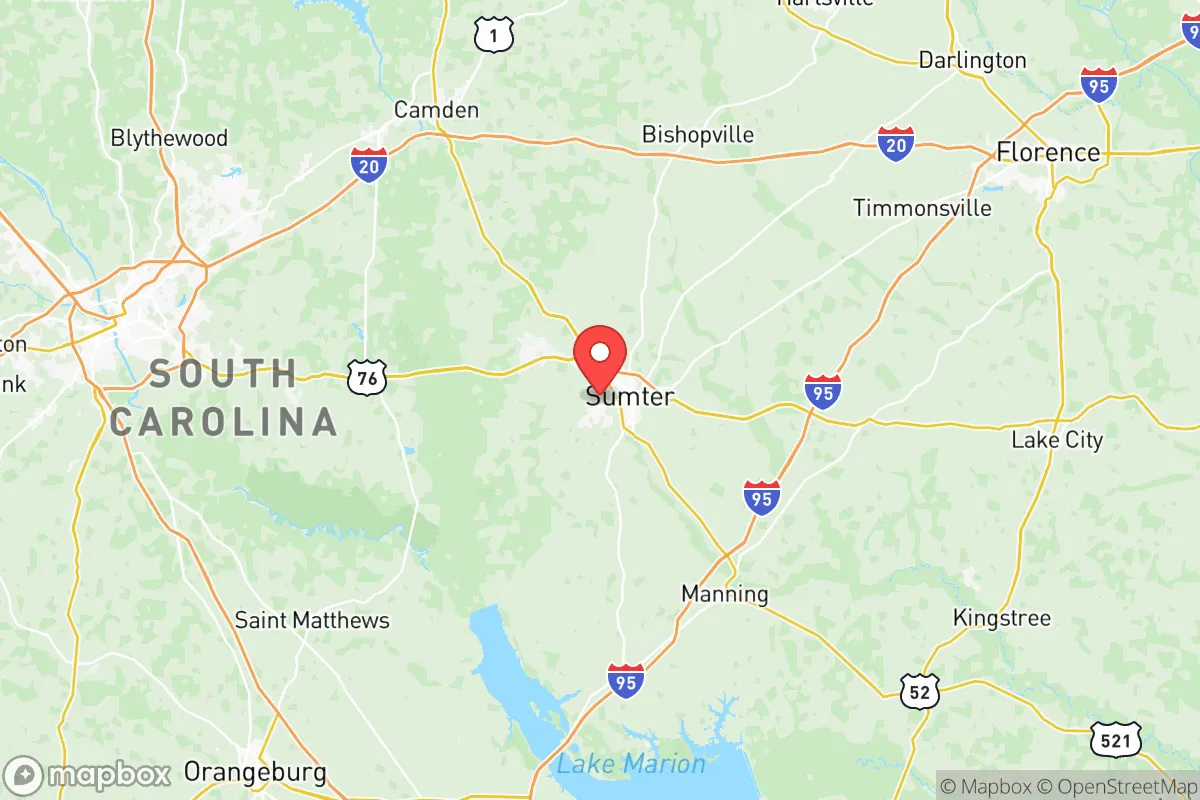
Photo: Wikipedia
Personal Sovereignty in Sumter County
Viable for self-reliance. Generally workable, though some barriers may limit total independence.
What does Personal Sovereignty tell us?
Personal Sovereignty measures your capacity for self-reliance and independence with minimal government friction. Higher scores mean fewer barriers between you and the way you want to live... but it assumes you have the space you need and good neighbors.
What does this tell us?
Personal Sovereignty measures your capacity for self-reliance and independence with minimal government friction. Higher scores mean fewer barriers between you and the way you want to live... but it assumes you have the space you need and good neighbors.
State Policy
Energy independence: Importer (25% of energy produced in-state)
Personal Liberty
Homesteading

Personal Liberty Analysis
Sumter County, South Carolina, offers a notably light-touch environment for personal sovereignty, where state-level preemption laws and a low tax burden create a foundation for individual autonomy that stands out even within the generally freedom-oriented Southeast. The county’s regulatory posture is distinctly hands-off compared to urbanized coastal areas, with local governance in places like Sumter city, Dalzell, and Stateburg generally deferring to state statutes on firearms, property use, and taxation. For a relocation-minded individual or family prioritizing self-reliance, the area presents a practical balance of low interference and accessible land, though the degree of autonomy varies noticeably between the more developed Sumter city limits and the unincorporated stretches near Wedgefield and Mayesville.
Tax burden and regulatory posture for residents and property owners
South Carolina’s tax structure is among the most favorable in the nation for those seeking to minimize government extraction, and Sumter County residents benefit directly. There is no state tax on Social Security benefits, and the state offers a $3,000 deduction on other retirement income for those over 65, with military retirement income fully exempt. The state income tax rate is a flat 6.2% as of 2026, but property taxes are the real draw: the effective property tax rate in Sumter County hovers around 0.55% of assessed value, roughly half the national average. The county’s millage rate is set by local council, but state law caps annual assessment increases on owner-occupied homes at 15% over a five-year period, providing predictability. Regulatory posture is similarly restrained. Sumter County has no county-wide zoning in unincorporated areas, meaning property owners in places like Wedgefield and rural stretches near Lynchburg can build, fence, and operate small-scale enterprises without the permitting layers common in more regulated jurisdictions. The city of Sumter itself does enforce a unified development ordinance, but it is considered moderate—focused on subdivision standards and commercial setbacks rather than micromanaging residential property use. For a homesteader or small-scale entrepreneur, the path of least resistance lies outside the city limits, where county oversight is minimal and the state’s right-to-farm law provides additional protection against nuisance complaints from later arrivals.
Self-defense and gun law specifics in Sumter County
South Carolina is a “shall-issue” state for concealed weapons permits, and Sumter County’s sheriff’s office processes applications with a typical turnaround of 30 to 60 days. The state does not require a permit to openly carry a firearm, and as of 2024, permitless (constitutional) carry is legal for anyone 18 or older who can legally possess a firearm. Sumter County’s local culture strongly supports these rights; the sheriff’s office has publicly stated it will not enforce any federal firearms regulations it deems unconstitutional, a stance shared by many rural South Carolina counties. Stand-your-ground laws apply statewide, with no duty to retreat in any place where the individual is lawfully present. For those living in unincorporated areas like Dalzell or Stateburg, discharging a firearm on private property is generally unrestricted, provided the shot does not cross property lines or violate local noise ordinances after dark. Within Sumter city limits, discharging a firearm is prohibited except at approved ranges, but the city’s boundaries are compact, and most residents with acreage live outside them. The practical effect is that a gun owner in rural Sumter County faces fewer legal constraints than in any major metropolitan area in the Southeast, with the county’s gun-friendly culture reinforced by multiple local gun shops and a well-attended annual gun show at the Sumter County Civic Center.
Self-reliance and homesteading viability: lot sizes, zoning, and off-grid feasibility
Sumter County’s land-use policies make it one of the more viable places in South Carolina for a self-reliant lifestyle. In unincorporated areas, there is no minimum lot size for residential use, though the county’s health department requires a minimum of one acre for a septic system. This effectively sets a practical floor of about one acre for off-grid or semi-off-grid living. Many parcels in the Wedgefield and Mayesville areas are available in 2-to-10-acre tracts, with prices ranging from $3,000 to $8,000 per acre as of 2026—significantly cheaper than the Midlands suburbs around Columbia. Zoning is essentially absent outside city limits: there are no restrictions on keeping chickens, goats, or even larger livestock on residential property, and no county-level ban on rainwater collection or composting toilets. Off-grid solar is legally straightforward; South Carolina has no statewide net-metering mandate that would require utility interconnection, but it also does not prohibit standalone systems. The main practical hurdle is well-drilling, which costs $5,000 to $12,000 depending on depth, but water tables in the county are generally reliable at 100 to 300 feet. For those seeking a more developed homesteading community, the area around Stateburg offers several rural subdivisions with covenants that allow livestock and gardens, while the truly independent will find the least interference in the far eastern part of the county near Lynchburg, where population density drops below 20 people per square mile.
Personal liberties: parental rights, medical autonomy, speech, and property
South Carolina’s legal framework in Sumter County tilts strongly toward individual discretion in several key areas. Parental rights are explicitly protected under state law, with a 2023 statute affirming that parents have the fundamental right to direct the upbringing, education, and healthcare of their minor children. This includes the ability to opt children out of any school curriculum or activity without penalty, and Sumter County School District has a formal policy honoring such requests. Medical autonomy is more constrained: South Carolina does not have a broad medical freedom law, and vaccine mandates for school attendance remain in place for standard childhood immunizations, though philosophical exemptions are available. The state’s emergency powers were reformed in 2022 to limit a governor’s ability to shut down businesses or mandate medical procedures without legislative approval, a change that directly affects how Sumter County would handle any future public health orders. Free speech protections are robust, with no county-level ordinances restricting signage, political expression, or public assembly beyond standard time-place-manner rules. Property rights are strongly protected by South Carolina’s “private property rights” act, which requires governments to prove a compelling interest before restricting land use, and Sumter County has not enacted any rental moratoriums or rent control measures. For a family seeking to live without excessive government oversight in daily decisions, the county’s legal climate is permissive, though it stops short of the full libertarian framework found in some Western states.
Overall, Sumter County offers a level of personal sovereignty that is high for the Southeast but moderate by national standards—stronger than any urban county in the Northeast or West Coast, but with fewer explicit protections than states like New Hampshire or Idaho. The combination of low property taxes, constitutional carry, minimal rural zoning, and strong parental rights creates a practical environment where self-reliance is not just tolerated but structurally supported. For a conservative-leaning individual or family weighing relocation, the county’s chief advantage is its predictability: the legal framework is stable, the culture is consistently freedom-oriented, and the cost of entry for land and housing remains low enough that financial independence is achievable without requiring high income. The trade-off is that Sumter County is not a legal frontier—it operates within a state that has a sales tax on groceries and standard building codes for new construction—but for most people prioritizing autonomy, it represents a solid, low-friction baseline from which to build a self-directed life.

* Values derived from national, state, county, city and local statistics and may differ in a specific area. Last updated: 2026-06-29T05:52:45.000Z
Narrative content on this page is AI-generated and may contain mistakes. Verify any details that matter before acting on them.
ReloMaps may earn a commission from affiliate links at no extra cost to you.

