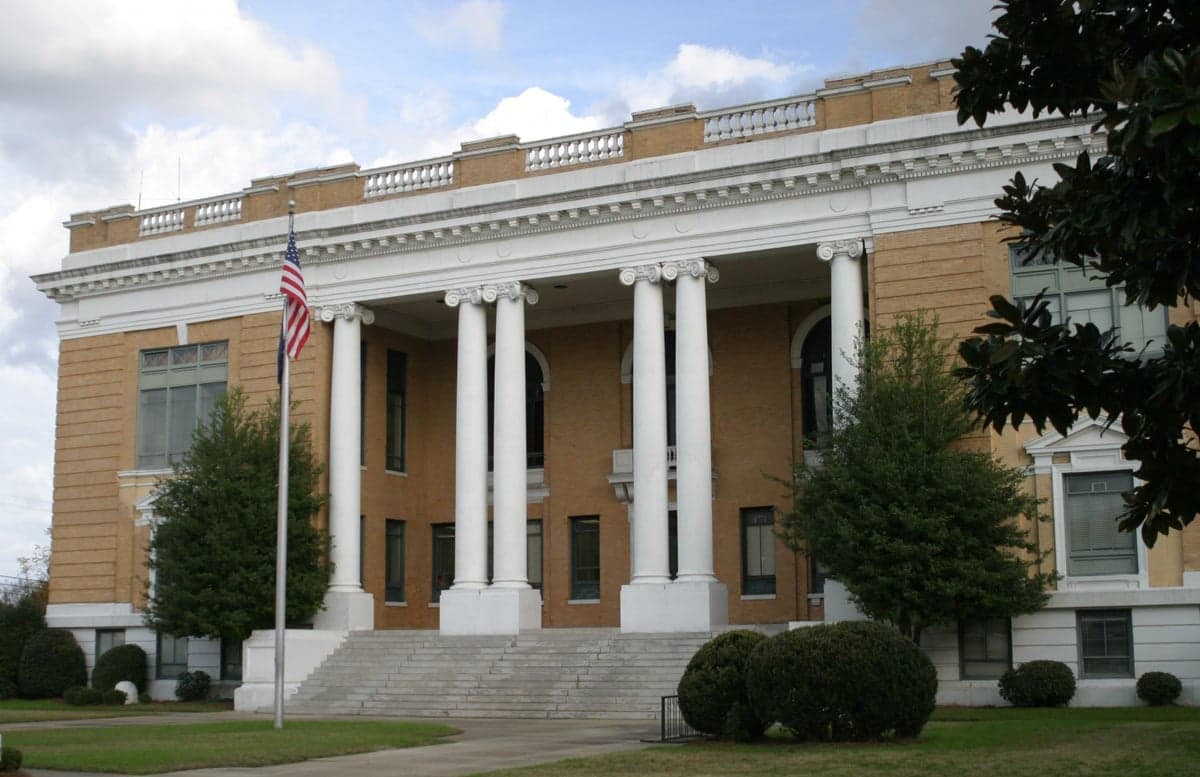
Photo: Wikipedia
Demographics of Sumter County
Affluence Level in Sumter County
A below-average socioeconomic profile. Incomes, home values, and educational attainment trail the U.S., with higher poverty and unemployment.
People of Sumter County
Today, Sumter County, South Carolina, is home to roughly 104,853 residents, a population that is nearly evenly split between Black (46.0%) and White (44.0%) communities, with a small but growing Hispanic presence at 4.3%. The county’s identity is shaped by its deep-rooted military connection to Shaw Air Force Base, a strong sense of Southern tradition, and a population density that feels both small-town and suburban. With a foreign-born rate of just 1.1% and a college-educated share of 23.2%, Sumter County remains a predominantly native-born, working-to-middle-class area where family and faith are central to daily life.
Settlement & growth (pre-1960)
The land that is now Sumter County was originally inhabited by the Wateree and Congaree Native American tribes, who lived along the Santee River and its tributaries. European contact began in the late 1600s with English traders and settlers pushing inland from Charleston, but permanent settlement did not accelerate until the mid-1700s. The area was part of the British colony of South Carolina, and the first major wave of European settlers were Scots-Irish and English farmers who moved south from Virginia and North Carolina along the fall line. They were drawn by the promise of fertile, low-cost land for tobacco and later cotton cultivation. These early settlers founded the community of Stateburg in the 1780s, which became a key crossroads and the county’s first significant settlement. By the early 1800s, the town of Sumter (originally called Sumterville) was established as the county seat, named for Revolutionary War hero General Thomas Sumter.
The antebellum period saw the rise of a plantation economy based on cotton, which brought a forced migration of enslaved Africans. By 1860, the majority of the county’s population was enslaved Black laborers working on large plantations. The Civil War and Reconstruction dramatically reshaped the county’s demographics. After emancipation, many freed Black families remained in the area as sharecroppers and tenant farmers, establishing independent communities such as Rembert and Dalzell, where descendants still live today. The post-Reconstruction era saw the imposition of Jim Crow laws, which entrenched racial segregation and limited economic mobility for Black residents.
The late 19th and early 20th centuries brought a new wave of domestic migration: white farmers from the Piedmont and Appalachia moved into the county, drawn by the expansion of the railroad and the timber industry. The town of Mayesville grew as a railroad stop and agricultural hub. The Great Depression hit the cotton-dependent economy hard, but World War II brought a transformative event: the establishment of Shaw Army Airfield (now Shaw Air Force Base) in 1941. This military installation became the county’s largest employer and a major driver of in-migration, bringing military personnel and their families from across the United States. The base’s presence also spurred the growth of suburbs around Sumter and Bishopville (though Bishopville is in neighboring Lee County). By 1960, Sumter County’s population was roughly 45% Black and 55% White, with a small number of Asian and Hispanic residents tied to the military.
Modern era (post-1965)
The 1965 Hart-Cellar Act had a minimal direct impact on Sumter County, as the area did not attract significant international immigration. The foreign-born population remains very low at 1.1%, far below the national average. Instead, the county’s modern demographic story is one of domestic migration and suburbanization. The desegregation of schools and public accommodations in the 1960s and 1970s led to gradual integration, though residential patterns remain somewhat divided, with many Black families concentrated in the city of Sumter’s historic neighborhoods and white families more prevalent in outlying areas like Lakewood and Millwood.
The most significant post-1965 shift has been the growth of the Hispanic population, which rose from negligible levels in 1990 to 4.3% today. This growth is driven by Mexican and Central American immigrants who came for work in agriculture (particularly poultry processing and produce farming) and construction. The Hispanic community is dispersed across the county but has a visible presence in the city of Sumter and in rural areas around Horatio and Pinewood. The East/Southeast Asian population (1.3%) is almost entirely tied to Shaw Air Force Base, with military families from the Philippines, Korea, and Vietnam rotating through the base. The Indian subcontinent population is negligible at 0.1%.
Suburbanization accelerated after 1980, with new subdivisions and shopping centers spreading along U.S. Highway 76 and U.S. Highway 521. The city of Sumter’s population has remained stable, while unincorporated areas have grown. The county’s Black population share has slightly increased from 45% in 1960 to 46% today, while the white share has declined from 55% to 44%, largely due to the influx of Hispanic residents and a slight out-migration of white families to faster-growing areas like Columbia and Charleston. The college-educated share of 23.2% reflects the presence of Shaw Air Force Base (which attracts officers with degrees) and Morris College, a historically Black college in Sumter, but remains below the national average.
The future
Sumter County’s population is projected to grow slowly, likely reaching 110,000–115,000 by 2040. The Hispanic share is expected to continue rising, potentially reaching 8–10%, as younger Hispanic families have higher birth rates and continued labor demand in agriculture and construction. The Black and White shares will likely converge further, with both groups declining slightly as a percentage of the total. The East/Southeast Asian population will remain tied to Shaw Air Force Base and will fluctuate with base deployments. The county is not expected to see significant new international immigration from other regions.
The cultural identity of Sumter County is evolving slowly. The military presence ensures a steady stream of newcomers from other parts of the U.S., which brings some diversity of thought and experience, but the county remains deeply rooted in Southern evangelical Christianity and conservative values. The growing Hispanic community is integrating into local churches and schools, and Spanish-language services are becoming more common. The county’s racial dynamics, while historically tense, have become more cooperative in recent decades, with shared civic institutions like the Sumter County Museum and the annual Sumter Iris Festival drawing participation across groups.
For someone moving in now, Sumter County offers a stable, affordable, and family-oriented environment with a strong military community and a slower pace of life. The population is becoming slightly more diverse, but the core character—native-born, religious, and politically conservative—is likely to persist. The county is not a destination for rapid growth or cosmopolitan change, but rather a place where tradition and community remain central, and where new residents are expected to adapt to established local norms.

* Values derived from national, state, county, city and local statistics and may differ in a specific area. Last updated: 2026-06-29T05:52:45.000Z
Narrative content on this page is AI-generated and may contain mistakes. Verify any details that matter before acting on them.
ReloMaps may earn a commission from affiliate links at no extra cost to you.

