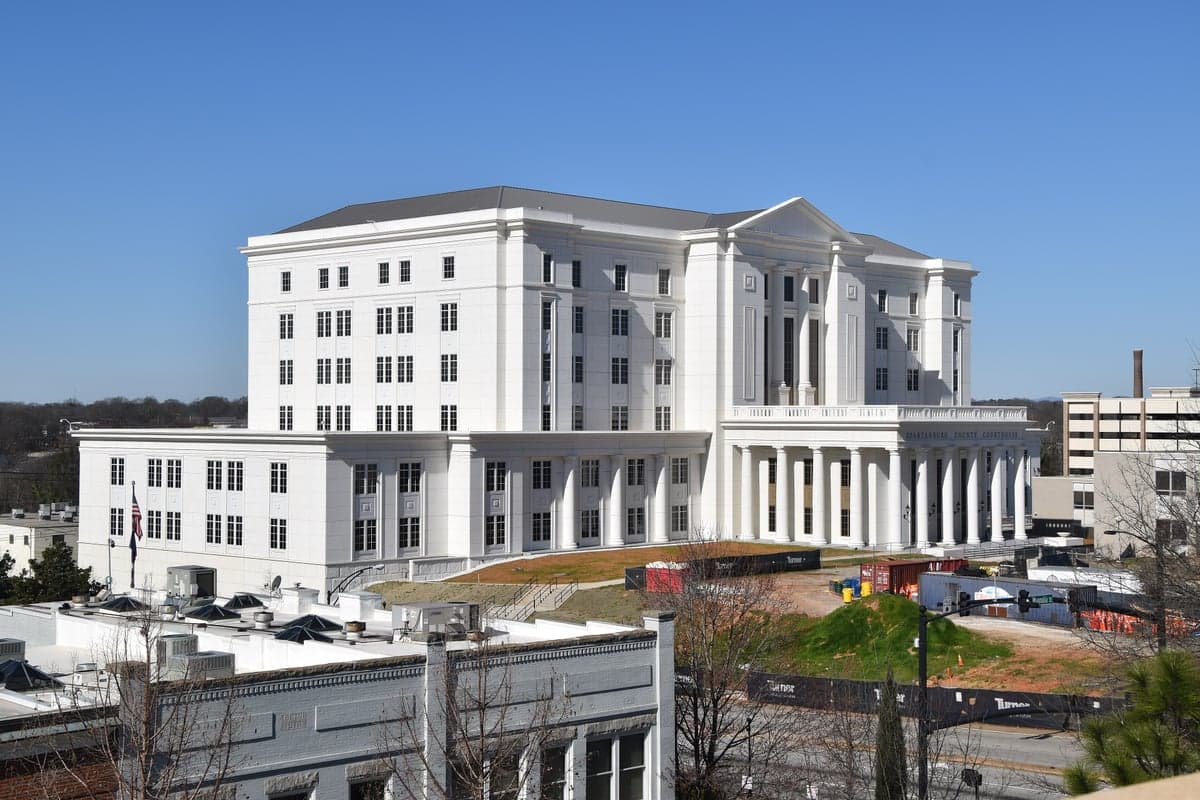
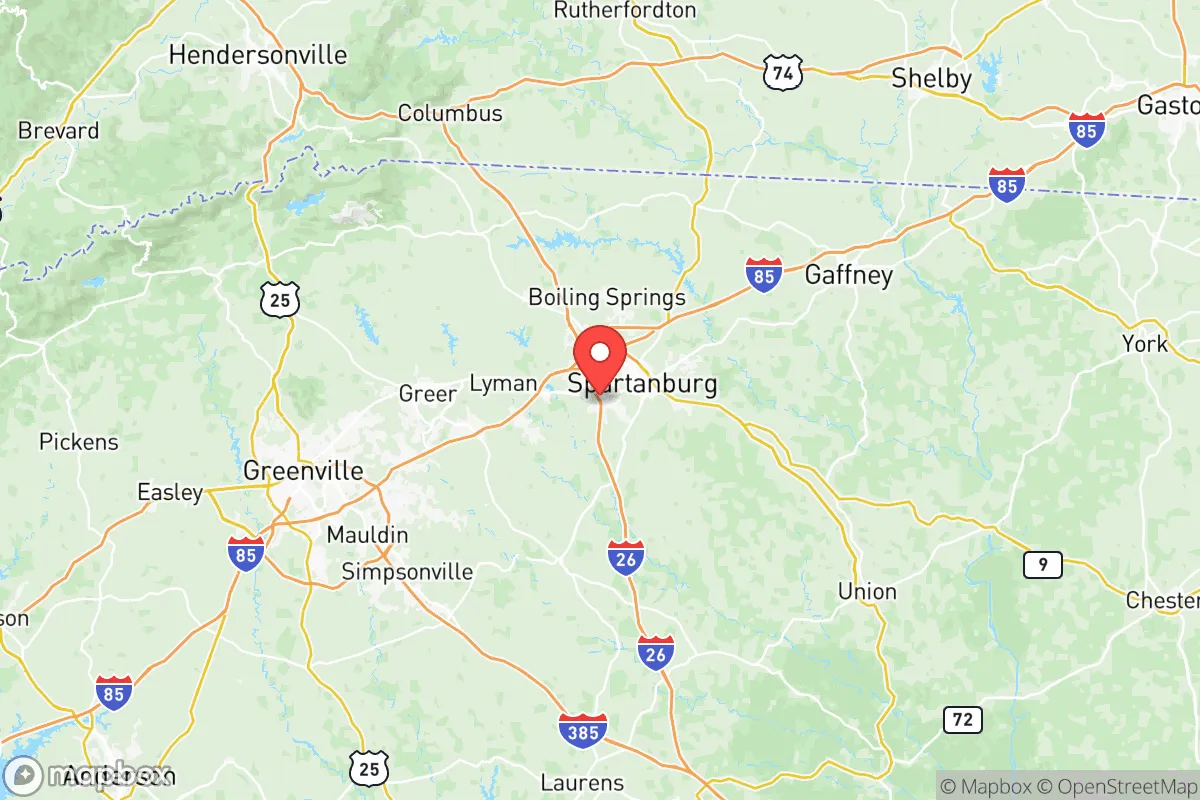
Photo: Wikipedia
Political ClimatePolitical Climate in Spartanburg County
Showing county-level results — no local-only data available.
Lean and PVI are calculated from this county’s 2020 and 2024 presidential results, Cook-style.
Political rankings in South Carolina
- Most Conservative Cities in South Carolina
- Most Liberal Cities in South Carolina
- Best Liberal-Leaning Towns in the South
- Best Liberal-Leaning Towns in the Deep South
- Safest Liberal-Leaning Towns in the South
- Safest Conservative-Leaning Towns in the South
- Safest Conservative-Leaning Towns on the East Coast
- Affordable Small Towns for Conservatives
- Most Conservative Counties in South Carolina
- Most Liberal Counties in South Carolina
Local Political AnalysisPolitical Analysis of Spartanburg County
Spartanburg County is a solidly Republican stronghold with a Cook PVI of R+16, making it significantly more conservative than South Carolina as a whole, which sits at R+8. This isn't a purple county trending blue; it's a deep-red area that has actually been shifting rightward in recent cycles, driven by rapid growth in the suburban and exurban corridors around the City of Spartanburg. While the county reliably delivers 60-65% of its vote to GOP candidates, the picture is more nuanced when you zoom in on individual towns and precincts.
How it compares to South Carolina
The R+16 rating means Spartanburg County votes about 8 points more Republican than the state average. To put that in perspective, while South Carolina as a whole is a safe red state, Spartanburg County is in the same conservative tier as places like Greenville or Oconee counties. The difference is driven by the explosive growth of the I-85 corridor between Greenville and Spartanburg, where new subdivisions and industrial parks (think BMW, Michelin, and the emerging "Inland Port" logistics hub) are attracting a largely conservative, family-oriented workforce. The state's R+8 rating includes the deep-blue pockets of Richland County (Columbia) and Charleston, which Spartanburg County simply doesn't have. The closest thing to a blue dot here is the City of Spartanburg proper, where precincts around Converse College and Wofford College can swing Democratic, but those votes are easily overwhelmed by the surrounding towns.
What this means for residents
For conservative residents, the political climate is highly comfortable. Local offices—from the County Council to the Sheriff's office—are dominated by Republicans, and policy tends to reflect that: low property taxes, limited zoning, and a pro-business regulatory environment. The local GOP is active and well-organized, with strong turnout in places like Boiling Springs, Duncan, and Lyman. For liberal residents, the reality is more about finding community in specific pockets. The City of Spartanburg itself, particularly the Hampton Heights and Converse Heights neighborhoods, offers a more progressive social environment, with a growing arts scene and walkable downtown. However, statewide issues like abortion access and gun laws are largely settled in a conservative direction, and local Democratic candidates rarely win countywide races. The practical effect is that political conversations tend to be less polarized than in swing states—most people agree on the basics, and the disagreements are more about pace and priority than fundamental direction.
Culturally, Spartanburg County has a distinct identity that blends old-school Southern conservatism with a newer, corporate-driven pragmatism. The influence of the BMW plant in Greer and the Michelin North America headquarters in Greenville County has created a workforce that values economic growth and infrastructure investment, even if it means some tax increases for roads and schools. This puts the county slightly to the left of more rural, agrarian counties like Union or Cherokee on issues like public spending. You'll find a strong evangelical Christian presence, but also a growing number of secular professionals drawn by the low cost of living and job opportunities. The biggest cultural distinction is the tension between the old mill-village communities—places like Inman and Chesnee, where family roots go back generations—and the new subdivisions filling up with transplants from Ohio, Michigan, and New York. That dynamic, more than any single policy debate, defines the local political conversation today.

State Political ClimatePolitical Climate in South Carolina
State Political AnalysisPolitical Environment in the State
South Carolina is a solidly Republican state with a Cook PVI of R+8, meaning it typically votes about eight points more Republican than the national average. The dominant coalition is a blend of traditional conservatives, evangelical Christians, and a growing number of transplants from the Northeast and Midwest who are drawn by low taxes and a slower pace of life. Over the last 10-20 years, the state has shifted rightward, but not uniformly—the explosive growth of the Lowcountry and Upstate has introduced new suburban voters who are reliably Republican but less culturally tied to the old Southern Democratic roots that faded in the 1990s. The Democratic stronghold remains the urban core of Charleston, Columbia, and parts of the I-95 corridor, but those areas are increasingly outmatched by the fast-growing exurbs and coastal retirement communities.
Urban vs. rural divide
The political map of South Carolina is a textbook study in the urban-rural split. The state’s three major metros—Charleston, Columbia, and Greenville—each tell a different story. Charleston County, anchored by the city of Charleston itself, is the bluest urban area in the state, with Democrats winning countywide races by comfortable margins thanks to a coalition of college-educated professionals, service industry workers, and a significant African American population. But just a few miles north, in Mount Pleasant and Summerville, the vote flips hard red; these are classic suburban Republican strongholds where transplants from New York and Ohio settle for good schools and low crime. Columbia, home to the state capitol and the University of South Carolina, is more purple, with Richland County reliably Democratic and neighboring Lexington County one of the most Republican in the state. Greenville, the Upstate’s booming hub, has seen its city core trend younger and more moderate, but the surrounding counties—Pickens, Spartanburg, Anderson—are deeply conservative. The rural I-95 corridor, from Florence down to the Savannah River, is the poorest and most Democratic-leaning rural area, but its population is shrinking, while the coastal and Upstate growth areas are adding Republican voters fast. The net effect is a state that feels more Republican every cycle, even as its cities become more diverse and liberal.
Policy environment
South Carolina’s policy environment is defined by low taxes, limited government, and a strong cultural conservatism. The state has a flat income tax rate of 6.4% (with a scheduled phase-down to 6.0% by 2026), no estate tax, and a relatively low property tax burden—though local millage rates vary widely. Sales tax is 6% statewide, with local options pushing it higher in some counties. The regulatory posture is business-friendly: South Carolina is a right-to-work state, and its economic development agency, the Department of Commerce, aggressively courts manufacturing and corporate relocations. Education policy is a flashpoint: the state has a robust school choice movement, with a new Education Scholarship Trust Fund program (passed in 2023) that provides state-funded accounts for private school tuition, tutoring, and other educational expenses. Public school funding remains a perennial issue, with rural districts struggling against well-funded suburban systems. Healthcare policy is largely hands-off; the state did not expand Medicaid under the Affordable Care Act, leaving a coverage gap for low-income adults. Election laws have tightened in recent years: voter ID is required, absentee voting has been restricted, and the state has purged inactive voter rolls. On social issues, South Carolina is among the most conservative: abortion is banned after six weeks (with exceptions for rape, incest, and life of the mother), and the state has a strong "heartbeat" law that took effect in 2023 after the Dobbs decision.
Recent policy direction
The last five years have seen South Carolina move decisively in a conservative direction across nearly every policy dimension. On gun rights, the state enacted permitless carry (constitutional carry) in 2024, allowing any law-abiding adult to carry a concealed firearm without a permit. On education, the 2023 Education Scholarship Trust Fund program is the most significant expansion of school choice in state history, and the state has also passed laws requiring schools to post curriculum materials online and banning "critical race theory" in K-12 classrooms. Parental rights were strengthened with a 2023 law requiring schools to notify parents of any changes in a student's mental, emotional, or physical health—a measure critics say targets LGBTQ+ students. On property rights, the state has resisted eminent domain expansions and maintains strong protections for landowners. On voting, the 2021 Election Integrity Act tightened absentee ballot rules, shortened the early voting window, and banned ballot drop boxes. On medical and bodily autonomy, the six-week abortion ban is among the strictest in the Southeast, and the state has not moved to protect gender-affirming care for minors—in fact, a 2024 law bans such care for those under 18. On privacy and surveillance, the state has no comprehensive data privacy law, but it does have a law restricting the use of facial recognition by law enforcement without a warrant. The overall direction is clear: South Carolina is doubling down on cultural conservatism and economic liberty, with little appetite for the kind of libertarian or progressive reforms seen in other states.
Civil unrest & political movements
South Carolina has a history of civil rights activism, from the Orangeburg Massacre of 1968 to the 2015 Charleston church shooting that sparked the movement to remove the Confederate flag from the Statehouse grounds. In recent years, political movements have been quieter but persistent. The state saw significant Black Lives Matter protests in Charleston and Columbia in 2020, but they were smaller and less sustained than in many other states. On the right, the "constitutional sheriff" movement has a foothold in rural counties like Greenville and Spartanburg, where sheriffs have publicly refused to enforce certain gun control or COVID-19 mandates. Immigration politics are less heated than in border states, but there is a strong undercurrent of concern about illegal immigration, particularly in the construction and agriculture sectors. The state has no sanctuary cities; in fact, a 2011 law requires local law enforcement to cooperate with federal immigration authorities. Election integrity remains a live issue: the 2020 election was not contested in South Carolina (Trump won by 12 points), but the 2021 law tightening voting rules was driven by Republican concerns about fraud. A new resident would notice that political activism is less visible than in swing states—most people are polite, but the cultural divide between the coastal cities and the inland rural areas is real and occasionally surfaces in local debates over school boards, library books, and development.
Projection
Over the next 5-10 years, South Carolina is likely to become even more Republican, but with a shifting internal character. The biggest demographic driver is in-migration: the state is adding about 100,000 new residents per year, many of them retirees and remote workers from the Northeast and Midwest who are drawn by low taxes and warm weather. These newcomers tend to be fiscally conservative but socially moderate—they support school choice and low taxes, but they are less invested in the culture war issues that animate the native evangelical base. This could create a tension between the old guard and the new suburbanites, particularly in fast-growing areas like Greenville County and Beaufort County. The urban cores of Charleston and Columbia will continue to trend Democratic, but their growth is outpaced by the exurbs. The I-95 corridor will continue to lose population and political influence. The most likely outcome is a state that remains R+8 to R+10, with a Republican legislature that is increasingly dominated by suburban pragmatists rather than rural firebrands. A new resident moving in now should expect a state that is reliably conservative on taxes, guns, and abortion, but where the culture wars are fought more in school board meetings than in the statehouse.
For someone moving to South Carolina, the practical takeaway is straightforward: if you are conservative, you will find a state that largely aligns with your values on taxes, regulation, and social issues, with a government that is responsive to Republican priorities. If you are liberal, you will find a state where your vote is unlikely to change the outcome of statewide elections, but where you can live comfortably in Charleston, Columbia, or Greenville without feeling politically isolated—just expect to be outvoted on most state-level policy. The state is growing, prosperous, and generally polite, but the political direction is clear and unlikely to reverse anytime soon.
* Values derived from national, state, county, city and local statistics and may differ in a specific area. Last updated: 2026-11-14T07:10:08.000Z
Narrative content on this page is AI-generated and may contain mistakes. Verify any details that matter before acting on them.
ReloMaps may earn a commission from affiliate links at no extra cost to you.

