
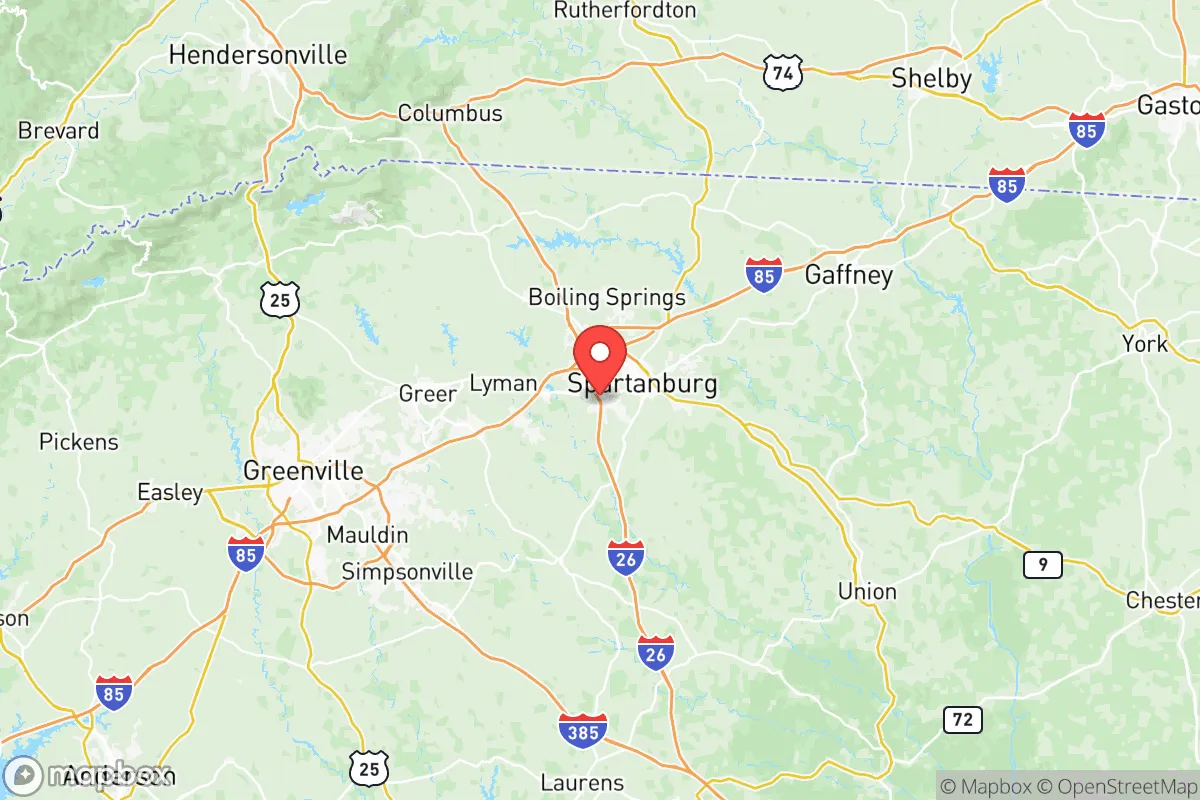
Photo: Wikipedia
Personal Sovereignty in Spartanburg County
Viable for self-reliance. Generally workable, though some barriers may limit total independence.
What does Personal Sovereignty tell us?
Personal Sovereignty measures your capacity for self-reliance and independence with minimal government friction. Higher scores mean fewer barriers between you and the way you want to live... but it assumes you have the space you need and good neighbors.
What does this tell us?
Personal Sovereignty measures your capacity for self-reliance and independence with minimal government friction. Higher scores mean fewer barriers between you and the way you want to live... but it assumes you have the space you need and good neighbors.
State Policy
Energy independence: Importer (42% of energy produced in-state)
Personal Liberty
Homesteading

Personal Liberty Analysis
Spartanburg County, South Carolina, offers a notably high degree of personal sovereignty relative to many other parts of the Southeast, driven by a state-level commitment to limited government, low taxation, and strong protections for individual rights. The county’s regulatory environment is generally light-touch, with local ordinances varying significantly between the more urbanized City of Spartanburg and the unincorporated rural areas like Roebuck, Pauline, and Cross Anchor. For a relocation-minded individual or family prioritizing autonomy, the key trade-offs lie in choosing between the convenience of city services and the greater freedom of county jurisdiction, where property use and self-reliance are less constrained.
Tax burden and regulatory climate in Spartanburg County
South Carolina’s tax structure is among the most favorable in the nation for those seeking to keep more of their earnings and property wealth. There is no state income tax on Social Security benefits, and a $3,000 deduction on other retirement income is available for those over 65. The state’s top marginal income tax rate is a flat 6.4%, with a standard deduction of $4,630 for single filers. Property taxes in Spartanburg County are assessed at a low 4% of fair market value for owner-occupied residential property, with a millage rate that typically lands around 0.3% to 0.5% of actual home value — significantly lower than in neighboring North Carolina or most of the Northeast. The county’s regulatory posture is generally permissive: there is no county-wide zoning in unincorporated areas, meaning a landowner in Woodruff or Enoree can operate a small workshop, keep livestock, or build a secondary dwelling without the layers of permitting common in more regulated states. However, the City of Spartanburg and the town of Duncan do enforce zoning codes and building permits, so buyers should verify local rules before purchasing. Business licensing is straightforward, with no county-level business tax for most small operations, and the state’s right-to-work laws further reduce regulatory friction for entrepreneurs.
Self-defense and gun law specifics in Spartanburg County
South Carolina is a strong Second Amendment state, and Spartanburg County reflects that culture. The state operates under a “shall issue” framework for concealed weapons permits (CWPs), meaning any law-abiding adult who completes a required training course and passes a background check can obtain a permit with no discretionary denial by local authorities. As of 2024, South Carolina also permits open carry of handguns for anyone legally allowed to possess a firearm, without a permit. Stand-your-ground laws are in full effect, with no duty to retreat in any place where the individual has a legal right to be. Castle doctrine protections extend to occupied vehicles and workplaces. In Spartanburg County specifically, sheriff’s office policy has historically been supportive of gun rights, with no local ordinances restricting magazine capacity or firearm types — state preemption law prohibits counties and municipalities from enacting their own gun control measures. The gun culture is visible and accepted; ranges and gun shops are common in areas like Inman and Lyman, and the annual Spartanburg Gun Show draws large crowds. For a family prioritizing self-defense autonomy, the legal environment here is among the most permissive in the Eastern U.S.
Self-reliance and homesteading viability across the county
Homesteading and off-grid living are feasible in Spartanburg County, but viability depends heavily on location. In unincorporated areas like Cross Anchor and Pauline, minimum lot sizes are typically 1 to 3 acres, and there is no county-wide zoning that restricts keeping chickens, goats, or even a few head of cattle. Rainwater collection is legal and unregulated, and many rural properties rely on private wells and septic systems, which are permitted by the state Department of Health and Environmental Control (DHEC) but not subject to county-level moratoria. Off-grid solar is permitted, though net metering with Duke Energy requires an interconnection agreement; going fully off-grid without utility hookup is legal but may complicate future property resale. The City of Spartanburg and the town of Duncan have stricter rules: livestock is generally prohibited within city limits, and building codes require connection to municipal water and sewer where available. For serious homesteaders, the rural western and northern parts of the county — around Enoree and Moore — offer the most freedom, with large tracts of land still available under $10,000 per acre. The county’s agricultural zoning allows for farm stands and direct-to-consumer sales of produce and eggs with minimal permitting, supporting a self-reliant lifestyle.
Personal liberties: parental rights, medical autonomy, speech, and property
Spartanburg County operates within a state legal framework that strongly emphasizes parental rights and limited government intervention in family matters. South Carolina law grants parents broad authority over their children’s education, medical decisions, and religious upbringing, with no state-level vaccine mandates for school attendance beyond standard childhood immunizations (which allow for religious and medical exemptions). Homeschooling is straightforward: parents must file a simple annual notice with the local school district and maintain a portfolio of work, but no standardized testing or curriculum approval is required. Medical autonomy is generally respected, though the state does not have a specific “right to try” law for experimental treatments beyond federal provisions. Free speech protections are robust, with no state-level hate speech laws that could chill expression, and the county’s public forums — including city council meetings and school board sessions — are open to citizen comment. Property rights are strongly protected: there is no county-wide rent control, no inclusionary zoning mandates, and eminent domain is rarely used for private development. The Spartanburg County Assessor’s office provides clear, online-accessible property records, and the appeals process for tax assessments is straightforward. For a family seeking to live with minimal government oversight in daily life, the county’s legal climate is permissive, though residents should be aware that the City of Spartanburg does enforce noise ordinances and rental property inspections that do not apply in unincorporated areas.
Overall, Spartanburg County offers a level of personal sovereignty that ranks among the highest in the Carolinas, particularly for those who choose to live outside municipal limits. The combination of low taxes, permissive gun laws, viable homesteading options, and strong protections for parental and property rights creates an environment where self-reliant individuals and families can operate with minimal government friction. Compared to the more regulated environments of Greenville County to the west or Mecklenburg County, NC to the north, Spartanburg County’s lighter touch on zoning and business licensing makes it a strategic choice for those who prioritize autonomy over proximity to urban amenities. The key is location: Roebuck, Pauline, and Cross Anchor offer the greatest freedom, while the City of Spartanburg and Duncan trade some sovereignty for access to services. For the relocation researcher, this county represents a solid middle ground — free enough for independence, but still connected enough for modern life.

* Values derived from national, state, county, city and local statistics and may differ in a specific area. Last updated: 2026-11-14T07:10:08.000Z
Narrative content on this page is AI-generated and may contain mistakes. Verify any details that matter before acting on them.
ReloMaps may earn a commission from affiliate links at no extra cost to you.

