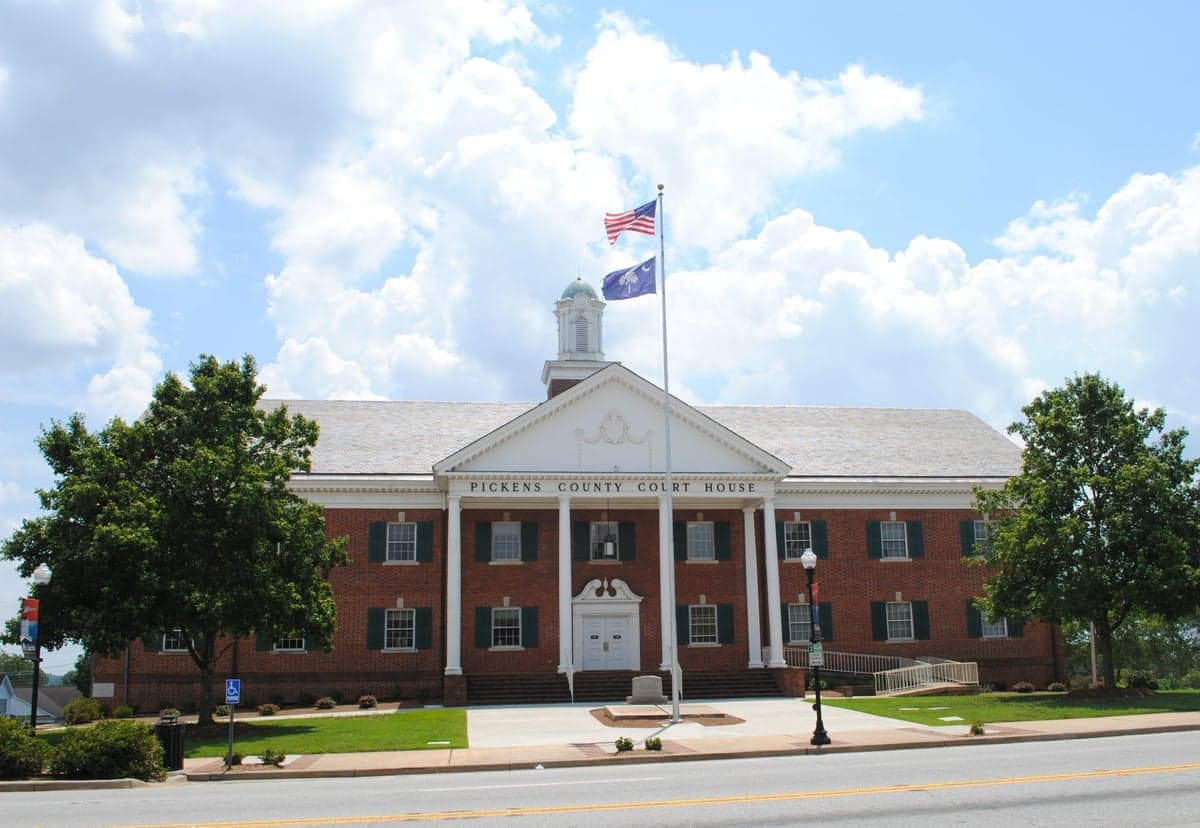
Photo: Wikipedia
Political ClimatePolitical Climate in Pickens County
Showing county-level results — no local-only data available.
Lean and PVI are calculated from this county’s 2020 and 2024 presidential results, Cook-style.
Political rankings in South Carolina
- Most Conservative Cities in South Carolina
- Most Liberal Cities in South Carolina
- Best Liberal-Leaning Towns in the South
- Best Liberal-Leaning Towns in the Deep South
- Safest Liberal-Leaning Towns in the South
- Safest Conservative-Leaning Towns in the South
- Safest Conservative-Leaning Towns on the East Coast
- Affordable Small Towns for Conservatives
- Most Conservative Counties in South Carolina
- Most Liberal Counties in South Carolina
Local Political AnalysisPolitical Analysis of Pickens County
Pickens County is one of the most reliably Republican corners of South Carolina, carrying a Cook Partisan Voting Index of R+21 — a full 13 points more conservative than the state as a whole, which sits at R+8. That gap isn't just a number; it reflects a deep, generational voting pattern that has only hardened over the past decade. The county hasn't voted for a Democratic presidential candidate since 1976, and in 2024, Donald Trump carried it by roughly 40 points. But if you drive from the Clemson city limits up into the hill towns, you'll see real variation — and that variation tells you everything about what life here is like politically.
How it compares
South Carolina as a state is solidly red, but it's not monolithic. The R+8 statewide PVI is driven by the deep-blue urban cores of Richland and Charleston counties, plus a handful of swing suburbs. Pickens County, by contrast, is a rural and exurban stronghold where the GOP's margins are rarely challenged. The biggest internal split is between Clemson and the rest of the county. Clemson's precincts, especially around the university and downtown, have trended bluer in recent cycles — in 2020, Biden actually won a few of those precincts outright, a first in modern memory. Meanwhile, towns like Easley, Pickens, and Liberty are reliably deep red, with Republican margins often exceeding 70%. The swing precincts are the suburban fringe of Easley and the rural areas along the Highway 123 corridor, where growth from Greenville County is bringing in more moderate voters. But even there, the shift is toward the GOP, not away from it.
What this means for residents
For conservative residents, this is about as comfortable as it gets. Local elections are decided in the Republican primary, and the general election is usually a formality. School board, county council, and sheriff races are all dominated by GOP candidates, and policy tends to reflect that — low taxes, limited regulation, and a strong emphasis on Second Amendment rights and religious liberty. For liberal residents, the reality is more isolating but not hostile. Clemson provides a small, educated bubble where progressive views are common, and the university itself is a reliably blue institution. Outside of that bubble, though, it's rare to see Democratic yard signs or campaign events. The practical effect is that liberal residents often engage in local politics through single-issue advocacy — land use, environmental protection around Lake Keowee, or school funding — rather than through party affiliation. There's no real organized Democratic Party presence in the county, so if you're left-leaning, you either get involved in nonpartisan civic groups or you accept that your vote is largely symbolic in countywide races.
Culturally, Pickens County is defined by a few key distinctions that set it apart from the rest of South Carolina. The most obvious is the Clemson factor — the university brings in a steady stream of out-of-state students and faculty, which keeps the county's politics from being as insular as neighboring Oconee or Anderson counties. You'll hear more out-of-state accents in Clemson than anywhere else in the Upstate, and that shows up in the local restaurant scene and housing market. But drive 15 minutes north to Pickens or Liberty, and you're back in a world of Baptist churches, gun shops, and pickup trucks. The county also has a strong libertarian streak — people here are skeptical of both state and federal overreach, and that shows up in local opposition to mask mandates, vaccine requirements, and land-use planning. The biggest policy fights in recent years have been over growth management (especially around the Clemson-Lake Keowee corridor) and school curriculum, where conservative parents have pushed back hard against what they see as progressive overreach. If you're moving here, the political climate is straightforward: you'll find your tribe easily if you're conservative, and you'll find a small but thoughtful community if you're not — but you won't find much middle ground in between.

State Political ClimatePolitical Climate in South Carolina
State Political AnalysisPolitical Environment in the State
South Carolina has been a reliably Republican state for the past half-century, but the depth of that lean has deepened significantly since 2010. The state carries a Cook PVI of R+8, meaning it votes about eight points more Republican than the national average in presidential elections. That shift wasn’t gradual — it accelerated after the 2010 Tea Party wave, then solidified as coastal transplants and retirees from the Northeast and Midwest poured into the Lowcountry and Upstate. The old Democratic stronghold of the rural Black Belt has shrunk in relative population, while the fast-growing suburbs around Charleston, Greenville, and Myrtle Beach have pulled the state rightward. The result is a state where Republicans hold supermajorities in both legislative chambers, control every statewide office, and have not voted for a Democratic presidential candidate since 1976.
Urban vs. rural divide
The political map of South Carolina is a study in contrasts. The state’s three major metros — Charleston, Greenville, and Columbia — each have distinct political personalities. Charleston County itself is a purple-to-blue island, driven by the city’s historic downtown, the college vote, and a growing professional class. In 2020, Charleston County went for Joe Biden by about 12 points. But the surrounding suburbs — Mount Pleasant, Summerville, and Goose Creek — are reliably Republican, though Mount Pleasant has been trending more moderate as young families move in. Greenville County, once a GOP stronghold, has shifted slightly left in the city core but remains deeply red in the exurbs like Simpsonville and Greer. Columbia (Richland County) is the state’s most reliably Democratic large county, driven by the University of South Carolina and a large African American population. The rural counties — Bamberg, Allendale, Marlboro — are majority-Black and vote heavily Democratic, but their populations are small and shrinking. The real engine of Republican dominance is the suburban and exurban growth corridor from Greenville down to Spartanburg, plus the coastal retirement boom in Horry County (Myrtle Beach), which votes about 60-40 Republican. The rural white counties of the Pee Dee and Upstate — Oconee, Pickens, Anderson — are among the most Republican in the nation, often voting 75-80% for GOP candidates.
Policy environment
South Carolina’s policy environment is shaped by a low-tax, low-regulation philosophy that has been consistent for decades. The state has a flat income tax rate of 6.4% (phasing down to 6.0% by 2026), no state property tax on vehicles, and a homestead exemption for primary residences that caps assessment increases. Sales tax is 6% statewide, but local options can push it to 9% in some counties. The regulatory climate is business-friendly, with a right-to-work law and no state-level minimum wage above the federal $7.25. Education policy is a flashpoint: the state has a robust school choice program (the Education Scholarship Trust Fund, expanded in 2023) that allows parents to use state funds for private school tuition, but public school funding remains among the lowest in the nation per pupil. Healthcare is a mixed bag: the state did not expand Medicaid under the Affordable Care Act, leaving roughly 200,000 low-income adults in a coverage gap. Election laws have tightened: voter ID is required, early voting was expanded to two weeks in 2022, but absentee voting requires an excuse. Abortion is banned after six weeks (the “Fetal Heartbeat Act,” passed in 2023), with no exceptions for rape or incest, only for medical emergencies. Gun laws are permissive: permitless carry was enacted in 2021, and the state has a “stand your ground” law.
Recent policy direction
The last five years have seen a sharp rightward turn on several fronts. The 2023 Fetal Heartbeat Act (S.474) effectively ended abortion access after about six weeks, making South Carolina one of the most restrictive states in the South after the Dobbs decision. On education, the Education Scholarship Trust Fund (2023) created a universal school choice program that any family can use for private school tuition, homeschooling materials, or tutoring — a major expansion from the earlier pilot program. On gun rights, the Permitless Carry Act (2021) allows any law-abiding adult to carry a concealed firearm without a permit. On voting, the Election Integrity Act (2022) eliminated same-day voter registration, shortened the absentee application window, and banned private funding of election offices. On property rights, the state has a strong “Dillon’s Rule” framework that limits local government authority, but recent legislation has preempted local zoning and short-term rental regulations in favor of property owners. On privacy and surveillance, the state has no comprehensive data privacy law, but a 2023 law restricts the use of facial recognition by law enforcement without a warrant. On speech, the state has a “campus free speech” law (2017) that prohibits public universities from designating “free speech zones” and requires them to allow any speaker invited by a student group. The overall direction is toward expanding individual liberties on guns, education choice, and property rights, while restricting them on abortion and voting access.
Civil unrest & political movements
South Carolina has a history of political activism that is both organized and, at times, confrontational. The state was the first to secede in 1860, and that legacy still echoes in occasional nullification rhetoric from fringe groups, though it has no serious political traction. The most visible recent protest movements have been around abortion: after the 2023 heartbeat ban, large protests erupted at the Statehouse in Columbia, with both pro-choice and pro-life groups holding competing rallies. The “Stand for Freedom” rallies, organized by conservative groups, have drawn thousands to the Statehouse steps. On the left, the SC Progressive Network and Indivisible chapters in Charleston and Columbia have organized around voting rights and Medicaid expansion. Immigration politics are less heated than in border states, but there is a vocal minority pushing for stricter enforcement; the state has a 2008 law (S. 392) that requires all employers to use E-Verify, and local law enforcement can inquire about immigration status during traffic stops. The “sanctuary city” debate flared in 2023 when the city of Columbia considered a non-cooperation policy with ICE, but the state legislature quickly passed a law (H. 3612) banning any local government from adopting sanctuary policies. Election integrity remains a live issue: the 2020 election saw no major fraud cases in South Carolina, but the state GOP has pushed for tighter rules, and the 2022 law was a direct response to that pressure. The “Stop the Steal” movement had a presence in the state, with a rally at the Statehouse in January 2021 drawing about 500 people, but it has since faded into online activism.
Projection
Over the next 5-10 years, South Carolina is likely to become more Republican, not less, but the character of that Republicanism may shift. The in-migration from blue states — particularly New York, New Jersey, and California — is concentrated in the coastal and Upstate suburbs, and these newcomers tend to be fiscally conservative but socially moderate. They support low taxes and business-friendly policies, but they are less enthusiastic about the culture-war issues that dominate the state legislature. This could create a tension between the rural, evangelical base and the suburban, libertarian-leaning newcomers. The state’s population is projected to grow by about 10% by 2030, with most growth in Greenville, Charleston, and Horry counties. The African American population, which makes up about 27% of the state, is growing slowly but remains concentrated in rural counties that are losing population. The Hispanic population is growing fast (now about 6% of the state), but it is not yet politically organized. The net effect is that the GOP’s supermajorities are likely to hold, but the party may moderate on some economic issues while doubling down on cultural ones. A new resident moving in now should expect a state that remains deeply conservative on taxes, guns, and abortion, but where the suburbs are becoming more diverse and politically contested at the local level.
For someone choosing South Carolina, the practical takeaway is this: if you are conservative, you will find a state that largely aligns with your values on taxes, regulation, gun rights, and education choice. If you are liberal, you will find a state where your vote matters little in statewide elections but where you can find like-minded communities in Charleston, Columbia, and parts of Greenville. The cost of living is low, the weather is warm, and the political climate is stable — but it is a stability built on a solid Republican majority that shows no signs of weakening. The suburbs are where the real action is, both politically and economically, and that is where most new residents will land.
* Values derived from national, state, county, city and local statistics and may differ in a specific area. Last updated: 2026-11-07T11:13:51.000Z
Narrative content on this page is AI-generated and may contain mistakes. Verify any details that matter before acting on them.
ReloMaps may earn a commission from affiliate links at no extra cost to you.

