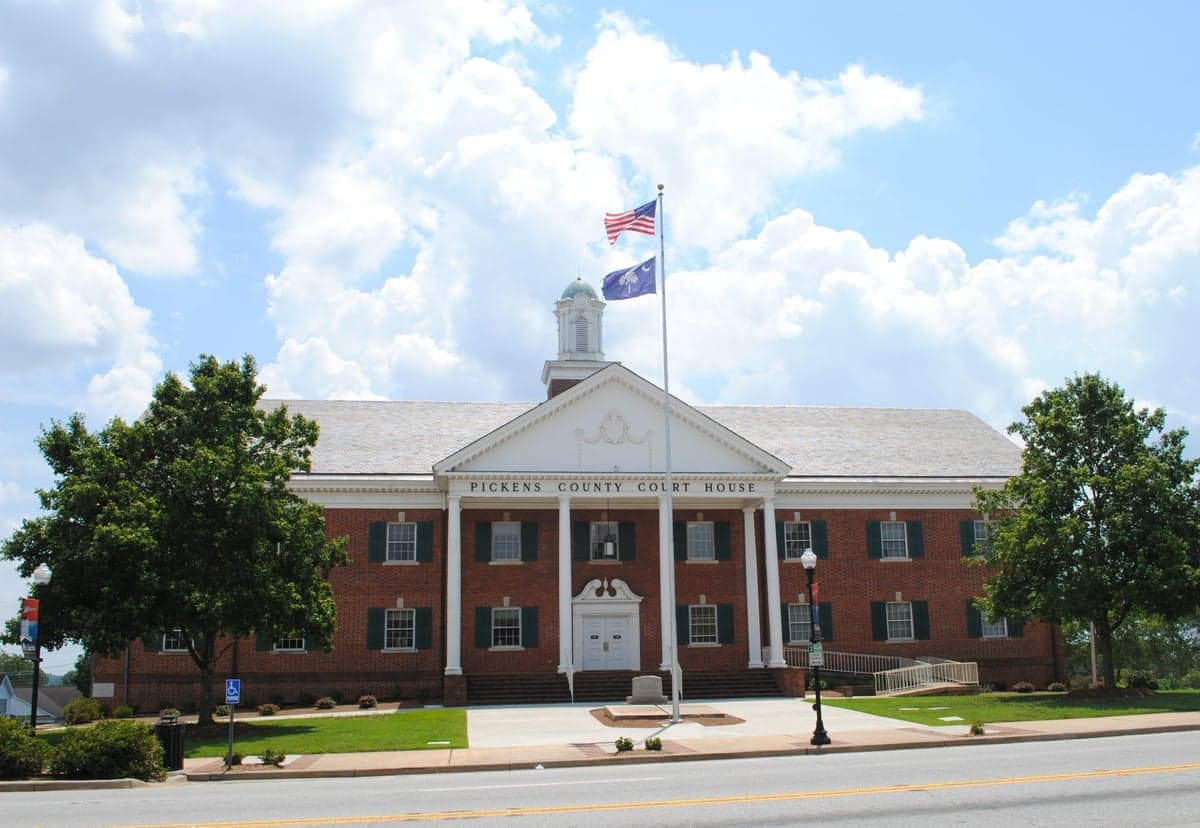
Photo: Wikipedia
Demographics of Pickens County
Affluence Level in Pickens County
A middle-class area roughly in line with national averages across income, home values, education, and employment.
People of Pickens County
The people of Pickens County, South Carolina, today number 132,604, forming a community that is predominantly white (83.4%) and native-born (only 2.4% foreign-born), with a character shaped by its Appalachian foothill roots and a growing suburban connection to Greenville. The county’s identity is a blend of small-town Southern tradition, a strong manufacturing and higher-education presence, and an increasingly diverse population that remains less cosmopolitan than the nearby Upstate metro. Distinctive markers include a higher-than-state-average share of families, a significant Blue Ridge Mountain recreation culture, and a political and social conservatism that aligns with the broader region.
Settlement & growth (pre-1960)
Before European settlement, the area now known as Pickens County was part of the homeland of the Cherokee Nation, with the Keowee River valley serving as a major corridor. The Cherokee had established towns along the river, and the region was a contested borderland during the Anglo-Cherokee wars of the mid-18th century. After the Cherokee were forced out following the American Revolution, the first permanent European settlers—primarily Scots-Irish and English from Virginia and North Carolina—began arriving in the 1790s. They were drawn by cheap land grants in the foothills and the promise of subsistence farming in the isolated valleys. These early families settled in what would become the towns of Pickens (the county seat, originally called Pickens Court House) and Easley, which grew as crossroads trading posts.
Through the 19th century, the population remained overwhelmingly rural and agricultural, with cotton and corn as primary crops. The arrival of the Atlanta and Charlotte Air Line Railway in the 1870s transformed the county. The railroad spurred the founding of Liberty (incorporated 1876) and Central (incorporated 1875) as depot towns, and it connected the county’s timber and cotton to outside markets. The post-Civil War period also saw a small but significant influx of freed African Americans, who concentrated in the mill villages and rural hamlets around Easley and Pickens, working as sharecroppers and later as mill hands. By 1900, the county’s population was roughly 75% white and 25% Black, a ratio that would shift dramatically over the next century.
The early 20th century brought the textile mill boom, which defined the county’s economy and settlement patterns for decades. Mill villages sprang up around Easley, Pickens, and Liberty, drawing white farm families off the land and into wage labor. The mills also attracted a small number of European immigrants, including a handful of German and Italian families who settled in Easley, though the county remained overwhelmingly native-born. The Great Depression hit the textile industry hard, but the county’s population stabilized during World War II as mills converted to war production. The post-war period saw the beginning of suburbanization, with Easley emerging as a bedroom community for Greenville workers, a trend that would accelerate dramatically after 1960.
Modern era (post-1965)
The 1965 Hart-Cellar Act had a minimal direct impact on Pickens County, as the foreign-born population remains just 2.4% today. However, the county’s demographic story since 1965 is overwhelmingly one of domestic migration from the Rust Belt and other parts of the South. The decline of the textile industry in the 1970s and 1980s was offset by the rise of manufacturing in the Upstate, particularly the arrival of BMW in nearby Spartanburg County (1992) and a wave of German and other European automotive suppliers. These plants drew workers from across the region, including a growing number of Hispanic laborers, who now make up 5.1% of the county’s population. The Hispanic community is concentrated in Easley and Pickens, where they work in construction, landscaping, and manufacturing.
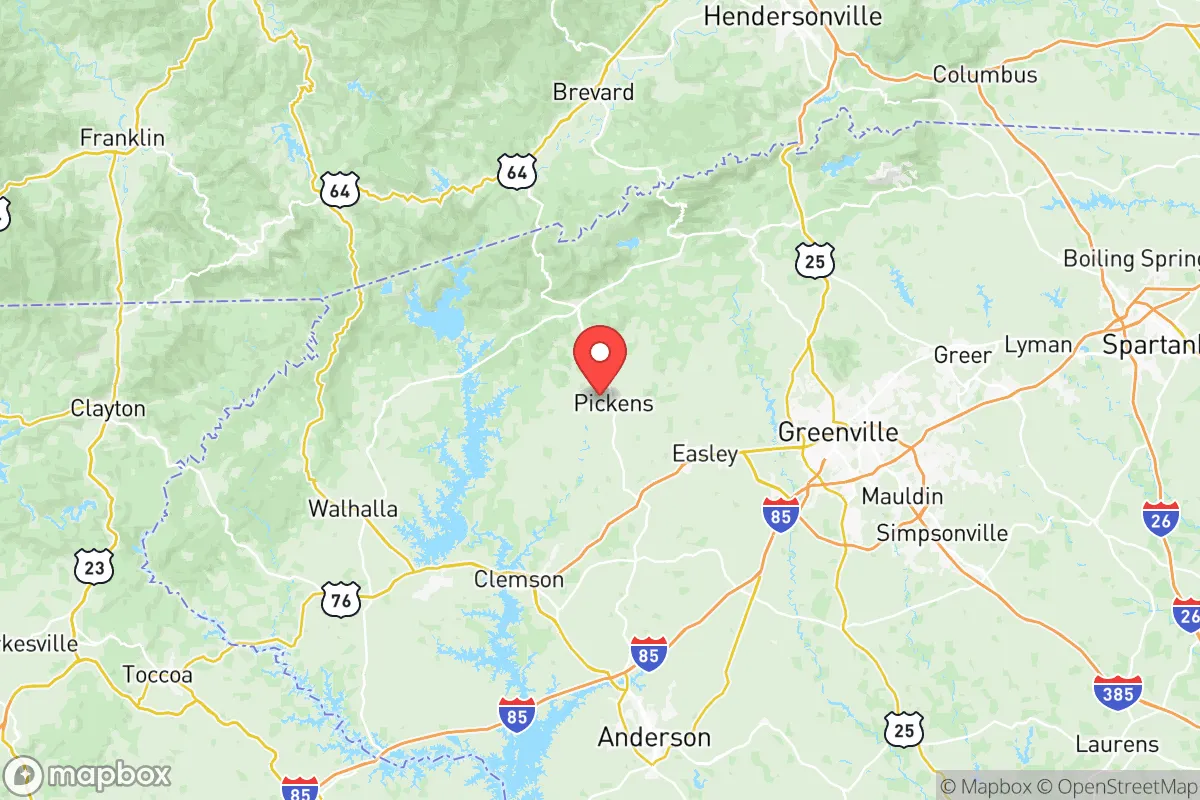
The most significant demographic shift since 1965 has been the suburbanization of Greenville. As Greenville’s economy boomed in the 1990s and 2000s, Pickens County—particularly the southern half along the I-85 corridor—became a destination for families seeking lower housing costs and more land. Easley has been the primary beneficiary, growing from a mill town of about 10,000 in 1970 to over 20,000 today. Powdersville, an unincorporated area in the county’s southern tip, has seen explosive growth as a Greenville exurb, with new subdivisions and retail centers. This wave of domestic migration has been overwhelmingly white, reinforcing the county’s white majority (83.4%). The Black population, which was once a quarter of the county, has declined to 6.1%, as many African American families left for urban centers during the Great Migration and later for Greenville proper.
The Asian and Indian populations remain small but growing. East/Southeast Asian communities (1.0% of the population) are largely concentrated in Clemson, which straddles the Pickens-Anderson county line and is home to Clemson University. The university attracts a small number of faculty and graduate students from China, South Korea, and Vietnam. The Indian subcontinent community (0.7%) is similarly tied to Clemson University and the region’s tech and engineering sectors, with families settling in Clemson and Central. The college-educated share (27.3%) is driven by the university’s presence, but remains below the national average, reflecting the county’s working-class manufacturing base.
The future
Pickens County is becoming more diverse, but slowly. The Hispanic share is projected to grow to 7-8% by 2035, driven by continued demand for labor in construction and manufacturing. The Asian and Indian populations will likely increase modestly as Clemson University expands its international recruitment and as the Greenville metro’s tech sector pushes outward. However, the county’s foreign-born share will remain well below the national average, as most growth will come from domestic migration—particularly from the Northeast and Midwest, where families are drawn by lower taxes and a conservative cultural climate.
The most dramatic change will be continued suburbanization. The southern half of the county, especially Powdersville and Easley, will absorb most of the new housing development, while the northern half—including Pickens and the mountain communities near Table Rock State Park—will remain more rural and slower-growing. The county’s cultural identity is likely to become more suburban and less distinctively Appalachian, as newcomers bring Greenville’s consumer habits and political leanings. The traditional mill-town character of Easley and Liberty is fading, replaced by chain retail and commuter lifestyles.
For someone moving in now, Pickens County offers a stable, family-oriented environment with a strong sense of local identity, low crime, and access to outdoor recreation. The trade-off is a relatively homogeneous social landscape and a slower pace of change than the booming Greenville core. The county is not becoming a melting pot, but it is becoming a more comfortable, well-connected suburb for those who value space, safety, and tradition.

* Values derived from national, state, county, city and local statistics and may differ in a specific area. Last updated: 2026-11-07T11:13:51.000Z
Narrative content on this page is AI-generated and may contain mistakes. Verify any details that matter before acting on them.
ReloMaps may earn a commission from affiliate links at no extra cost to you.

