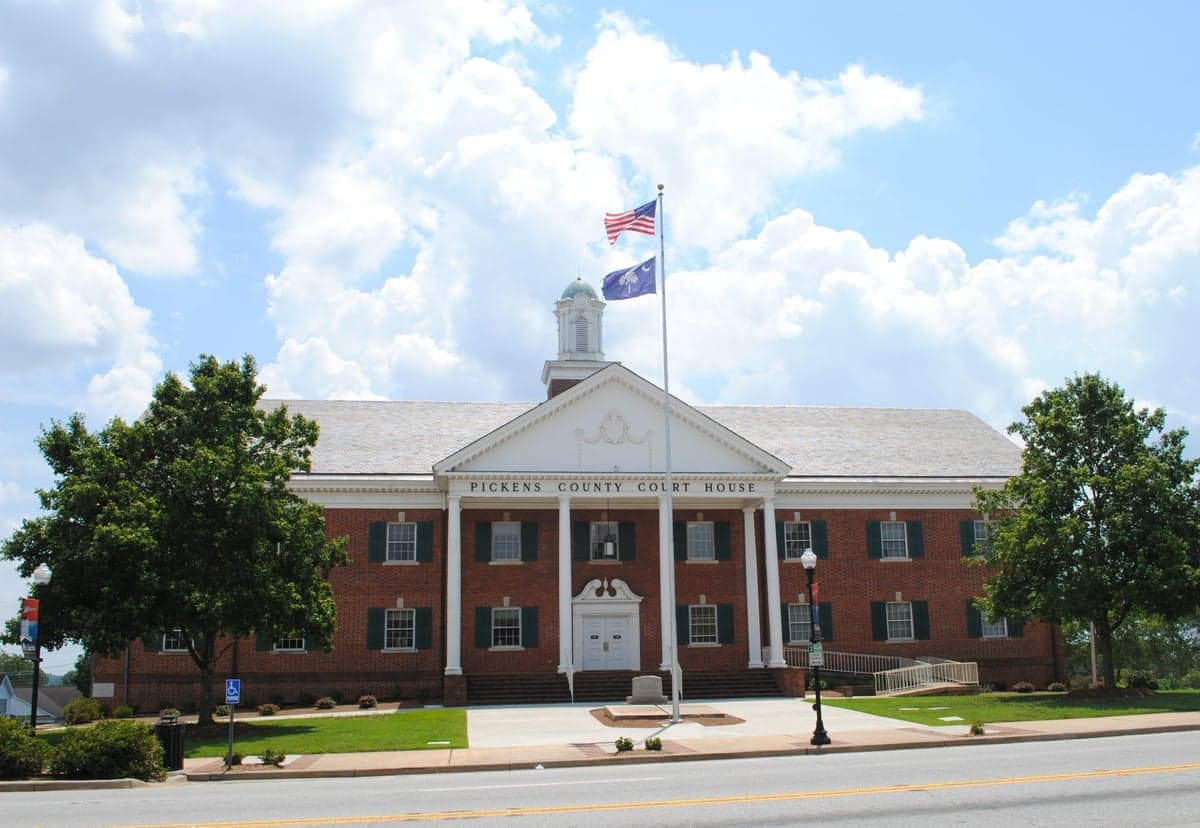
Photo: Wikipedia
Personal Sovereignty in Pickens County
Viable for self-reliance. Generally workable, though some barriers may limit total independence.
What does Personal Sovereignty tell us?
Personal Sovereignty measures your capacity for self-reliance and independence with minimal government friction. Higher scores mean fewer barriers between you and the way you want to live... but it assumes you have the space you need and good neighbors.
What does this tell us?
Personal Sovereignty measures your capacity for self-reliance and independence with minimal government friction. Higher scores mean fewer barriers between you and the way you want to live... but it assumes you have the space you need and good neighbors.
State Policy
Energy independence: Importer (42% of energy produced in-state)
Personal Liberty
Homesteading

Personal Liberty Analysis
Pickens County, South Carolina, offers a notably high degree of personal sovereignty compared to many parts of the Southeast, driven by a combination of low state taxes, permissive gun laws, and a regulatory environment that generally favors individual choice over government mandate. The county’s autonomy environment is shaped by its position in the conservative Upstate region, where local governance tends to be light-touch, and state-level preemption laws limit municipal overreach. For individuals and families prioritizing self-reliance, Pickens County provides a legal and cultural framework that supports independent decision-making in areas from taxation to self-defense and property use, though the degree of freedom varies between the more rural towns like Pickens and Liberty and the more developed areas near Clemson and Easley.
Tax burden and regulatory posture: How South Carolina’s policies shape local freedom
South Carolina’s overall tax burden is among the lowest in the nation, and Pickens County residents benefit directly from this. There is no state income tax on Social Security benefits, and the state’s top marginal income tax rate is a flat 6.2% as of 2026, with a standard deduction that reduces liability for most filers. Property taxes are assessed at a state-mandated 4% of fair market value for owner-occupied primary residences, with a local millage rate in Pickens County averaging around 200 mills, translating to roughly $800 annually on a $200,000 home. This is significantly lower than in neighboring Greenville County, where higher millage rates and more frequent reassessments can push taxes 20-30% higher for comparable properties. The regulatory posture in Pickens County is characterized by minimal local business licensing requirements and a general absence of zoning overlays in unincorporated areas, particularly in the rural stretches around Six Mile and Sunset. The county does not impose its own building codes beyond the state’s minimum standards, and there is no county-wide noise or nuisance ordinance that would restrict typical rural activities like woodworking or vehicle repair on personal property. However, the town of Clemson, home to Clemson University, has a more active municipal code enforcement, including stricter rental property inspections and noise regulations, which can feel more intrusive to residents accustomed to the county’s hands-off approach.
Self-defense and gun law specifics: What the Second Amendment means in Pickens County
South Carolina is a shall-issue state for concealed weapons permits, and Pickens County’s sheriff’s office processes applications efficiently, typically within 30-45 days. The state also permits constitutional carry for residents 18 and older who are legally allowed to possess a firearm, meaning no permit is required for open or concealed carry. This is a critical factor for personal sovereignty advocates. Pickens County has no local ordinances restricting firearm possession beyond state law, and there are no county-specific waiting periods or magazine capacity limits. The county’s culture strongly supports self-defense rights; the sheriff’s department publicly affirms its commitment to the Second Amendment, and there are no known instances of local law enforcement enforcing federal restrictions that conflict with state law. Stand-your-ground laws apply statewide, with no duty to retreat in any place where a person has a legal right to be. For residents in more remote areas like Rocky Bottom or the Jocassee Gorges region, where law enforcement response times can exceed 20 minutes, the ability to carry and use a firearm for personal protection is a practical necessity. The only notable local nuance is that Clemson University’s campus is a gun-free zone under state law, which affects students and faculty who live in the town of Clemson but does not impact residents in the rest of the county.
Self-reliance and homesteading viability: Lot sizes, zoning, and off-grid feasibility
Pickens County is one of the more homestead-friendly areas in the Upstate, particularly in its unincorporated regions. Minimum lot sizes in rural zoning districts are typically 1-2 acres, but many parcels in areas like Six Mile, Sunset, and the northern reaches near the North Carolina border are sold in 5- to 20-acre tracts, allowing for substantial self-sufficiency. The county does not require building permits for agricultural structures under 200 square feet, and there are no county-wide restrictions on keeping livestock, including chickens, goats, or even cattle, on parcels of 2 acres or more. Off-grid living is legally viable: the county does not mandate connection to municipal water or sewer systems, and private wells and septic systems are permitted with standard health department approvals. Solar panel installation is allowed without special permitting beyond basic electrical inspections, and there are no county-level restrictions on rainwater collection. However, residents in the town of Pickens and Liberty face slightly more oversight, including setback requirements for accessory structures and a limit of three non-commercial vehicles visible from the road. The town of Easley, the county’s largest municipality, has more comprehensive zoning that restricts certain agricultural activities within city limits, such as keeping roosters or operating a home-based sawmill. For those seeking maximum autonomy, the unincorporated areas around Lake Keowee and the Blue Ridge Escarpment offer the least regulatory friction, with many residents living fully off-grid with solar, propane, and private water systems.
Personal liberties: Parental rights, medical autonomy, speech, and property
South Carolina law strongly supports parental rights in education and healthcare. The state’s Parents’ Bill of Rights, enacted in 2023, gives parents the explicit right to direct their child’s upbringing, education, and medical care, including the ability to opt out of any school curriculum or activity without penalty. Pickens County School District has a conservative school board that generally defers to parental authority, and there are no local policies that override state law on medical consent or educational transparency. Medical autonomy is further supported by the state’s lack of a vaccine mandate for school attendance (only standard childhood immunizations are required, with broad religious and medical exemptions) and the absence of any county-level public health orders that restrict individual medical choices. Freedom of speech and assembly are robustly protected; the county has no local ordinances restricting political signage, leafleting, or public gatherings, and the sheriff’s office does not enforce federal speech restrictions. Property rights are strong, with South Carolina’s right-to-farm law protecting agricultural operations from nuisance lawsuits, and Pickens County has no county-wide tree preservation or wetland buffer ordinances that would limit a landowner’s ability to clear or develop their property. The only notable limitation is in the Lake Keowee watershed area, where Duke Energy imposes some restrictions on shoreline development and septic system placement, but these are private covenant-based rather than government mandates.
Overall, Pickens County ranks among the top 20% of South Carolina counties for personal sovereignty, with a regulatory environment that is significantly lighter than in Greenville or Charleston counties. The combination of low taxes, permissive gun laws, viable off-grid living options, and strong protections for parental and property rights makes it a strong choice for individuals and families who prioritize autonomy. The main trade-off is that residents in the more urbanized towns of Clemson and Easley will encounter slightly more municipal oversight, while those in the rural areas of Six Mile, Sunset, and Rocky Bottom enjoy near-total freedom from local government interference. For a relocation researcher advising a conservative-leaning audience, Pickens County offers a balanced sovereignty profile that is competitive with the most freedom-oriented counties in the Southeast, such as Oconee County to the west or Polk County, North Carolina, to the north.

* Values derived from national, state, county, city and local statistics and may differ in a specific area. Last updated: 2026-11-07T11:13:51.000Z
Narrative content on this page is AI-generated and may contain mistakes. Verify any details that matter before acting on them.
ReloMaps may earn a commission from affiliate links at no extra cost to you.

