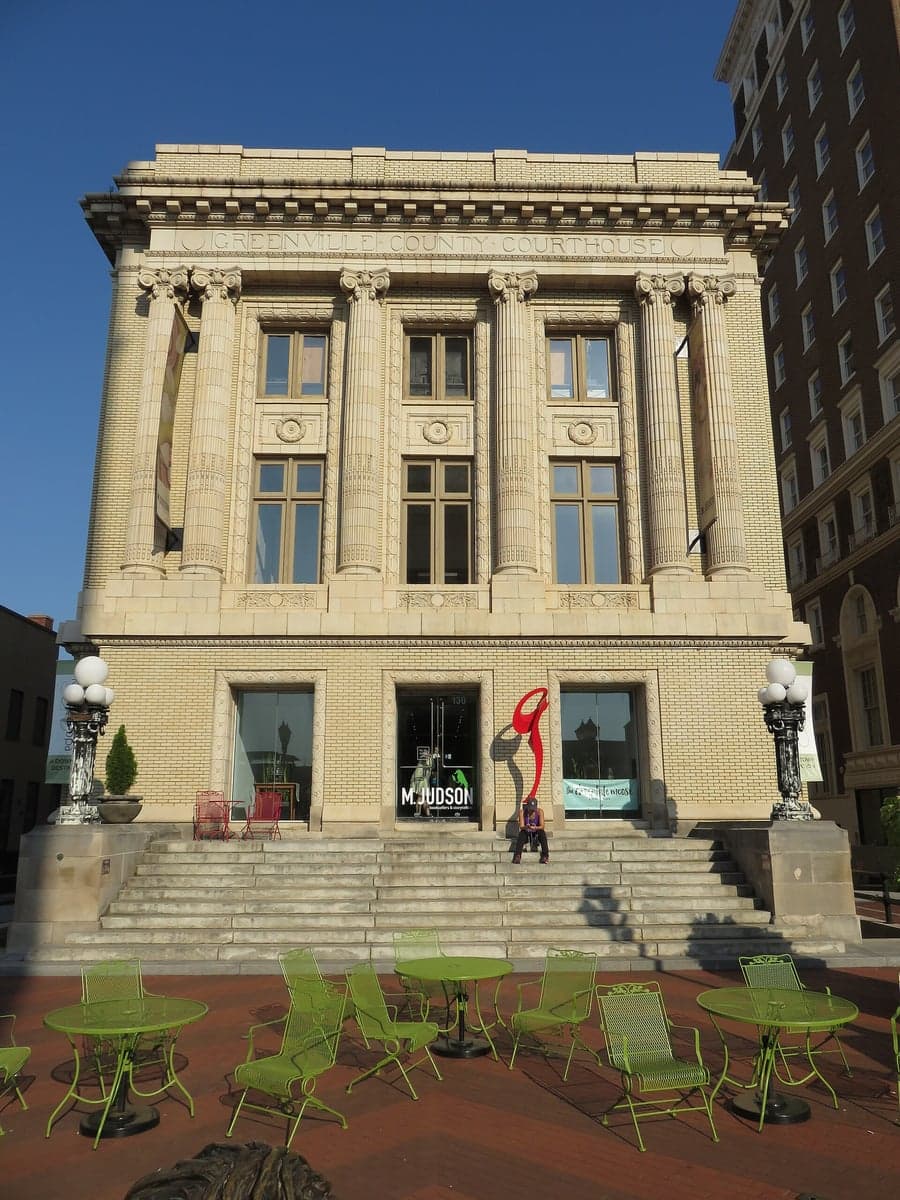
Photo: Wikipedia
Political ClimatePolitical Climate in Greenville County
Showing district-level results — no local-only data available.
Local Political AnalysisPolitical Analysis of Greenville County
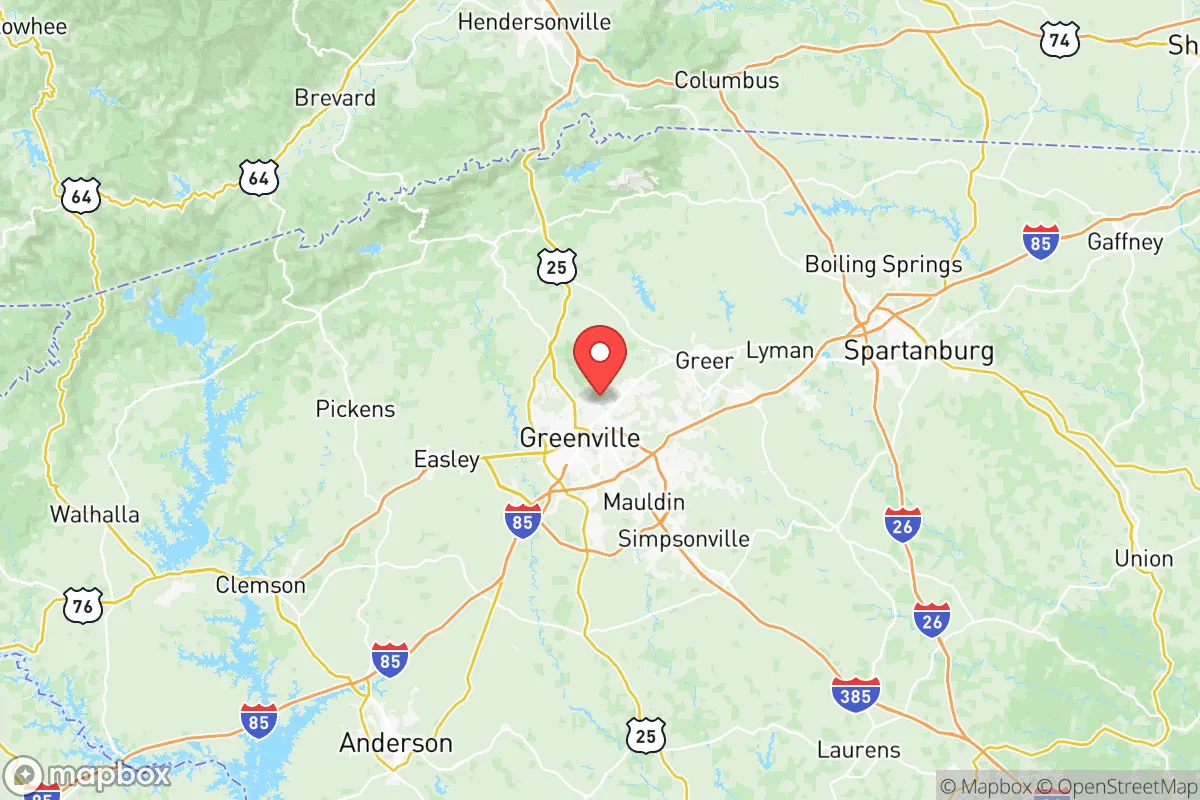
Greenville County has a Cook PVI of R+11, making it significantly more Republican than South Carolina as a whole (R+8), and that gap has actually widened slightly over the past decade even as the city of Greenville itself has trended purple. The county's politics are shaped by a strong suburban and exurban conservative base, but the city's downtown and near-downtown neighborhoods have become reliably Democratic in local races, creating a sharp urban-rural divide that defines the county's political landscape. Longtime residents will tell you it wasn't always this way—the county GOP machine was nearly unchallenged twenty years ago, but now you see real competition in city council and state house races, especially in precincts around the West End, North Main, and the Augusta Road corridor.
How it compares
Compared to the rest of South Carolina, Greenville County is about three points more conservative on the Cook scale, but the comparison is messier than that single number suggests. The state's R+8 is pulled down by the Charleston area (Dorchester County is R+7, Charleston County is D+1) and the rural black belt counties that lean Democratic; Greenville County lacks those blue pockets. Inside the county, the political geography is distinct: Greenville city precincts (especially those near Furman University, downtown, and the Swamp Rabbit Trail) often vote 60-65% Democratic, while Simpsonville, Fountain Inn, and Greer regularly deliver 70%+ Republican margins. Travelers Rest is a true swing zone—precincts there split roughly 50-50 in the 2024 presidential election, reflecting the area's mix of old families and new transplants from the Northeast. The deep-red heartland lies in the northern and western parts of the county: Berea, Mauldin, and the unincorporated areas around Powdersville and Tigerville, where evangelical churches and gun clubs are community anchors. The county's overall R+11 is a composite of these extremes, not a sign of moderate consensus.
What this means for residents
For conservative residents, the R+11 lean means that local government—County Council, the Sheriff's Office, and most school board seats—has been reliably Republican for decades, so policies on taxes, land use, and law enforcement rarely face serious opposition. Property taxes are low relative to the state average, and the county has resisted adopting a local option sales tax that many other South Carolina counties have. For liberal residents, the reality is that you're a minority voice in most countywide contests, but the city of Greenville provides a strong counterweight: the city council is majority-Democratic, and the mayor is a moderate Democrat. If you're a progressive, you'll find your community in the city's downtown, the West End, or the Nicholtown neighborhood, but you'll have to drive to Columbia or Charlotte for larger political rallies or LGBTQ+ events. The county's Republican tilt also means that the area's state legislative delegation is overwhelmingly GOP, which affects everything from abortion access to education funding. Still, the growing population of young professionals and tech workers is slowly changing the conversation—several precincts in the city shifted from lean-Republican to lean-Democratic between 2016 and 2024.
The cultural and policy distinctions in Greenville County are perhaps more visible than the raw numbers suggest. The county is home to the evangelical headquarters of the Christian Broadcasting Network (CBN) and a robust network of private Christian schools, which reinforces a socially conservative tone in local ordinances—for example, the county's alcohol sales laws are more restrictive than in Charleston or Columbia. On the other hand, the city of Greenville has embraced a bike-friendly, arts-heavy identity that attracts a younger, more secular crowd, leading to ongoing tension between the city's pro-density zoning changes and the county's preference for suburban development. In practice, this means a resident living in the city can walk to a brewery, a progressive bookstore, and a drag brunch, while a resident in Simpsonville drives fifteen minutes to the nearest Target and lives under a homeowners' association that mandates specific grass heights. The county's politics are best understood as a tug-of-war between a rapidly urbanizing core and a deeply entrenched rural and suburban base—and that fight is only going to intensify as the population of Greenville County approaches 600,000.

State Political ClimatePolitical Climate in South Carolina
State Political AnalysisPolitical Environment in the State
South Carolina is a solidly Republican state, carrying a Cook PVI of R+8, meaning it votes about eight points more Republican than the national average in presidential elections. The dominant coalition is a blend of traditional conservatives in the Upstate and Lowcountry, evangelical Christians, and a growing number of fiscally conservative transplants, particularly in the suburbs around Greenville and Charleston. Over the last 10-20 years, the state has shifted rightward, driven by rapid population growth in reliably red suburban and exurban areas, even as the rural Black Belt counties have become more reliably Democratic. The result is a state where Republicans hold supermajorities in both legislative chambers and control every statewide office, but where the margin of victory in presidential races has actually tightened slightly since 2016 as the Charleston and Columbia metros have become more competitive.
Urban vs. rural divide
The political map of South Carolina is a classic story of three distinct regions. The Upstate, anchored by Greenville and Spartanburg, is the GOP's strongest base—Greenville County itself voted 60% for Trump in 2020. The Lowcountry, including Charleston and Mount Pleasant, is more nuanced: Charleston County has trended Democratic in recent cycles (Biden won it by 12 points), driven by the city's growing tech and tourism workforce, but the surrounding suburbs like Summerville and Goose Creek remain reliably red. The Midlands, centered on Columbia (Richland County), is the Democratic stronghold, with Richland voting 65% for Biden, while the surrounding rural counties like Lexington and Kershaw are deeply Republican. The rural Black Belt counties along the I-95 corridor—Orangeburg, Williamsburg, Marlboro—are heavily Democratic and predominantly African American, but their populations are shrinking, reducing their electoral weight. The real political action is in the fast-growing exurbs: Bluffton near Hilton Head, Fort Mill near Charlotte, and Simpsonville outside Greenville, all of which are adding conservative-leaning families at a rapid clip.
Policy environment
South Carolina's policy environment is unmistakably conservative. The state has a flat income tax rate of 6.2% (phasing down to 6% by 2025), no estate tax, and a sales tax cap of 6% on most goods. Property taxes are among the lowest in the Southeast, with a 4% assessment ratio for owner-occupied homes and a $50,000 exemption on the first $50,000 of value. The regulatory posture is business-friendly: South Carolina is a right-to-work state, and the state's Department of Commerce aggressively courts manufacturing and corporate relocations with tax incentives. Education policy is a flashpoint: the state has a robust school choice program, including the Education Scholarship Trust Fund (vouchers for private school tuition), which was expanded in 2023. Public school funding, however, remains below the national average, and teacher pay, while rising, still lags. Healthcare policy is limited: the state did not expand Medicaid under the Affordable Care Act, leaving roughly 200,000 residents in the coverage gap. Election laws are restrictive by national standards: voter ID is required, early voting was only introduced in 2022 (with a two-week window), and absentee voting requires an excuse. Abortion is banned after six weeks under the 2023 "Fetal Heartbeat Act," with no exceptions for rape or incest.
Recent policy direction
The last three years have seen a sharp conservative turn in state law. On gun rights, South Carolina became a permitless carry state in 2024, allowing any adult who can legally possess a firearm to carry it openly or concealed without a permit. On parental and education rights, the 2023 "Parents' Bill of Rights" (H. 3728) requires schools to notify parents of any changes to a student's health or well-being, effectively limiting classroom discussion of gender identity and sexual orientation. The state also passed a ban on "divisive concepts" in public schools, prohibiting teaching that the U.S. is fundamentally racist or that any individual bears responsibility for past wrongs based on race. On speech and privacy, the state has no broad surveillance law, but law enforcement can access cell-site simulators without a warrant in some cases. Medical and bodily autonomy is sharply restricted: the six-week abortion ban is among the strictest in the nation, and the state has no shield law for providers. Property rights are strong: the state has a "right to farm" law protecting agricultural operations from nuisance lawsuits, and eminent domain for private economic development is limited. On voting, the 2021 "Voter Integrity Act" added stricter ID requirements for absentee ballots and limited drop boxes, though turnout has remained high. On taxation, the state is phasing out the corporate income tax entirely by 2026, a clear signal to business relocators.
Civil unrest & political movements
South Carolina has a history of political activism that is both organized and, at times, confrontational. The state was a flashpoint in the 2020 racial justice protests, with Charleston and Columbia seeing large, mostly peaceful demonstrations following the murder of George Floyd. The removal of the Confederate flag from the Statehouse grounds in 2015, after the Charleston church shooting, was a watershed moment that still divides opinion. On the right, the "Moms for Liberty" movement has been particularly active in Lexington and Greenville counties, pushing for book bans and curriculum oversight. Immigration politics are less heated than in border states, but there is a vocal minority pushing for stricter enforcement; the state has no sanctuary city policies, and local law enforcement cooperates with ICE. Secession or nullification rhetoric is rare but not extinct—a 2021 resolution in the state House calling for a "convention of states" to limit federal power passed easily. Election integrity remains a live issue: the 2022 gubernatorial race saw no major controversies, but the 2020 election aftermath included a brief push for a "forensic audit" of the state's voting machines, which was ultimately dropped. A new resident would notice the strong presence of evangelical churches in public life, with pastors often endorsing candidates from the pulpit and prayer breakfasts at the Statehouse being a regular fixture.
Projection
Over the next 5-10 years, South Carolina is likely to remain solidly Republican, but the margin of control may narrow slightly. The key demographic shift is in-migration: the state is adding about 100,000 new residents per year, many from blue states like New York, New Jersey, and California. These newcomers tend to be fiscally conservative but socially moderate, which could push the GOP primary electorate toward more pragmatic candidates. The Charleston and Columbia metros are becoming more diverse and younger, which may slowly shift their partisan lean. However, the fastest-growing areas are still the exurbs of Greenville and the Lowcountry, which are deeply red. The state's Republican supermajority is unlikely to be threatened in the near term, but the party's internal dynamics—between the business-friendly chamber of commerce wing and the more populist, culture-war-focused wing—will intensify. Expect continued expansion of school choice, further tax cuts, and a hardening of the state's abortion ban. The biggest wildcard is whether the state's growing population of non-college-educated white voters, who are the most reliable GOP base, will continue to turn out at high rates. For a new resident, the political environment will feel stable and conservative, with a strong emphasis on low taxes, limited government, and traditional social values.
For someone moving to South Carolina, the bottom line is this: you are entering a state where conservative policies are the norm and are likely to stay that way for the foreseeable future. If you are a conservative, you will find a government that aligns with your values on taxes, guns, education, and abortion. If you are a liberal, you will face a state government that is actively hostile to many of your priorities, though you will find like-minded communities in Charleston, Columbia, and parts of Greenville. The practical takeaway is to understand that your local experience will vary dramatically by county—a move to Fort Mill or Bluffton will feel politically different from a move to downtown Charleston or the Five Points neighborhood in Columbia. Do your homework on the specific county and city council dynamics, because in South Carolina, local government is where the rubber meets the road on everything from school boards to zoning to mask mandates.
* Values derived from national, state, county, city and local statistics and may differ in a specific area. Last updated: 2026-07-26T22:01:46.000Z
Narrative content on this page is AI-generated and may contain mistakes. Verify any details that matter before acting on them.
ReloMaps may earn a commission from affiliate links at no extra cost to you.

