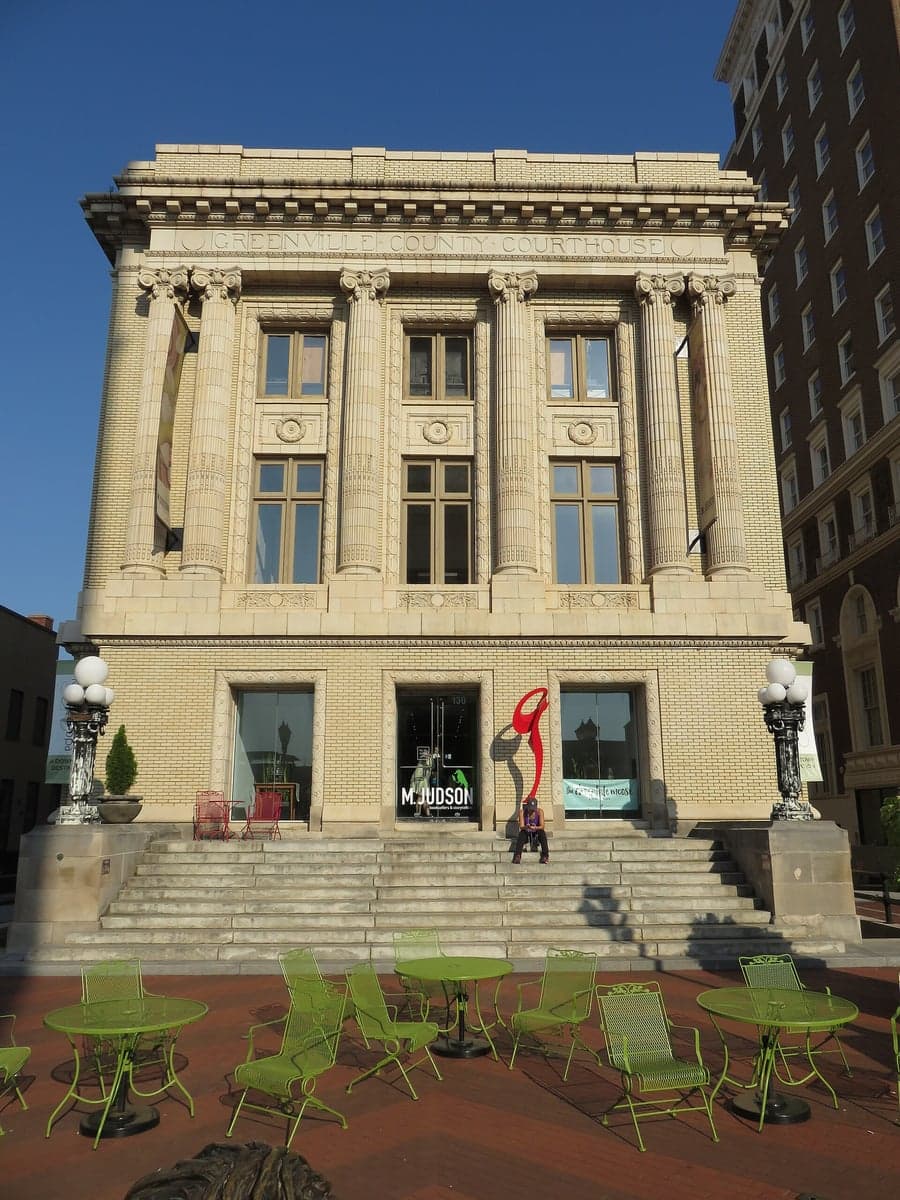
Photo: Wikipedia
Personal Sovereignty in Greenville County
Viable for self-reliance. Generally workable, though some barriers may limit total independence.
What does Personal Sovereignty tell us?
Personal Sovereignty measures your capacity for self-reliance and independence with minimal government friction. Higher scores mean fewer barriers between you and the way you want to live... but it assumes you have the space you need and good neighbors.
What does this tell us?
Personal Sovereignty measures your capacity for self-reliance and independence with minimal government friction. Higher scores mean fewer barriers between you and the way you want to live... but it assumes you have the space you need and good neighbors.
State Policy
Energy independence: Importer (25% of energy produced in-state)
Personal Liberty
Homesteading

Personal Liberty Analysis
Greenville County, South Carolina, offers a personal sovereignty environment shaped by a strong state-level conservative tilt and significant local variation between its urban core and rural outskirts. The county benefits from South Carolina’s relatively low tax burden, permitless carry law, and parental rights protections, but the degree of personal freedom you experience depends heavily on whether you settle inside the city of Greenville, a suburban suburb like Simpsonville, or a rural patch near Travelers Rest or Pelzer. For a relocation-minded individual or family seeking wide latitude in self-defense, property use, and daily autonomy, the county presents a range of options — from the light-touch regulatory atmosphere of unincorporated areas to the more structured rules of municipal zoning.
Tax burden and regulatory climate in Greenville County
South Carolina’s state-level tax structure is among the more favorable for personal sovereignty in the Southeast. The state levies a flat personal income tax of 6.4% as of 2026, with a standard deduction of $4,320 for single filers, and does not tax Social Security income. Property taxes in Greenville County are assessed at 6% of market value for owner-occupied homes, with a millage rate roughly 280 mills in the unincorporated county, producing effective rates around 0.5–0.7% of home value — well below the national average. Sales tax in the county is 8% (6% state, 2% county), which includes a 1% local option for transportation. The county’s regulatory posture is generally light-touch outside of municipal limits. In the city of Greenville, zoning is tighter, with strict setbacks, tree preservation ordinances, and historic district overlays that can delay home alterations. Farther out, in areas like Travelers Rest or Piedmont, the county’s zoning code allows for greater flexibility — agricultural uses, home-based businesses, and accessory dwelling units are easier to permit. Business licensing is handled at the city or county level, and South Carolina is a right-to-work state, meaning no forced union membership. For the self-employed or small-business owner, Greenville County’s unincorporated areas offer a lower regulatory hurdle than the city limits.
Self-defense laws and gun rights in Greenville County
South Carolina is a constitutional carry state: as of July 2024, any resident 18 or older who is legally allowed to possess a firearm may carry openly or concealed without a permit. This applies in Greenville County, though local ordinances prohibit firearms in certain government buildings and schools. The county has a strong shop-and-range culture, with indoor ranges such as Allen Arms in Greenville and outdoor facilities like Piedmont Gun Club. The state also has a Castle Doctrine and a Stand Your Ground law, providing broad legal protection for the use of deadly force in self-defense when facing unlawful force. In practical terms, this means a homeowner in Simpsonville or a homeowner in rural Slater-Marietta has a legal framework that presumes self-defense in a home invasion or confrontation. Deputies in the Greenville County Sheriff’s Office generally support these laws, and the county does not impose its own waiting periods or additional firearm registration requirements beyond state law. However, in the city of Greenville, a 2025 ordinance prohibits firearms in city parks, a restriction that does not apply in unincorporated county parks. For those prioritizing gun rights, residing outside city limits — in Fountain Inn or Greer — avoids these local overlays.
Homesteading viability and off-grid living options
Greenville County’s rural areas offer viable homesteading opportunities, but with some caveats. Lot sizes in the unincorporated county are generally zoned for a minimum of 1 acre in the A-1 (Agricultural) district, though many parcels in the northern part of the county, around Travelers Rest and Slater-Marietta, are commonly 2–5 acres and come with existing well water and septic systems. The county allows keeping of livestock — chickens, goats, horses — on parcels of 2 acres or more in the A-1 zone, with no limit on the number of chickens but a cap on larger animals. Beekeeping is permitted without a permit in unincorporated areas. Off-grid living is feasible but not entirely unrestricted: South Carolina law requires a septic system for any dwelling, and the county enforces minimum housing codes (habitable space, electrical, plumbing). Solar panels are allowed with a standard building permit, and rainwater collection is legal for non-potable uses. The county does not have a specific ban on composting toilets, but they must be approved by the health department. In Pelzer and Piedmont areas, properties are more likely to have existing wells and septic, reducing the need to connect to municipal utilities. The city of Greenville, by contrast, requires connection to city water and sewer for any new construction, making off-grid living there impractical. Overall, Greenville County is more homestead-friendly than the suburbs of Charlotte or Atlanta, but less so than more rural counties in the Upstate like Pickens or Oconee.
Personal liberties: parental rights, medical autonomy, and property protections
South Carolina has a Parents’ Bill of Rights (enacted 2023) that affirms parental authority over educational decisions, medical consent, and access to school records. In Greenville County, this means school districts — including Greenville County Schools, the largest in the state — must notify parents before any changes to a student’s services or identity markers, and parents can opt their children out of any curriculum they find objectionable. Medical autonomy is strong: the state prohibits mandatory COVID-19 vaccinations for any resident, and there is no legal requirement for routine childhood vaccines beyond school entry mandates (which have broad religious exemption options). In health care, the county has a mix of large hospital systems — Prisma Health, Bon Secours — and a growing number of direct-primary-care clinics and holistic providers. Property rights are protected by South Carolina’s strong eminent domain laws, which require public use and just compensation. The county’s planning commission holds public hearings on any zoning changes, and the process is generally transparent. Free speech is protected under the state constitution, and Greenville County has no local hate speech or speech codes beyond federal limits. For those concerned about government overreach, the county’s sheriff’s office has publicly stated it will not enforce federal firearms laws it deems unconstitutional, reflecting a local culture of limited government.
Compared to other high-growth areas in the Southeast, Greenville County offers a balanced sovereignty environment — not as permissive as rural Texas counties, but notably more protective of individual rights than the urban corridors of the Northeast or West Coast. The key is location: Greenville city imposes more rules on firearms, property use, and business operations, while Simpsonville, Greer, Travelers Rest, and Pelzer each offer distinct trade-offs in tax burden, zoning flexibility, and cultural alignment with personal independence. For a family or individual whose primary priority is maximum personal sovereignty, the unincorporated areas north and south of the city provide the most room to live, work, and defend yourself on your own terms.

* Values derived from national, state, county, city and local statistics and may differ in a specific area. Last updated: 2026-07-26T22:01:46.000Z
Narrative content on this page is AI-generated and may contain mistakes. Verify any details that matter before acting on them.
ReloMaps may earn a commission from affiliate links at no extra cost to you.

