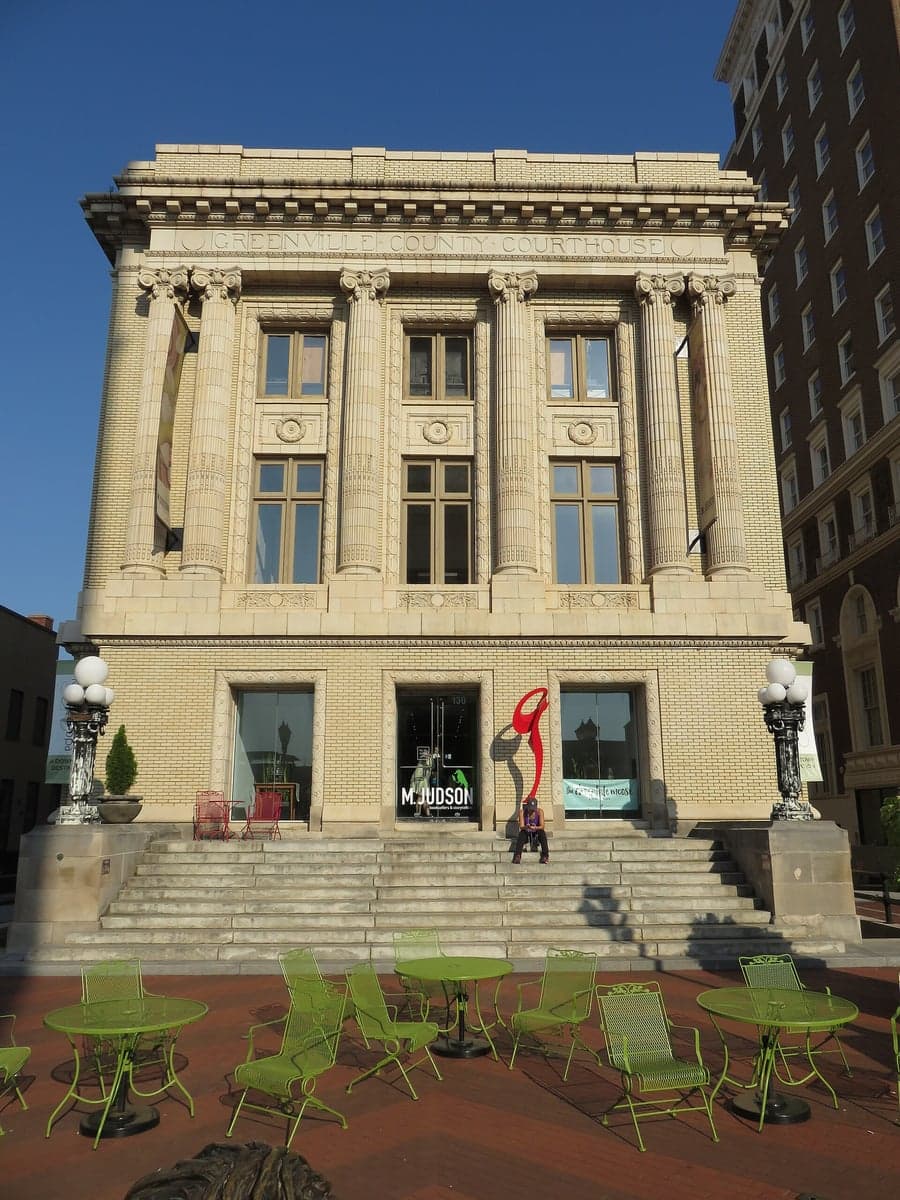
Photo: Wikipedia
Demographics of Greenville County
Affluence Level in Greenville County
A middle-class area roughly in line with national averages across income, home values, education, and employment.
People of Greenville County
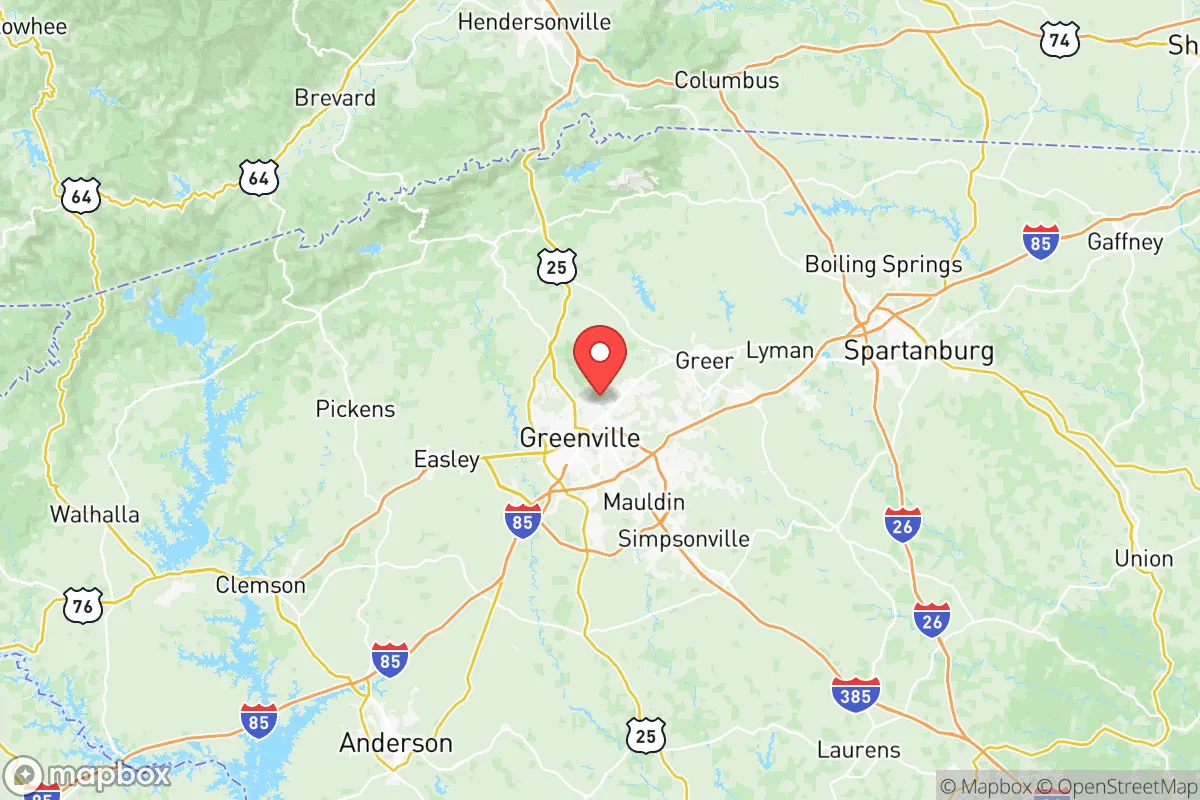
Greenville County’s 537,575 residents today form a rapidly diversifying Sun Belt hub, where a historically white, Protestant, and rural population has been reshaped by decades of corporate relocation, suburban expansion, and Hispanic immigration. The county is the economic engine of the Upstate, with a population density of roughly 650 people per square mile, concentrated in the city of Greenville and its surrounding suburbs like Mauldin, Simpsonville, and Greer. Distinctive markers include a strong evangelical Christian presence, a booming manufacturing and logistics sector, and a growing professional class drawn by companies like Michelin, BMW, and Prisma Health.
Settlement & growth (pre-1960)
Before European contact, the area now known as Greenville County was part of the Cherokee Nation’s vast hunting grounds, with the Cherokee town of Keowee located just to the north in present-day Pickens County. The Cherokee were forcibly removed after the American Revolution, and by the 1790s, white settlers—primarily of Scots-Irish and English descent—began arriving from Virginia, North Carolina, and Pennsylvania. They were drawn by cheap land grants in the Piedmont foothills, and they established small farms and crossroads communities such as Pleasantburg (the original name for Greenville), Fountain Inn, and Travelers Rest.
Cotton agriculture dominated the early 19th century, and by the 1820s, Greenville’s location along the fall line made it a natural hub for textile mills. The first cotton mill opened in 1822, and by the 1880s, the county was dotted with mill villages—company-owned housing for workers—in places like West Greenville, Poe Mill, and Monaghan Mill. These mills drew a largely white, native-born workforce from the surrounding countryside, with few immigrants compared to Northern industrial cities. The county’s Black population, which had grown during Reconstruction as freed people moved to towns for work, was largely confined to segregated neighborhoods like Southernside and Nicholtown in Greenville, and to rural areas near Simpsonville and Fountain Inn.
The Great Depression and the decline of the textile industry in the mid-20th century hit Greenville County hard. Many mill villages closed, and the county’s population growth slowed to a crawl. By 1950, the county was still overwhelmingly white (roughly 80%) and native-born, with a small Black minority and virtually no foreign-born population. The post-World War II era brought the first significant suburbanization, as returning veterans used GI Bill mortgages to buy homes in new developments like Augusta Road and East North Street, but the county remained a quiet, conservative, and largely rural place until the 1960s.
Modern era (post-1965)
The 1965 Hart-Cellar Act had little immediate effect on Greenville County, as the region lacked the industrial or agricultural pull for large-scale immigration. Instead, the county’s modern demographic transformation began with the arrival of foreign automotive and manufacturing investment in the 1970s and 1980s. Michelin opened its North American headquarters in Greenville in 1975, followed by BMW’s announcement of a major plant in nearby Greer in 1992. These facilities, along with a growing logistics and distribution sector, began attracting a new wave of domestic migrants from the Rust Belt—engineers, managers, and skilled tradespeople from Michigan, Ohio, and Pennsylvania—who settled in suburbs like Simpsonville and Five Forks.
Hispanic immigration began accelerating in the 1990s, driven by construction, landscaping, and poultry processing jobs. The Hispanic population grew from less than 1% in 1990 to 11.2% today, with the largest concentrations in West Greenville, San Souci, and parts of Mauldin. This community is predominantly Mexican and Central American, with smaller numbers of Puerto Ricans and Cubans. The Black population, which had declined during the mid-20th century as textile jobs disappeared, stabilized at 16.4% today, with many families now living in suburban areas like Simpsonville and Fountain Inn as well as historic neighborhoods in Greenville proper.
The East/Southeast Asian population (1.4%) and Indian subcontinent population (1.0%) are smaller but growing, concentrated in professional and tech sectors. Many Asian families have settled in Greer and Five Forks, drawn by jobs at BMW, Michelin, and the expanding Prisma Health system. The Indian community, while small, has established a visible presence in the Pelham Road area of Greenville, with temples and cultural organizations. The county’s foreign-born share remains low at 4.9%, but the domestic migration from the Northeast and Midwest has been substantial, making the county whiter (65.8%) than the state average but more diverse than its own past.
The future
Greenville County is projected to become more diverse over the next 10-20 years, driven by continued Hispanic growth and domestic migration from more diverse regions. The Hispanic share is expected to rise to 15-18% by 2040, with new communities forming in Travelers Rest and Piedmont as housing costs push families outward from central Greenville. The Black population is likely to remain stable or grow slightly, while the Asian and Indian populations will continue to expand as the county’s tech and healthcare sectors grow. The white population, while still the majority, will see its share decline as the county becomes more multiethnic.
Suburbanization will continue to reshape the county, with new master-planned communities in Five Forks, Reidville, and Fountain Inn attracting families from both inside and outside the region. The county’s cultural identity is evolving from a quiet, evangelical, textile-mill past to a more cosmopolitan, professional, and politically moderate Sun Belt hub. The city of Greenville itself is becoming a magnet for young professionals and retirees from the Northeast, while the outer suburbs remain more conservative and family-oriented.
Greenville County is becoming a more diverse, more suburban, and more economically dynamic place than it was a generation ago. For someone moving in now, the county offers a mix of traditional Southern culture and modern Sun Belt opportunity, with a growing population that is increasingly Hispanic and Asian, but still anchored by a white, native-born majority. The key trend to watch is the continued dispersion of new residents into the outer suburbs, which will keep the county’s character more suburban than urban, and more family-oriented than cosmopolitan.

* Values derived from national, state, county, city and local statistics and may differ in a specific area. Last updated: 2026-07-26T22:01:46.000Z
Narrative content on this page is AI-generated and may contain mistakes. Verify any details that matter before acting on them.
ReloMaps may earn a commission from affiliate links at no extra cost to you.

