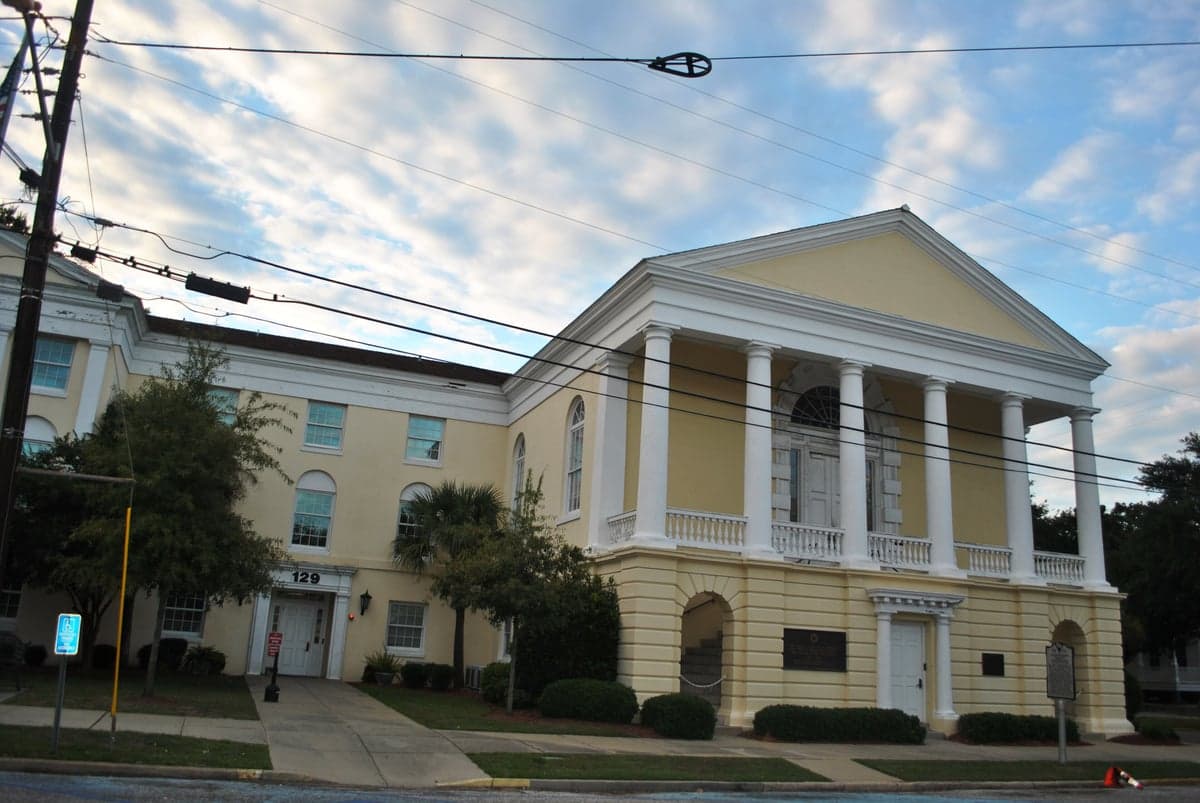
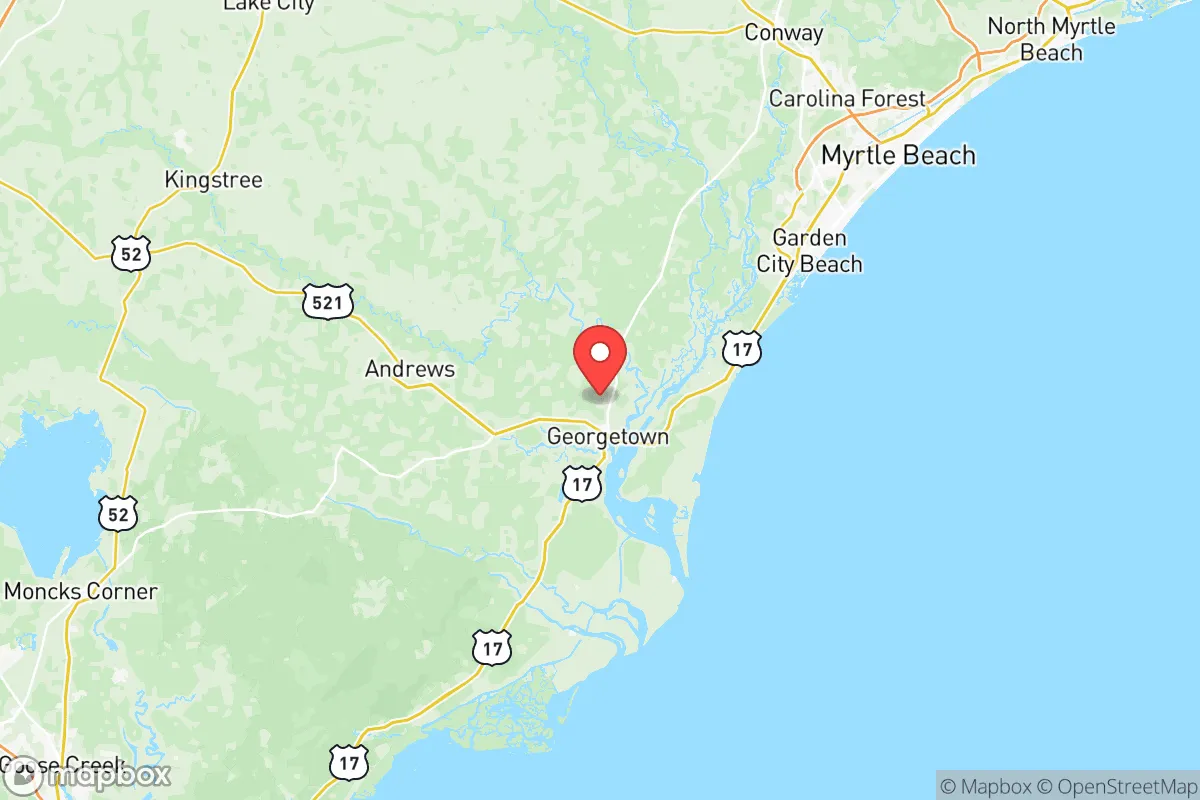
Photo: Wikipedia
Political ClimatePolitical Climate in Georgetown County
Showing district-level results — no local-only data available.
Local Political AnalysisPolitical Analysis of Georgetown County
Georgetown County, South Carolina, is a reliably conservative area with a Cook Partisan Voting Index of R+12, making it significantly more Republican than the state as a whole (R+8). This isn't a new trend; the county has voted for the GOP presidential candidate in every election since 2000, though the margins have tightened slightly in recent cycles as the coastal areas see an influx of retirees and remote workers from more moderate states. The real story, however, is the internal divide between the rural, deeply red inland communities and the more politically mixed coastal towns.
How it compares
Compared to South Carolina at large, Georgetown County is about 4 points more conservative on the Cook PVI scale, which translates to a consistent 10-15 point gap in actual election results. For example, in the 2024 presidential race, the county went for the Republican candidate by roughly 58% to 40%, while the statewide margin was closer to 55% to 43%. The biggest driver of this difference is the county's rural character: the inland towns of Andrews and Pawleys Island (the mainland portion, not the beach) are deeply conservative, with precincts often voting 70%+ Republican. In contrast, the historic waterfront city of Georgetown itself is the county's blue dot, with its downtown and waterfront precincts often splitting 50-50 or even leaning slightly Democratic, driven by a mix of artists, preservationists, and younger professionals. The swing precincts are in the unincorporated areas around Murrells Inlet and Litchfield Beach, where new housing developments attract a mix of retirees from the Northeast and younger families, making those precincts more competitive (typically 52-55% Republican).
What this means for residents
For conservative residents, the R+12 lean means local governance is reliably aligned with their values. County council races are usually decided in the Republican primary, and the school board, sheriff's office, and planning commission are all dominated by conservatives. Property taxes are low, and there is strong resistance to new zoning regulations or public transit initiatives. For liberal residents, the political reality is one of being a clear minority, but not an invisible one. The city of Georgetown provides a small but active Democratic base, and the county's growing retiree population has made local elections slightly more competitive than they were a decade ago. You won't see many progressive policy wins at the county level, but the city of Georgetown itself has managed to maintain a more inclusive, arts-friendly character. The practical impact is that social issues like gun rights and abortion access are non-negotiable in county politics, while economic development debates often split along growth vs. preservation lines rather than strict party lines.
Culturally, Georgetown County stands apart from the rest of the state in one key way: its fierce protection of the natural environment. The county is home to the Waccamaw National Wildlife Refuge and the Huntington Beach State Park, and there is a bipartisan consensus that overdevelopment is the enemy. This has led to some unusual political alliances, where conservative landowners and liberal environmentalists both oppose large-scale resort projects or new highway expansions. The county's Gullah Geechee heritage also plays a role, particularly in the rural areas around Pawleys Island and Georgetown, where historic preservation is a cross-party value. If you're moving here, expect a place where the politics are red, but the pace is slow, and the biggest fights are often about how many trees to cut down, not which party is in charge.

State Political ClimatePolitical Climate in South Carolina
State Political AnalysisPolitical Environment in the State
South Carolina is a solidly Republican state, with a Cook PVI of R+8, but that number only tells part of the story. The state has shifted rightward over the past 10-20 years, driven by the rapid growth of conservative-leaning retirees and families moving into the coastal and upstate regions, even as the traditional Democratic stronghold in the rural Lowcountry has eroded. The dominant coalition is a mix of evangelical conservatives, fiscal hawks, and a growing number of transplants from the Northeast and Midwest who are drawn to low taxes and a slower pace of life, but the state’s politics are far from monolithic — the urban centers of Charleston, Columbia, and Greenville each have their own distinct flavor, and the rural-urban divide is sharp and getting sharper.
Urban vs. rural divide
The political map of South Carolina is a classic tale of three metros and a whole lot of countryside. Charleston is the most politically competitive area in the state — the city itself and its inner suburbs like Mount Pleasant lean blue, driven by a growing professional class, a strong tourism economy, and a historically significant Black population. But as you move just 15 minutes west into Summerville or up the coast toward Myrtle Beach, the landscape flips hard red. Greenville and the entire Upstate region are the engine of the state’s conservative majority — this is the heart of the evangelical vote, with megachurches, a booming manufacturing and logistics sector, and a steady stream of transplants from the Rust Belt who are looking for lower taxes and fewer regulations. Columbia, the capital, is a purple island in a red sea: the city proper is reliably Democratic, thanks to the University of South Carolina and a sizable state government workforce, but the surrounding suburbs like Lexington and Irmo are deeply conservative. The rural counties — especially in the Pee Dee region around Florence and the Lowcountry around Beaufort — are overwhelmingly Republican, with the notable exception of the historic Black Belt counties like Allendale and Orangeburg, which still vote heavily Democratic but have shrinking populations.
Policy environment
South Carolina’s policy environment is designed to attract business and limit government growth. There is a flat state income tax that is being phased down to 6.2% by 2026, and the state has no estate tax and a relatively low property tax burden, though sales taxes can be high in some counties (up to 9% in Charleston). The regulatory posture is broadly pro-business, with a right-to-work law and a tort reform system that caps noneconomic damages in medical malpractice cases. On education, the state has a robust charter school and school choice movement — the Education Scholarship Trust Fund program, passed in 2023, provides state dollars for private school tuition, which is a major draw for conservative families. Healthcare is a mixed bag: the state did not expand Medicaid under the Affordable Care Act, leaving a coverage gap for low-income adults, but it has a strong network of rural hospitals and a growing telehealth infrastructure. Election laws are among the more restrictive in the South — voter ID is required, early voting was expanded to two weeks in 2022, but absentee voting requires an excuse, and the state has purged inactive voters from the rolls regularly. The state also has a near-total abortion ban, with exceptions only for the life of the mother, rape, or incest, which was enacted in 2023 after the Dobbs decision.
Recent policy direction
The last few years have seen South Carolina double down on conservative priorities across the board. On gun rights, the state passed constitutional carry in 2024, allowing permitless concealed carry for anyone 18 or older who can legally possess a firearm — this was a major win for the gun rights movement and a clear signal of where the legislature stands. On parental and education rights, the state passed the "Parents' Bill of Rights" in 2023, which requires schools to notify parents about curriculum changes and gives them the right to opt their children out of certain instruction, and the "Transparency in Education" law that bans the teaching of critical race theory in public schools. On speech and privacy, the state has not passed a comprehensive data privacy law, but it did enact a ban on TikTok on government devices in 2023. On medical and bodily autonomy, the abortion ban is the most significant piece of legislation, but the state also passed a law in 2024 restricting gender-affirming care for minors, banning puberty blockers, hormone therapy, and surgery for those under 18. On property rights, the state has a strong eminent domain protection law, and there is no statewide rent control. On taxation, the flat tax rate is being reduced incrementally, and the state eliminated the corporate income tax surcharge in 2022. On voting and ballot access, the state passed a law in 2021 that shortened the absentee ballot application window and banned the mass mailing of absentee ballot applications, which was seen as a tightening of access by critics and a security measure by supporters.
Civil unrest & political movements
South Carolina has a relatively low level of visible civil unrest compared to some other states, but there are active political movements on both sides. The most visible flashpoint in recent years was the 2020 protests in Columbia and Charleston following the murder of George Floyd, which were largely peaceful but did see some property damage and a heavy police presence. The state has a strong and organized conservative grassroots movement, particularly around gun rights and school choice — the annual "Second Amendment Rally" at the Statehouse in Columbia draws thousands of attendees. Immigration politics are less heated here than in border states, but there is a vocal faction pushing for stricter enforcement, and the state has a law requiring all employers to use E-Verify. There is no sanctuary city policy anywhere in the state — in fact, the legislature passed a law in 2024 prohibiting any local government from adopting such policies. Secession and nullification rhetoric is mostly confined to fringe groups and online spaces, but the state’s history with the Confederate flag — which was removed from the Statehouse grounds in 2015 after the Charleston church shooting — still resonates, and the debate over monuments and symbols continues in local communities. Election integrity controversies have been relatively muted compared to states like Georgia or Arizona, but there was a high-profile audit of the 2020 election in Horry County (Myrtle Beach) that found no evidence of widespread fraud, though it did recommend some procedural changes.
Projection
Over the next 5-10 years, South Carolina is likely to become even more Republican, but with a more suburban and less rural flavor. The in-migration from the Northeast and Midwest is accelerating — places like Greenville, Spartanburg, and the Grand Strand are growing fast, and these new residents tend to be fiscally conservative but socially moderate, which could create tension with the more socially conservative native population. The Democratic Party’s base is shrinking in rural areas but growing in the suburbs of Charleston and Columbia, and if the party can turn out young voters and transplants in those metros, it could make the state more competitive at the presidential level — but that’s a long shot. The biggest wildcard is the state’s economy: if the manufacturing and logistics boom in the Upstate continues, the conservative coalition will hold; if a recession hits and the housing market cools, the anti-incumbent sentiment could open the door for more moderate or even Democratic candidates in some districts. For someone moving in now, expect the political environment to remain broadly conservative, with a focus on low taxes, school choice, and gun rights, but with a growing undercurrent of suburban moderation that could shift the tone of the debate even if it doesn’t flip the outcomes.
For a new resident, the bottom line is this: if you’re conservative, you’ll find a state that largely aligns with your values on taxes, education, and personal liberties, and you’ll be moving into a growing community of like-minded people. If you’re liberal, you’ll find vibrant blue enclaves in Charleston, Columbia, and parts of Greenville, but you’ll need to be comfortable living in a state where your views are in the minority on most policy issues. The practical takeaway is that South Carolina is a place where your vote matters less in statewide races but can make a real difference in local elections — school boards, city councils, and county commissions are where the real action is, and they’re often decided by a few hundred votes. Come for the low taxes and the beaches, stay for the community, but know that the politics here are as much about where you live as who you vote for.
* Values derived from national, state, county, city and local statistics and may differ in a specific area. Last updated: 2026-06-16T00:22:57.000Z
Narrative content on this page is AI-generated and may contain mistakes. Verify any details that matter before acting on them.
ReloMaps may earn a commission from affiliate links at no extra cost to you.

