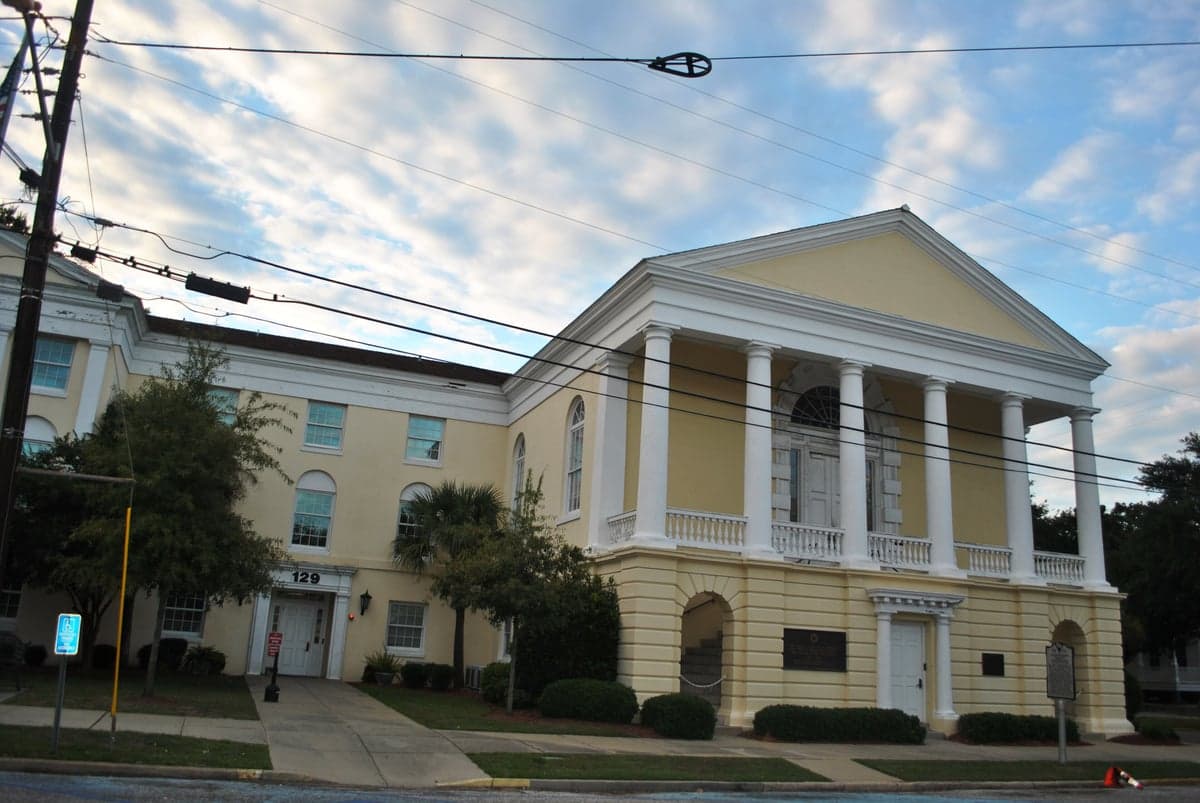
Photo: Wikipedia
Personal Sovereignty in Georgetown County
Viable for self-reliance. Generally workable, though some barriers may limit total independence.
What does Personal Sovereignty tell us?
Personal Sovereignty measures your capacity for self-reliance and independence with minimal government friction. Higher scores mean fewer barriers between you and the way you want to live... but it assumes you have the space you need and good neighbors.
What does this tell us?
Personal Sovereignty measures your capacity for self-reliance and independence with minimal government friction. Higher scores mean fewer barriers between you and the way you want to live... but it assumes you have the space you need and good neighbors.
State Policy
Energy independence: Importer (25% of energy produced in-state)
Personal Liberty
Homesteading

Personal Liberty Analysis
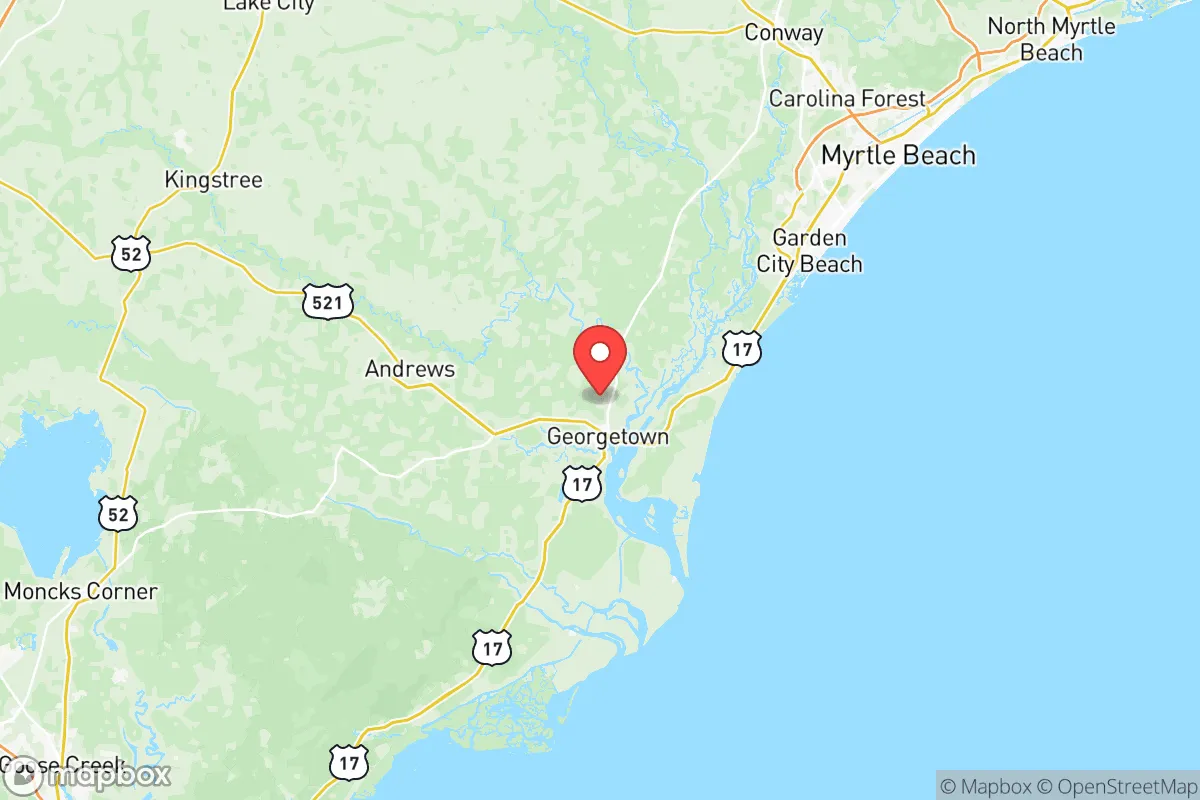
Georgetown County offers a notably high degree of personal sovereignty relative to most coastal South Carolina counties, with a light regulatory touch in unincorporated areas and a tax climate that rewards self-reliance. The county seat of Georgetown, the beach communities of Pawleys Island and Murrells Inlet, and the inland town of Andrews each sit on a spectrum of permissiveness, but the overarching environment favors property rights, gun ownership, and homesteading freedom more than what you would find in Charleston or even Horry County to the north.
Tax burden and regulatory posture for residents and property owners
South Carolina's tax structure already leans favorably for those seeking to keep more of their earnings, and Georgetown County adds no outsized local burden. The state's flat income tax rate dropped to 6.2% for 2025 with scheduled reductions toward 6.0%, and there is no state estate or inheritance tax. Property taxes in Georgetown County are assessed at the state-mandated 4% for owner-occupied primary residences (on the first $50,000 of value exempted from school operating taxes) and 6% for second homes and rental properties — a split that makes long-term ownership more tenable than in states with uniform high rates. The county's millage rate sits around 100–110 mills depending on the specific district, which keeps annual tax bills on a $300,000 home in the $1,000–$1,500 range, significantly lower than comparable properties in Charleston County. Regulatory posture is generally light-touch, especially outside city limits. The unincorporated areas around Andrews and the rural stretches near Plantersville have no countywide zoning for agricultural uses, meaning you can keep livestock, run a small farm stand, or build a workshop without navigating a thicket of permits. The city of Georgetown itself has a historic district overlay that tightens rules on exterior modifications, but those restrictions are limited to a defined zone near the waterfront and do not extend into the broader county. Building permits are processed efficiently, with no county-level impact fees on new construction, and the local government has not adopted the kind of growth-management ordinances seen in Beaufort County or Mount Pleasant.
Self-defense and gun law specifics across the county
Georgetown County is firmly within South Carolina's strong firearm-rights framework, and local law enforcement culture aligns with that posture. South Carolina became a constitutional carry state in March 2023, so anyone lawfully allowed to possess a handgun can carry it openly or concealed without a permit — no training requirement, no fee, no government permission slip. For those who still want a permit for reciprocity purposes (e.g., travel to states that recognize permits but not permitless carry), the Georgetown County Sheriff's Office issues South Carolina CWP permits with a typical turnaround of 30–60 days, and the process is straightforward: a certified training course and a background check. The county has no additional restrictions beyond state law, meaning no local waiting periods, no bans on standard-capacity magazines, and no additional registration schemes. Shooting ranges are accessible — the Georgetown County Sheriff's Office operates a public range near the county complex, and private clubs like the Hobcaw Gun Club offer membership options. "No gun" signage posted by businesses carries force of law only if the property is posted with a specific statutory notice, but enforcement is rarely aggressive. In Murrells Inlet, a tourist-heavy area, businesses tend to be more gun-friendly than similar zones in Myrtle Beach, and most restaurants and bars along the Marsh Walk respect lawful carry. Pawleys Island, a gated beach community, permits firearm possession consistent with state law, though rental properties may have their own rules. The broader county culture strongly supports self-defense rights, and public spaces like the Waccamaw National Wildlife Refuge allow lawful carry under federal law that defers to state statutes.
Self-reliance and homesteading viability, including lot sizes, zoning, and off-grid feasibility
For those wanting to live off the grid or run a small homestead, Georgetown County is more accommodating than any coastal county between it and Charleston. In unincorporated areas, there is no countywide minimum lot size for single-family homes on septic and well — the effective minimum is driven by the state Department of Health and Environmental Control's septic system requirements, which typically demand one to two acres for a conventional system depending on soil percolation rates. This makes it feasible to buy a three- to five-acre parcel near Andrews or along the rural roads west of U.S. 17 and set up a self-sufficient property without fighting zoning appeals. Livestock keeping is unrestricted in most of the county, with no limit on chickens, goats, or even cattle on parcels that meet minimum acreage for manure management. Off-grid solar is legal and common — there are no county-level bans on solar panels or battery storage, and net metering is available through Dominion Energy and Santee Cooper, the two primary electric providers. Rainwater collection for non-potable uses (irrigation, livestock) is unrestricted; for potable use, it is not prohibited, but DHEC recommends treatment standards that are easy to meet with off-the-shelf filtration. Composting toilets and graywater systems are permissible under DHEC's alternative onsite wastewater rules, and several rural properties in the county operate entirely off the municipal water and sewer grid. The biggest practical constraint is floodplain regulation — portions of the county near the Waccamaw River and the coast are in FEMA flood zones, which can require elevation certificates and flood insurance for new construction. Choosing a parcel in the Sampit community or the higher ground around Georgetown city's western edges avoids most of that complication. The county does not have an aggressive code enforcement presence in rural areas, so you are largely left alone to manage your property as you see fit, provided you meet basic health and safety requirements for structures and septic.
Personal liberties: parental rights, medical autonomy, free speech, and property rights
Georgetown County sits in a state that has prioritized parental rights and medical freedom in recent legislation. South Carolina's 2024 Parents' Bill of Rights gives parents the explicit authority to direct the upbringing, education, and healthcare decisions for their children, including the right to opt out of any public-school curriculum or activity they find objectionable. Local school districts — Georgetown County School District and the charter options in the area — respect these opt-out rights in practice, and school board meetings in Georgetown County have been generally civil compared to more contentious districts elsewhere. On medical autonomy, South Carolina does not have a broad medical freedom statute, but it also has no county-level mandates that override a patient's right to refuse treatment or choose alternative therapies. The state's 2023 ban on gender-affirming care for minors and its protection for healthcare providers who decline to participate in procedures they find objectionable reflect the area's social conservatism. Vaccine mandates for employment are uncommon in the county, and law enforcement has not enforced any federal public-health orders locally since 2022. Free speech and property rights are strongly protected under state law. The county has no sign ordinances that restrict political or religious expression on private property, and there are no local hate-speech codes or content-based restrictions on public expression. The most significant property-rights protection is South Carolina's Private Property Rights Protection Act, which requires governments to prove that a land-use regulation does not "unreasonably diminish" property value — a meaningful check on overreach that does not exist in many states. The county's planning department takes a pragmatic approach: if your proposed use is not explicitly prohibited in the zoning code (and in unincorporated areas, the code is permissive by default), you are generally free to proceed without a special hearing.
Overall, Georgetown County ranks among the most sovereignty-friendly coastal areas in the Southeast. The combination of a low and falling state income tax, no local income tax, constitutionally protected gun carry, rural zoning that allows homesteading without special permits, and strong parental and property rights creates an environment where self-reliance is not just tolerated but structurally supported. Compared to the tighter regulatory climates in Beaufort County, Charleston County, or any of the over-regulated enclaves along the Florida coast, Georgetown County offers a genuinely lighter touch — especially if you choose the rural stretches around Andrews or Sampit over the more restrictive beachfront communities. For a single individual or a family who values independence and wants to maximize personal autonomy without living in a remote mountain county, this is a practical coastal option that delivers on the freedom metrics that matter most.

* Values derived from national, state, county, city and local statistics and may differ in a specific area. Last updated: 2026-06-16T00:22:57.000Z
Narrative content on this page is AI-generated and may contain mistakes. Verify any details that matter before acting on them.
ReloMaps may earn a commission from affiliate links at no extra cost to you.

