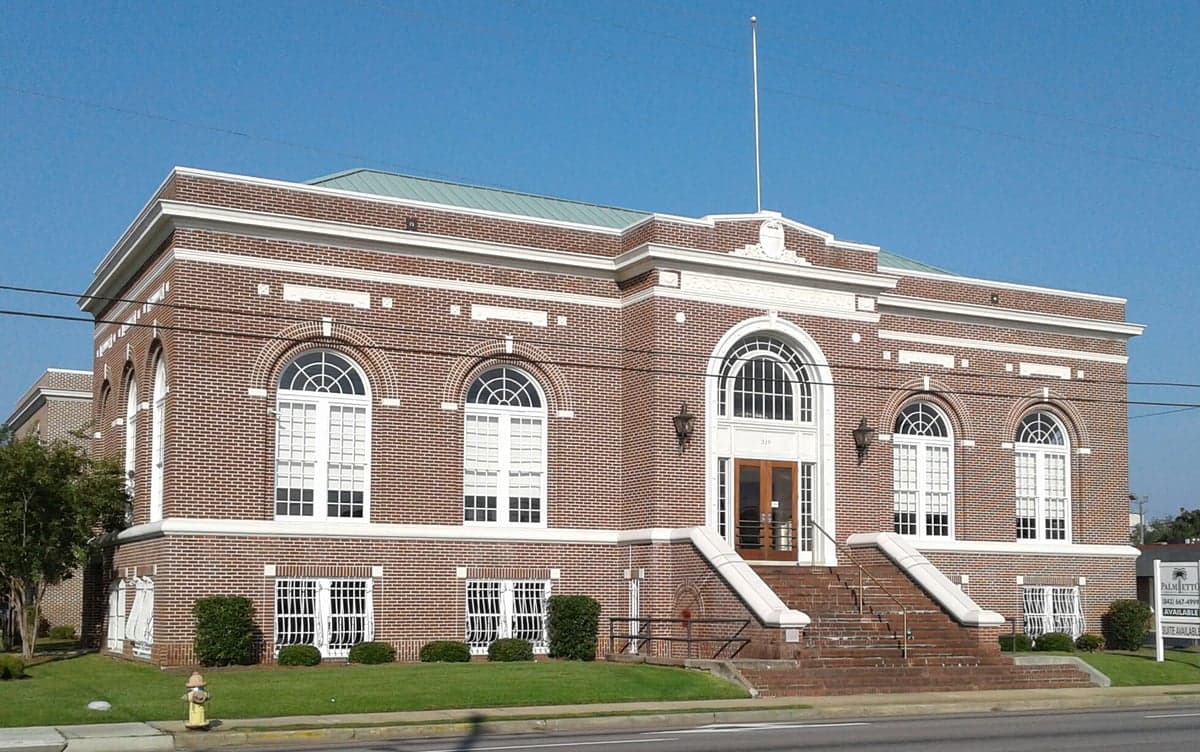
Photo: Wikipedia
Political ClimatePolitical Climate in Florence County
Showing district-level results — no local-only data available.
Local Political AnalysisPolitical Analysis of Florence County
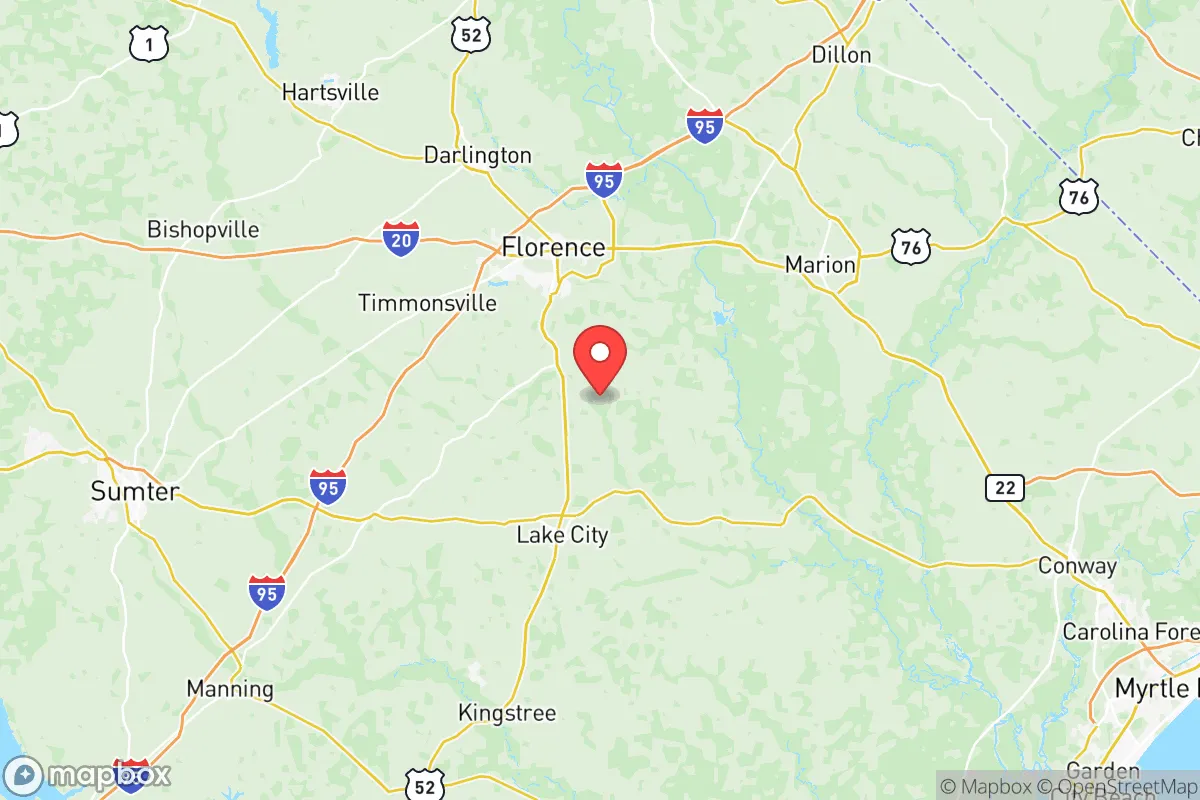
Florence County is a reliably Republican stronghold in South Carolina’s Pee Dee region, carrying a Cook Partisan Voting Index (PVI) of R+12 — four points more conservative than the state’s overall R+8 rating. That gap has widened over the past decade as rural precincts have shifted right faster than the state average, though the county’s political geography is far from monolithic. The city of Florence itself, home to roughly 40,000 people, contains the county’s only reliably blue precincts — particularly around downtown and near Francis Marion University — while the surrounding towns like Lake City, Pamplico, and Timmonsville lean heavily red. The swing precincts are mostly in the suburban fringe of Florence, especially along the I-95 corridor near the Darlington County line, where ticket-splitting is still common in local races.
How it compares to South Carolina as a whole
Florence County’s R+12 PVI places it among the more conservative counties in a state that’s already solidly Republican. For context, neighboring Darlington County is R+11, while more rural Dillon County is R+14. The state’s R+8 average is pulled leftward by the Charleston and Columbia metro areas, which are closer to R+4 or even lean Democratic in some precincts. In Florence County, the Republican edge is driven by strong turnout in the rural and small-town precincts — places like Effingham and Quinby routinely deliver 70-75% of the vote for GOP candidates. By contrast, the city of Florence’s urban core votes about 55-60% Democratic in presidential elections, though its lower turnout means it doesn’t offset the rural margins. This urban-rural split is more pronounced in Florence County than in the state overall, where suburban growth in the Upstate and Lowcountry has created more competitive swing areas.
What this means for residents
For conservative residents, the county’s lean means local offices — from the county council to the sheriff — are almost always held by Republicans, and policy debates tend to center on tax rates, infrastructure, and economic development rather than social issues. The county commission has been reliably GOP since the early 2000s, and the last Democrat to hold a countywide office left in 2014. For liberal residents, the political reality is one of limited local representation, though the city of Florence itself provides a more progressive pocket — the city council has had Democratic members consistently, and the mayor’s office has flipped between parties. State-level representation is solidly Republican: the county’s three state House seats and one state Senate seat are all held by GOP incumbents, with the most competitive race in 2024 seeing a 12-point margin. Practically, this means conservative residents see their priorities reflected in local zoning, school board decisions, and law enforcement funding, while liberal residents often focus their energy on city-level issues or statewide advocacy through groups like the Pee Dee Democratic Caucus.
Culturally, Florence County stands apart from the state’s coastal and Upstate regions by its slower pace and deeper roots in agriculture and manufacturing. The county’s politics are shaped less by the culture-war battles that dominate state-level headlines and more by bread-and-butter concerns: the health of the local hospital system, the condition of rural roads, and the availability of jobs outside of the service sector. The presence of Francis Marion University and the McLeod Health system injects a moderate, professional-class influence into local politics, especially in the city of Florence, where bond referendums for schools and parks often pass with bipartisan support. In the smaller towns, the political culture is more personal — candidates are known by name, and local races often turn on family ties and church connections rather than party labels. That’s changing slowly as national polarization seeps into local races, but for now, Florence County remains a place where a Republican can win a countywide race by 20 points while still losing the city of Florence by 5.

State Political ClimatePolitical Climate in South Carolina
State Political AnalysisPolitical Environment in the State
South Carolina has a solid Republican lean, rated R+8 on the Cook Partisan Voting Index, meaning it votes about eight points more Republican than the national average in presidential elections. The dominant coalition is a blend of traditional conservatives in the Upstate and Lowcountry, evangelical Christians, and a growing number of fiscally conservative transplants from the Northeast and Midwest. Over the last 20 years, the state has shifted from a competitive purple state—it voted for George W. Bush by 6 points in 2000—to a reliably red one, with Donald Trump winning it by 12 points in 2020 and by a similar margin in 2024. The Democratic base is increasingly concentrated in the urban core of Columbia, Charleston, and a few majority-minority rural counties, but the state’s overall trajectory is toward deeper Republican control.
Urban vs. rural divide
The political map breaks down along clear geographic lines. The Upstate, anchored by Greenville and Spartanburg, is the state’s most reliably Republican region. Greenville County itself voted 58% for Trump in 2020, and the surrounding counties—Pickens, Oconee, Anderson—are even redder. The Lowcountry, including Charleston and Beaufort, is more mixed: Charleston County went 56% for Biden in 2020, driven by the city’s growing tech and tourism economy and a younger, more diverse population. But the suburban and exurban parts of Charleston County, like Mount Pleasant and Summerville, lean Republican, and Beaufort County (home to Hilton Head) is solidly red. The Midlands, centered on Columbia, is a battleground within the state: Richland County (Columbia proper) is heavily Democratic, but Lexington County, just across the river, is one of the most Republican suburban counties in the nation. Rural counties like Allendale and Marlboro in the Pee Dee region are predominantly Black and vote Democratic, but their populations are small and shrinking. The real driver of the state’s Republican lean is the fast-growing suburban and exurban ring around Greenville, Charleston, and Columbia, where transplants from blue states often adopt the local conservative politics.
Policy environment
South Carolina’s policy environment is defined by low taxes and limited government. The state has a flat income tax rate of 6.2% (phasing down to 6% by 2026), no state estate tax, and a sales tax cap of 6% (with local add-ons). Property taxes are among the lowest in the nation, especially for owner-occupied homes, thanks to a 6% assessment ratio cap. The regulatory posture is business-friendly: South Carolina is a right-to-work state, and the state’s economic development agency aggressively recruits manufacturing and tech firms. Education policy is a flashpoint: the state has a robust school choice program, including the Education Scholarship Trust Fund (vouchers for private school tuition), but public school funding remains below the national average. Healthcare is a mixed bag: South Carolina did not expand Medicaid under the Affordable Care Act, leaving roughly 200,000 residents in the coverage gap, but the state has a strong network of rural hospitals and telehealth initiatives. Election laws are restrictive by national standards: voter ID is required, early voting was expanded to two weeks in 2022, but absentee voting requires an excuse. The state also has a strict six-week abortion ban (the “Fetal Heartbeat Act”), with no exceptions for rape or incest, though a court challenge is ongoing.
Recent policy direction
Recent legislation points toward a continued conservative trajectory. In 2023, the state passed a permitless carry law (Constitutional Carry), allowing any adult who can legally own a firearm to carry it concealed without a permit. The same year, the legislature passed a Parents’ Bill of Rights, requiring schools to notify parents of any changes to a student’s health or well-being (including gender identity) and banning instruction on sexual orientation in K-5 classrooms. On education, the state expanded its school voucher program to cover all families, regardless of income, by 2025. On property rights, the state strengthened eminent domain protections, requiring governments to prove a “public use” and pay fair market value plus relocation costs. On voting, the state tightened ballot access by banning ballot harvesting and requiring signature verification for absentee ballots. On medical and bodily autonomy, the state banned gender-affirming care for minors in 2024, and the six-week abortion ban remains in effect. On privacy and surveillance, the state passed a data privacy law in 2023 that gives residents the right to opt out of data collection, but it’s weaker than California’s. On speech, the state has no hate speech law, and campus free speech protections were strengthened in 2022. The overall direction is toward more individual liberty on guns and parental rights, but less on reproductive and transgender issues.
Civil unrest & political movements
South Carolina has a history of civil rights activism, but recent political movements are more subdued than in many states. The 2020 Black Lives Matter protests in Charleston and Columbia were large but largely peaceful, and the state’s Confederate monument debate has been mostly settled: the Confederate flag was removed from the Statehouse grounds in 2015 after the Charleston church shooting, and most local governments have left monuments in place. Immigration politics are less heated than in border states: South Carolina has no sanctuary cities, and the state passed a law in 2024 requiring local law enforcement to cooperate with ICE. Election integrity controversies flared after 2020, with some Republican activists alleging fraud, but no major scandals emerged. The state’s most visible political movement is the growing influence of the “Freedom Caucus” in the state legislature, which pushes for further tax cuts, school choice, and gun rights. On the left, the Working Families Party has a small but active presence in Charleston and Columbia, focusing on affordable housing and police reform. A new resident would notice that political activism is less visible than in swing states: most people keep their politics private, and the state’s culture is generally polite and avoidant of confrontation.
Projection
Over the next 5-10 years, South Carolina will likely become more Republican, not less. The state’s population is growing by about 1.5% annually, driven by domestic migration from the Northeast and Midwest. These newcomers tend to be older, wealthier, and more conservative than the national average, and they settle in the suburban rings of Greenville, Charleston, and Myrtle Beach. The Democratic base is aging and shrinking in rural areas, while the urban cores of Columbia and Charleston are growing but not fast enough to offset the suburban gains. The state’s Hispanic population is growing (now about 7% of the state), but they vote Republican at higher rates than Hispanics nationally. The biggest wild card is the state’s Black population (about 27% of the state), which votes overwhelmingly Democratic but is slowly declining as a share of the electorate. By 2030, expect the state to be R+10 or R+12, with Republicans holding supermajorities in both chambers of the legislature. A new resident moving in now should expect a political environment that is stable, conservative, and unlikely to shift dramatically, with continued emphasis on tax cuts, school choice, and gun rights.
For a new resident, the bottom line is straightforward: South Carolina offers a low-tax, business-friendly environment with strong protections for gun owners and parents, but limited access to abortion and gender-affirming care. Conservatives will find a welcoming political culture with a growing economy and affordable housing. Liberals will find a state where their votes are unlikely to change the outcome of statewide elections, but where local politics in Charleston or Columbia can still feel competitive. The state’s political trajectory is clear: more of the same, with a steady march rightward. If you’re moving here, expect a place where politics is less central to daily life than in many states, but where the policy direction is unmistakably conservative.
* Values derived from national, state, county, city and local statistics and may differ in a specific area. Last updated: 2026-07-03T11:24:49.000Z
Narrative content on this page is AI-generated and may contain mistakes. Verify any details that matter before acting on them.
ReloMaps may earn a commission from affiliate links at no extra cost to you.

