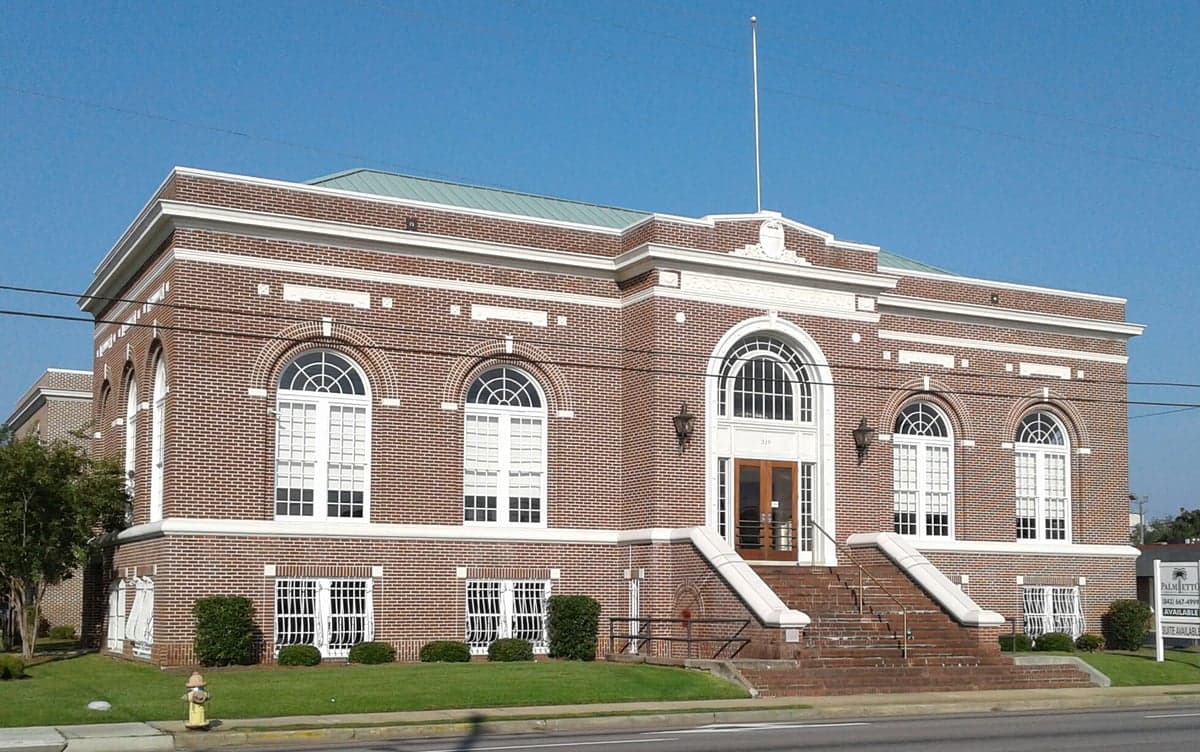
Photo: Wikipedia
Demographics of Florence County
Affluence Level in Florence County
A below-average socioeconomic profile. Incomes, home values, and educational attainment trail the U.S., with higher poverty and unemployment.
People of Florence County
Florence County, South Carolina, is a community of roughly 137,000 residents defined by a near-even split between White (49.9%) and Black (42.9%) populations, with a small but growing Hispanic (3.2%) and Asian (1.6%) presence. Its people are predominantly native-born (only 1.5% foreign-born) and rooted in a history of agricultural labor, railroad commerce, and post-Civil War settlement patterns that have created a distinctly Southern, biracial character. The county’s identity is shaped by its role as a regional medical and retail hub, anchored by the city of Florence, while its rural towns retain a slower, agrarian pace. For a relocating family or individual, this is a place where community ties run deep, racial lines remain visible, and the economy is steadily diversifying beyond its historical dependence on tobacco and textiles.
Settlement & growth (pre-1960)
Long before European settlers arrived, the area now known as Florence County was the domain of the Pee Dee and Waccamaw Native American tribes, who lived along the Great Pee Dee River and its tributaries. These groups were largely displaced or decimated by disease and conflict by the early 1700s, as English colonists from the coastal lowcountry pushed inland. The first permanent European settlers were primarily of English and Scots-Irish stock, arriving in the mid-18th century to farm the fertile river bottoms. They established small, scattered communities such as Effingham (founded circa 1740) and Mars Bluff, which became early centers of plantation agriculture.
The county’s true founding moment came with the railroad. In the 1850s, the Wilmington and Manchester Railroad laid tracks through the area, and a depot was established at a spot originally called “Wild’s Ferry.” This depot grew into the city of Florence, named after the daughter of a railroad official, and was incorporated in 1871. The railroad brought a wave of laborers, merchants, and professionals, transforming Florence from a rural crossroads into a commercial hub. The county itself was formed in 1888 from parts of Marion, Darlington, and Williamsburg counties, with Florence city as the seat. By 1900, the population was roughly 60% White and 40% Black, a ratio that reflected the region’s heavy reliance on cotton and tobacco farming, worked largely by sharecropping and tenant farming systems that kept many Black families in poverty.
The early 20th century saw modest industrial growth. The Atlantic Coast Line Railroad established major repair shops in Florence in the 1910s, drawing skilled workers—mostly White—from across the Southeast. Meanwhile, the Great Migration (1910–1970) saw tens of thousands of Black residents leave Florence County for Northern industrial cities like New York and Philadelphia, seeking better wages and escaping Jim Crow segregation. This outflow, combined with agricultural mechanization, began to shift the county’s demographic balance. By 1950, the population was 135,000, with a White majority of about 55%. Small towns like Lake City, Pamplico, and Scranton remained predominantly agricultural, with Black communities concentrated in rural hamlets such as Olanta and Quinby, where churches and schools served as social anchors.
Modern era (post-1965)
The 1965 Hart-Cellar Act, which ended national-origin quotas, had a minimal direct impact on Florence County due to its low foreign-born population. Instead, the post-1965 era was defined by domestic migration and suburbanization. The civil rights movement brought desegregation to schools and public accommodations, but also accelerated White flight from the city of Florence to newer suburbs like West Florence and South Florence. These areas, developed from the 1970s onward, attracted middle-class families seeking larger lots and newer homes, while the city’s core saw a growing concentration of Black residents and lower-income households.
The decline of tobacco farming in the 1980s and 1990s hit rural communities hard. Johnsonville and Pamplico lost population as younger residents left for jobs in Charlotte, Columbia, or Charleston. However, Florence city itself reinvented itself as a medical and retail hub. The expansion of McLeod Health and the Carolinas Hospital System (now part of MUSC Health) drew healthcare professionals from across the state and nation, many of them White and middle-class, settling in the Florence city limits and its suburbs. The arrival of a Walmart distribution center and a few light manufacturing plants brought some Hispanic workers, primarily from Mexico and Central America, who settled in small numbers in Florence and Lake City. Today, the Hispanic population stands at 3.2%, still small but growing, concentrated in service and construction jobs.
The Asian population, at 1.6%, is split between East/Southeast Asian communities (1.0%) and Indian-subcontinent residents (0.6%). Many of these families are professionals—doctors, engineers, and academics—drawn by the medical and educational sectors. They tend to live in the Florence city area, near the hospitals and Francis Marion University. The Indian community, while small, has established a visible presence through a Hindu temple and cultural organizations. The Black population, at 42.9%, remains heavily concentrated in the city of Florence and in rural communities like Olanta and Scranton, where poverty rates are higher and educational attainment lower (the county’s college-educated rate is just 23.6%).
The future
Florence County is slowly becoming more diverse, but the pace is glacial compared to the rest of the Sun Belt. The Hispanic and Asian populations are projected to grow modestly, driven by healthcare and manufacturing jobs, but the county’s low foreign-born share (1.5%) means it will remain overwhelmingly native-born for the foreseeable future. The White and Black populations are likely to remain in near parity, with the Black share possibly edging slightly higher as younger White families continue to move to coastal or metropolitan areas. Suburbanization will continue around Florence city, with new developments spreading toward Effingham and Quinby, while rural towns like Pamplico and Johnsonville may see further population loss.
The county’s cultural identity is evolving, but slowly. The old biracial, Southern framework is being nudged by a small but growing Hispanic presence, particularly in the service sector, and by a professional class that is more diverse and educated. However, political and social divisions remain along racial and geographic lines, with the city of Florence leaning more Democratic and the rural areas more Republican. For a newcomer, the county offers a stable, affordable, and community-oriented environment, but one where the legacy of segregation and the challenges of economic mobility are still very much present.
In short, Florence County is a place in transition—from a tobacco-and-textile past to a healthcare-and-logistics future. Its people are rooted, resilient, and increasingly diverse, but the change is incremental. For someone moving in now, the county offers a lower cost of living and a slower pace than the booming coastal cities, but also a community where history, race, and place still shape daily life in tangible ways.

* Values derived from national, state, county, city and local statistics and may differ in a specific area. Last updated: 2026-07-03T11:24:49.000Z
Narrative content on this page is AI-generated and may contain mistakes. Verify any details that matter before acting on them.
ReloMaps may earn a commission from affiliate links at no extra cost to you.

