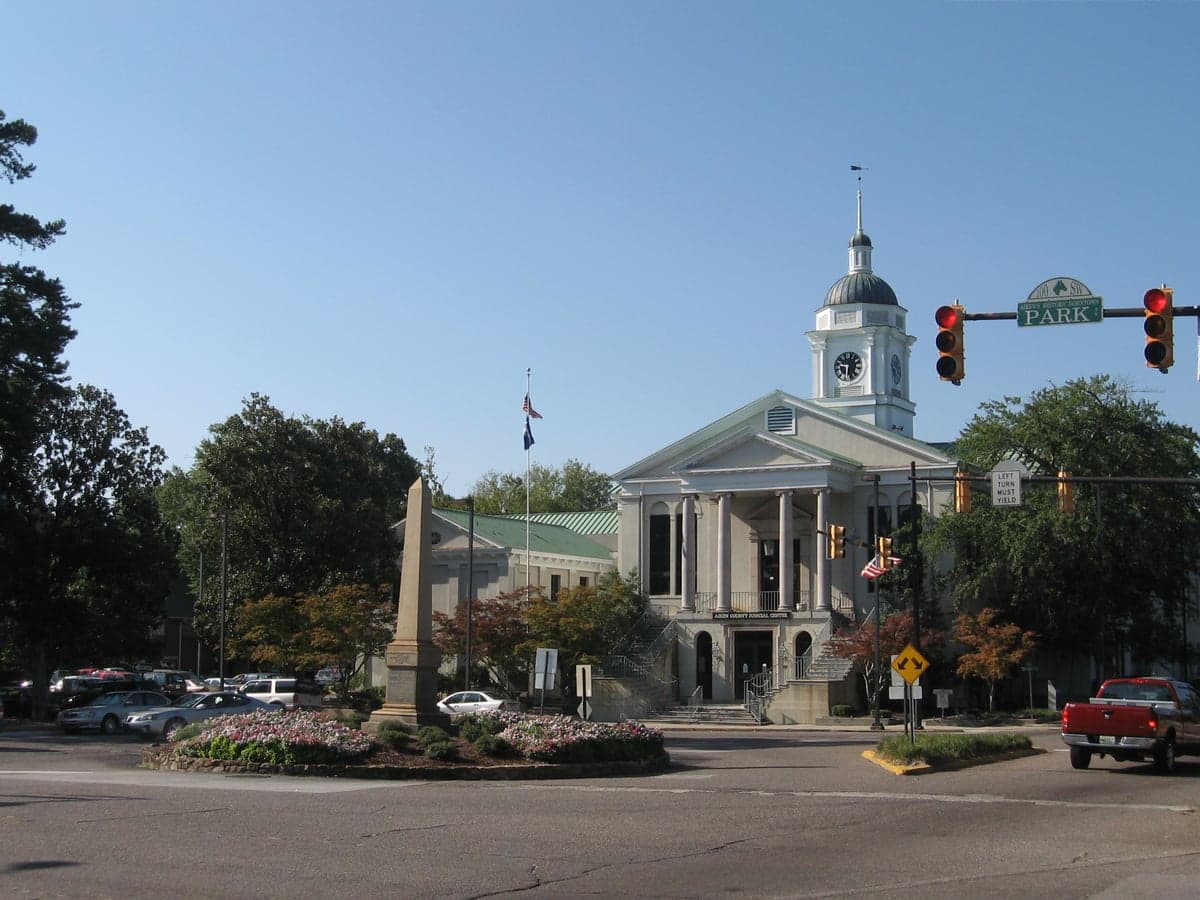
Photo: Wikipedia
Political ClimatePolitical Climate in Aiken County
Showing district-level results — no local-only data available.
Local Political AnalysisPolitical Analysis of Aiken County
Aiken County leans solidly Republican with a Cook PVI of R+7, making it slightly more competitive than South Carolina as a whole (R+8) but still firmly in red territory. The county has been reliably Republican for decades, though the margins have tightened in some precincts as the population grows and diversifies, particularly around the city of Aiken itself and the Savannah River Site employment corridor. The overall trajectory is one of slow, steady Republican dominance, with local elections often decided in the primaries rather than the general election.
How it compares
At first glance, Aiken County's R+7 looks nearly identical to the state's R+8, but the internal dynamics tell a more nuanced story. The city of Aiken proper, especially its historic downtown and neighborhoods near USC Aiken, has a noticeable Democratic presence — precincts there can swing 5-10 points bluer than the county average. In contrast, the rural northern and eastern parts of the county, including towns like Wagener, Salley, and Monetta, vote heavily Republican, often delivering margins of 70% or more for GOP candidates. The swing precincts tend to cluster along the I-20 corridor and around the horse country areas south of the city, where a mix of retirees, professionals, and newcomers from more moderate states creates a more competitive environment. Compared to the state, Aiken County's Republican lean is slightly softer than the deep-red Upstate (Greenville, Spartanburg) but harder than the coastal areas around Charleston, which have trended bluer in recent cycles.
What this means for residents
For conservative residents, the political climate is comfortable and familiar. Local government, school boards, and county council are reliably Republican, and conservative values are reflected in policy decisions around taxes, development, and public safety. Republicans can expect their votes to count in primaries, which often determine the outcome of local races. For liberal residents, the reality is more about finding community within a minority. Democratic voters tend to concentrate in the city of Aiken and in the neighborhoods near the Savannah River Site, where a more diverse workforce lives. Activism and progressive organizing exist but are less visible than in Columbia or Charleston. The practical effect is that both sides can participate in local governance, but the agenda is set by the majority. The county's growth — driven by the Savannah River Site, the Savannah River National Laboratory, and the broader Augusta-Aiken metro area — is slowly shifting the political center of gravity, but not fast enough to change the overall lean in the near term.
Culturally, Aiken County stands apart from the rest of South Carolina in a few notable ways. The equestrian tradition — the city is known as "the polo capital of the South" — brings a distinct, somewhat aristocratic flavor to local politics, with land-use and conservation issues often taking center stage. The presence of the Savannah River Site, a major federal employer, also means that federal funding and nuclear policy are perennial local concerns, cutting across party lines. The county's proximity to Augusta, Georgia, creates a cross-border dynamic that softens some of the sharper edges of South Carolina politics, as many residents work, shop, and consume media in Georgia. This blend of horse country, nuclear science, and Southern tradition gives Aiken County a political culture that is conservative but not uniformly so — pragmatic, locally focused, and slow to change.

State Political ClimatePolitical Climate in South Carolina
State Political AnalysisPolitical Environment in the State
South Carolina is a solidly Republican state with a Cook PVI of R+8, meaning it typically votes about eight points more Republican than the national average. The dominant coalition is a blend of traditional conservatives in the suburbs and rural areas, evangelical Christians, and a growing number of transplants from more liberal states who often lean right on economic issues. Over the last 10-20 years, the state has shifted from a reliably red but occasionally competitive state (it went for George W. Bush by 6 points in 2004) to a deeper shade of red, with Trump winning it by 12 points in 2020 and 18 points in 2024. The Democratic stronghold is shrinking to just a few urban cores and the rural, predominantly African American "Corridor of Shame" counties along the I-95 corridor, while the suburbs and exurbs around Charleston, Greenville, and Columbia have become reliably Republican.
Urban vs. rural divide
The political map of South Carolina is a study in contrasts. The major metros—Charleston, Greenville, and Columbia—are the economic engines, but their politics diverge sharply. Charleston County is the state's most competitive large county, with a Democratic lean driven by the city of Charleston itself and the surrounding barrier islands, while the northern suburbs like Mount Pleasant and Summerville are reliably Republican. Greenville County, once a conservative stronghold, has seen the city of Greenville itself trend leftward with an influx of young professionals and out-of-state transplants, but the county as a whole still votes Republican by double digits thanks to the exurbs and rural areas. Columbia (Richland County) is a Democratic bastion, anchored by the state capital and the University of South Carolina, while the surrounding Lexington County is one of the most Republican counties in the state. The rural "Lowcountry" and "Pee Dee" regions—places like Florence, Myrtle Beach, and Beaufort—are deeply red, driven by older, white, and evangelical voters. The I-95 corridor, running through counties like Allendale and Williamsburg, remains the only reliably Democratic rural area, powered by a high concentration of African American voters.
Policy environment
South Carolina's policy environment is distinctly conservative. The state has a flat income tax rate of 6.4% (phasing down to 6.0% by 2026), no estate tax, and a relatively low property tax burden thanks to a 6% assessment cap on owner-occupied homes. Sales tax is 6% at the state level, with local options adding up to 2-3%. The regulatory posture is business-friendly, with a right-to-work law and a low unionization rate. Education policy is a hot-button issue: the state has a robust school choice program, including the Education Scholarship Trust Fund (vouchers for private school), and a strong charter school presence. Healthcare is a mixed bag—the state did not expand Medicaid under the ACA, leaving roughly 200,000 residents in the coverage gap, but it has a relatively high number of federally qualified health centers. Election laws are among the stricter in the South: voter ID is required, early voting was expanded to two weeks in 2022, but absentee voting requires an excuse (though a "no-excuse" bill passed in 2024). The state also has a "stand your ground" self-defense law and a permitless carry law (Constitutional Carry) passed in 2024.
Recent policy direction
The last few years have seen a flurry of conservative legislation that signals where the state is headed. On gun rights, the 2024 permitless carry law (H. 3594) allows any legal gun owner to carry a concealed weapon without a permit, making South Carolina the 29th state to do so. On parental and education rights, the 2023 "Parents' Bill of Rights" (H. 3728) requires schools to notify parents of any changes to a child's mental, emotional, or physical health, effectively banning classroom discussion of gender identity without parental consent. The state also passed a near-total abortion ban in 2023 (the "Fetal Heartbeat Act"), with exceptions only for rape, incest, and the life of the mother. On property rights, the state has a strong "Dillon's Rule" framework, meaning local governments have only the powers explicitly granted by the state, which limits local zoning and rent control experiments. On taxation, the 2022 "Tax Cut and Jobs Act" accelerated the income tax rate reduction and doubled the standard deduction. On voting and ballot access, the 2022 "Election Integrity Act" (S. 108) tightened absentee ballot rules, banned ballot harvesting, and required a photo ID for all in-person voting. The state has not expanded Medicaid, and there is no state-level privacy law akin to California's CCPA, though a 2023 bill to create a data privacy framework (S. 399) is still pending.
Civil unrest & political movements
South Carolina has a history of civil rights activism, but recent political movements have been more focused on conservative cultural issues. The "Moms for Liberty" chapter in Berkeley County (outside Charleston) was one of the most active in the country, pushing for book bans and curriculum transparency. The "Stand for Health Freedom" movement, opposing vaccine mandates, had a strong presence in the Upstate (Greenville-Spartanburg area) during 2021-2022. On the left, the "Indivisible" movement has chapters in Charleston and Columbia, focusing on voting rights and abortion access. Immigration politics are relatively muted compared to border states, but the 2023 "Sanctuary City" ban (S. 576) prohibits any local government from adopting sanctuary policies, and the state has a law requiring all law enforcement to cooperate with ICE. The "Confederate flag" debate, which dominated state politics for decades, was largely settled in 2015 when the flag was removed from the Statehouse grounds after the Charleston church shooting. There is no serious secession or nullification rhetoric in the mainstream, though some far-right groups have advocated for "county supremacy" movements in rural areas like Oconee County. Election integrity remains a flashpoint: the 2020 election saw no major fraud in the state, but the 2022 law tightened procedures, and some activists continue to push for hand-counting of ballots.
Projection
Over the next 5-10 years, South Carolina is likely to become even more Republican, but with a more suburban, professional-class flavor rather than the old-school rural evangelical base. The state is one of the fastest-growing in the country, with net in-migration of about 90,000 people per year, many from New York, New Jersey, and California. These transplants tend to be more moderate on social issues but strongly conservative on taxes and regulation, which will push the state further toward a "low tax, low service" model. The Democratic Party will continue to hold the Charleston city core and the I-95 corridor, but the suburbs of Greenville and Columbia are likely to become more Republican as the exurbs fill in. The biggest wildcard is the Myrtle Beach area (Horry County), which is growing explosively and is already deeply red. Expect continued battles over school choice (expansion of vouchers), abortion (potential further restrictions), and election laws (possible move to all-mail voting or further tightening). The state's political trajectory is clear: a slow, steady march to the right, tempered only by the moderating influence of new residents who care more about low taxes than culture wars.
For a new resident, the bottom line is this: if you're a conservative, you'll find a state that largely aligns with your values on taxes, guns, and education, with a government that is actively moving in your direction. If you're a liberal, you'll find a state where your vote counts little in statewide elections, but where cities like Charleston and Columbia offer progressive enclaves with good schools and a vibrant cultural scene. The practical takeaway is that South Carolina is a place where your personal freedoms—especially around property, business, and self-defense—are broadly protected, but where the social safety net is thin and public services are limited. It's a state that rewards self-reliance and punishes dependence, and that's unlikely to change anytime soon.
* Values derived from national, state, county, city and local statistics and may differ in a specific area. Last updated: 2026-07-10T21:24:49.000Z
Narrative content on this page is AI-generated and may contain mistakes. Verify any details that matter before acting on them.
ReloMaps may earn a commission from affiliate links at no extra cost to you.

