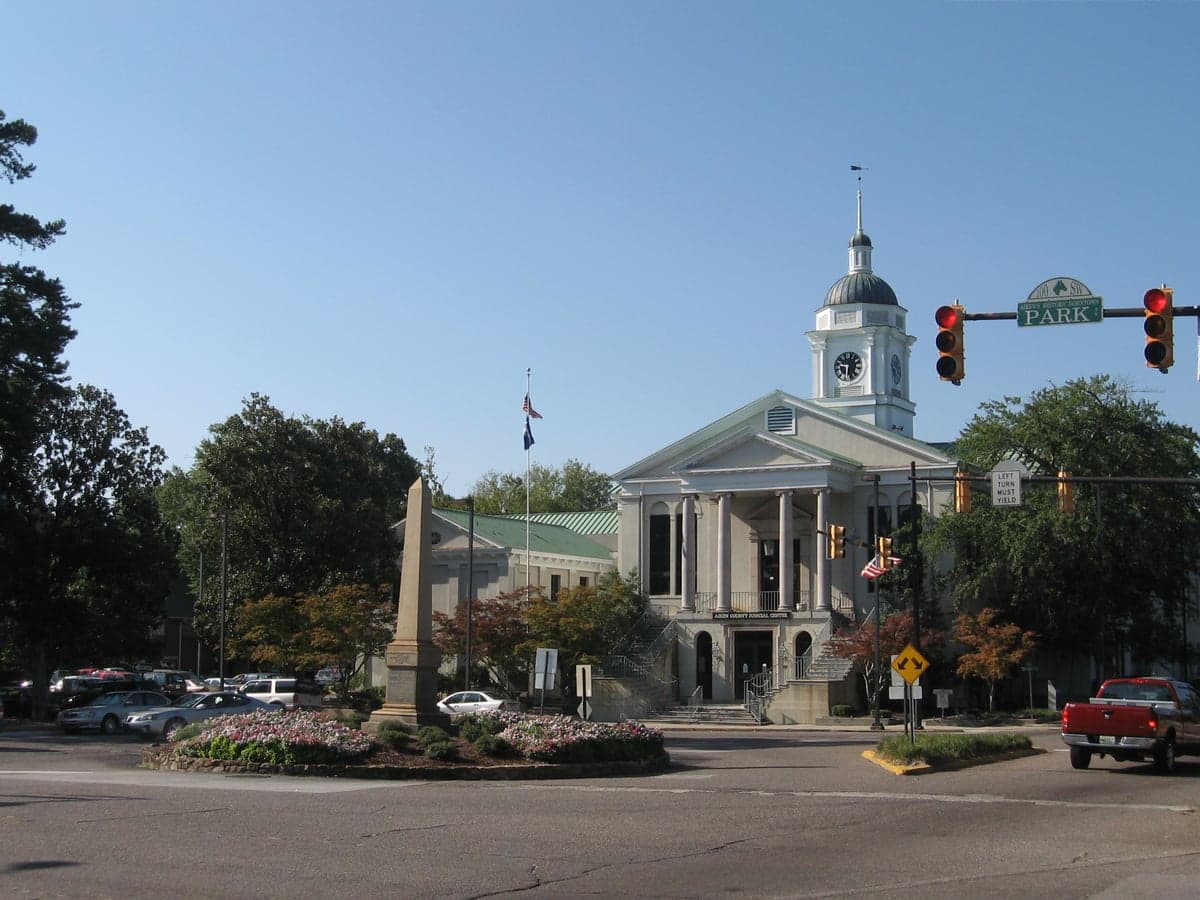
Photo: Wikipedia
Personal Sovereignty in Aiken County
Viable for self-reliance. Generally workable, though some barriers may limit total independence.
What does Personal Sovereignty tell us?
Personal Sovereignty measures your capacity for self-reliance and independence with minimal government friction. Higher scores mean fewer barriers between you and the way you want to live... but it assumes you have the space you need and good neighbors.
What does this tell us?
Personal Sovereignty measures your capacity for self-reliance and independence with minimal government friction. Higher scores mean fewer barriers between you and the way you want to live... but it assumes you have the space you need and good neighbors.
State Policy
Energy independence: Importer (25% of energy produced in-state)
Personal Liberty
Homesteading

Personal Liberty Analysis
Aiken County, South Carolina, offers a notably high degree of personal sovereignty, grounded in South Carolina's broad preemption laws, a light regulatory touch outside of the Aiken city limits, and a deeply embedded culture of self-reliance. For individuals and families prioritizing autonomy over government oversight, the county presents a strategic advantage compared to much of the Southeast, particularly in areas like Graniteville, Wagener, and rural Edgefield County borders where local ordinances are minimal. The balance of power tilts heavily toward the individual, with the state constitution and recent legislation actively limiting the reach of local governments.
Tax burden and regulatory posture in Aiken County
South Carolina's tax structure is a primary driver of personal financial sovereignty. The state imposes a flat income tax rate of 6.4% (as of 2026, with scheduled reductions toward a flat 6.0%), but Aiken County's property tax burden is exceptionally low. The effective property tax rate on owner-occupied homes hovers around 0.5% of assessed value, one of the lowest in the nation. There is no county-level inventory tax on business equipment, and the state's homestead exemption shields up to $50,000 of a home's value from school operating taxes for residents over 65 or those with disabilities. Regulatory posture varies sharply by municipality. The City of Aiken enforces a traditional zoning code and building permits, but unincorporated areas—including much of the land around Montmorenci, Windsor, and Salley—operate with minimal county oversight. There is no county-wide building code for agricultural structures, and many rural parcels are zoned for general use without the overlay districts common in more regulated states. The county's planning department is understaffed relative to its size, meaning enforcement is complaint-driven rather than proactive, a de facto advantage for those seeking to develop land without bureaucratic friction.
Self-defense and gun law specifics in Aiken County
South Carolina is a "shall issue" state for concealed weapons permits, and Aiken County's sheriff's office processes permits efficiently, typically within 30-45 days. The state enacted constitutional carry (permitless carry) in 2024, allowing any law-abiding resident 18 or older to carry a concealed firearm without a permit. This applies fully within Aiken County, including the City of Aiken, though private property owners and businesses may post signage to restrict carry. The county has no local ordinances that exceed state law on firearms; state preemption is absolute, preventing cities like Aiken or North Augusta from enacting magazine capacity bans, waiting periods, or registration requirements. Stand-your-ground law is codified in South Carolina Code § 16-11-440, with no duty to retreat in any place where the individual has a legal right to be. The sheriff's office in Aiken County is publicly supportive of Second Amendment rights, and the county's gun culture is visible: shooting ranges are common in rural areas, and firearm sales at local pawn shops and dedicated dealers in Graniteville and Langley are a routine part of commerce. For residents moving from restrictive states, the shift in legal posture is immediate and unambiguous.
Self-reliance and homesteading viability in Aiken County
Homesteading and off-grid living are genuinely viable in Aiken County, particularly outside the urbanized corridor along I-20. Minimum lot sizes in unincorporated areas are generally 1 acre for a single-family dwelling on septic, though many parcels in the county's western and southern reaches—around Wagener, Perry, and the Savannah River border—are sold in 5- to 20-acre tracts. There is no county-wide ban on rainwater collection, and South Carolina law explicitly protects the right to harvest rainwater (S.C. Code § 6-4-10). Solar panel installation is permitted without special county approval, and net metering is available through Aiken Electric Cooperative and Dominion Energy, though the payout rate is lower than retail. Off-grid living without utility connections is legal, provided the property meets septic and well requirements; the county health department inspects wells and septic systems but does not mandate connection to municipal water or sewer. Raising livestock—chickens, goats, cattle—is unrestricted in agricultural zoning, which covers most of the county outside city limits. The City of Aiken restricts backyard chickens to 6 hens (no roosters) on lots under 1 acre, but this does not apply in unincorporated areas. For those seeking maximum autonomy, the rural tracts near the Savannah River Site buffer zone offer deep privacy and minimal neighbor interaction, though buyers should verify any conservation easements that may restrict development.
Personal liberties in Aiken County: parental rights, medical autonomy, and property
South Carolina has become a focal point for parental rights in education. The state's "Parental Bill of Rights" (S.C. Code § 59-29-110 et seq.) grants parents explicit authority over their children's medical decisions, educational records, and curriculum objections. Aiken County Public Schools, the 10th-largest district in the state, has a conservative school board that generally defers to parental opt-out requests for sex education and sensitive materials. Medical autonomy is more constrained: South Carolina maintains a near-total abortion ban after approximately 6 weeks (fetal heartbeat), with no exceptions for rape or incest, only for life of the mother or fatal fetal anomaly. This is a binding state law that applies uniformly across Aiken County. Vaccine mandates are not enforced at the county level; the state legislature has passed laws prohibiting proof-of-vaccination requirements for government services and public schools. Property rights are strongly protected under South Carolina's "private property rights" act, which requires governments to demonstrate a compelling interest before restricting land use. Aiken County's zoning board of appeals is known for granting variances, particularly for agricultural uses and home-based businesses. The county does not have a noise ordinance that applies to rural areas, and there is no county-wide ban on burning yard waste, though the South Carolina Forestry Commission regulates open burning during drought conditions.
Overall, Aiken County ranks among the most sovereignty-friendly areas in the Carolinas for those who value low taxes, minimal regulation, and strong self-defense rights. The county's political culture—consistently Republican by 20+ points in presidential elections—reinforces a hands-off approach from local government. Compared to the Atlanta suburbs or Charlotte metro, Aiken County offers a materially lighter regulatory burden, especially for homesteaders and those seeking to live without HOA oversight. The primary trade-offs are limited public transit, slower internet in deep rural areas, and the proximity of the Savannah River Site, which imposes some federal security restrictions on land use near the plant. For the reader who prioritizes personal freedom and independence, Aiken County is a strong candidate, particularly if they choose a home in the unincorporated areas rather than within the City of Aiken or North Augusta's stricter municipal codes.

* Values derived from national, state, county, city and local statistics and may differ in a specific area. Last updated: 2026-07-10T21:24:49.000Z
Narrative content on this page is AI-generated and may contain mistakes. Verify any details that matter before acting on them.
ReloMaps may earn a commission from affiliate links at no extra cost to you.

