
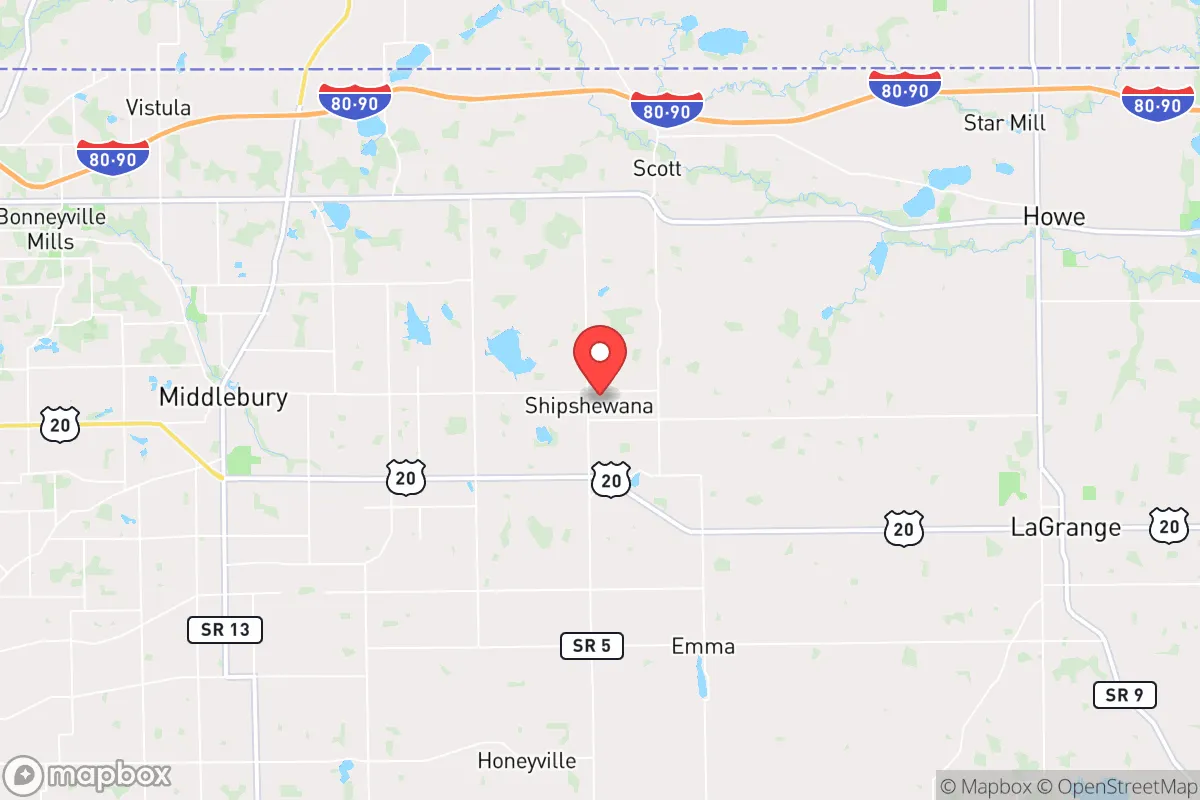
Photo: Wikipedia
Personal Sovereignty in Shipshewana, IN
Viable for self-reliance. Generally workable, though some barriers may limit total independence.
What does Personal Sovereignty tell us?
Personal Sovereignty measures your capacity for self-reliance and independence with minimal government friction. Higher scores mean fewer barriers between you and the way you want to live... but it assumes you have the space you need and good neighbors.
What does this tell us?
Personal Sovereignty measures your capacity for self-reliance and independence with minimal government friction. Higher scores mean fewer barriers between you and the way you want to live... but it assumes you have the space you need and good neighbors.
State Policy
Energy independence: Importer (29% of energy produced in-state)
Personal Liberty
Homesteading

Personal Liberty Analysis
Shipshewana, Indiana, offers one of the strongest personal sovereignty environments in the Midwest, anchored by Indiana’s constitutional carry law, a flat income tax, and a county-level regulatory culture that leans heavily toward agricultural independence. For individuals and families weighing relocation, the autonomy here is not theoretical—it is embedded in the state’s legal code and the local township’s zoning realities. The trade-off is a rural infrastructure that demands self-reliance in ways suburban transplants often underestimate, from septic system maintenance to 20-minute drives for routine services.
Tax burden and regulatory posture in LaGrange County
Indiana’s fiscal structure is deliberately light-touch, and LaGrange County operates well within that framework. The state levies a flat 3.05% individual income tax (as of 2025), and property taxes in LaGrange County are capped by Indiana’s constitutional 1% residential rate limit—meaning a $250,000 home carries a maximum annual property tax bill of roughly $2,500 before local option deductions. The effective rate in Shipshewana typically lands between 0.8% and 0.9%, which is materially lower than neighboring Michigan or Ohio averages.
Regulatory posture at the county level is permissive by design. LaGrange County has no county-wide zoning ordinance covering unincorporated areas—a rarity in the Midwest—which means land use is governed primarily by township trustees and state code rather than a centralized planning commission. This creates a practical environment where building a pole barn, running a home-based repair shop, or keeping livestock on a residential parcel is far less bureaucratically fraught than in nearby Elkhart or Goshen. The absence of county-wide zoning is a double-edged sword: it maximizes individual discretion but also means disputes are settled neighbor-to-neighbor or in small claims court, not through a predictable permitting process. For a relocation reader, the key takeaway is that the default answer to "can I do this on my property?" is usually "yes," provided state health department rules on septic and well placement are met.
Self-defense and gun law specifics in Shipshewana
Indiana is a constitutional carry state, and Shipshewana sits squarely within that legal reality. Since July 2022, no permit is required to carry a handgun openly or concealed for any law-abiding adult 18 or older. The state preempts local firearm ordinances, so LaGrange County cannot impose its own restrictions on purchase, storage, or carry—a meaningful protection against patchwork local rules that plague states like Colorado or Illinois.
Use-of-force law in Indiana is also favorable to the defender. The state’s Castle Doctrine statute (IC 35-41-3-2) establishes a legal presumption that a person reasonably feared imminent death or serious bodily injury if an intruder unlawfully enters their dwelling or occupied vehicle—no duty to retreat applies in those spaces. Outside the home, Indiana is a "stand your ground" state, meaning there is no legal obligation to retreat in any place where you are lawfully present. For a family considering self-defense preparedness, the practical implication is that legal liability hinges on the reasonableness of the threat perception, not on whether you attempted to flee first. One caveat: Indiana prohibits carry in certain locations (school property, courthouses, and the Statehouse), and private property owners in Shipshewana—including the large Amish-owned businesses—can post no-carry signs that carry trespassing weight if you refuse to leave.
Self-reliance and homesteading viability: lot sizes, zoning, and off-grid feasibility
Homesteading in Shipshewana is not a fringe lifestyle; it is the cultural baseline. The area is the heart of the largest Amish settlement in the world, and the surrounding countryside is characterized by working farms, not hobby lots. Minimum parcel sizes in the unincorporated areas of LaGrange County are generally governed by the state’s subdivision control act rather than local density mandates, which means a 5-acre parcel is readily available and legally sufficient for a house, barn, and pasture—often for $15,000 to $25,000 per acre, depending on proximity to Shipshewana’s town limits.
Off-grid feasibility is genuinely high, but with specific constraints. Indiana’s residential building code (based on the 2023 IRC) applies to new construction, but the state has no mandate for grid-tied electrical service; a solar array with battery storage is fully legal, and net metering is available if you choose to connect. The critical regulatory hurdle is water and waste: a drilled well and a septic system are required by the LaGrange County Health Department, and the soil in parts of the county has high clay content that can complicate conventional leach fields—so a perc test before purchase is non-negotiable. Rainwater collection for potable use is technically restricted by state plumbing code, though collection for irrigation is unregulated. For livestock, Indiana’s "right to farm" law (IC 32-30-6) provides strong protection against nuisance lawsuits from neighbors who move in after your operation is established—a meaningful shield for anyone planning chickens, goats, or a small cattle operation.
Personal liberties: parental rights, medical autonomy, speech, and property
Indiana’s legal climate in 2026 is explicitly protective of parental authority. The state’s parental rights statute (IC 34-24-10) gives parents the explicit right to direct the "upbringing, education, and health care" of their minor children, and it creates a private right of action against schools or government entities that violate those rights without a court order. In practical terms, this means parents in Shipshewana can opt children out of curricula or health screenings with minimal friction, and the local school corporation (Westview School Corporation) has historically accommodated such requests without litigation.
Medical autonomy is more mixed. Indiana does not mandate COVID-19 vaccines, and the state banned vaccine passports in 2021, but it also maintains broad public health authority for traditional communicable disease control. The state has no income tax on retirement income—a significant sovereignty-adjacent benefit for older relocators—and no estate tax. Property rights are strongly protected under Indiana’s "private property protection" statute, which requires government to compensate landowners for regulatory takings that reduce property value by more than 50%. Free speech is protected under the Indiana Constitution’s Article 1, Section 9, which is interpreted by state courts as offering protections at least as broad as the First Amendment, and there are no local "hate speech" ordinances in LaGrange County that would chill expression.
Relative to the rest of the Midwest, Shipshewana and LaGrange County rank in the top tier for personal sovereignty. The combination of constitutional carry, no county-wide zoning, a flat and capped tax structure, and a state-level parental rights statute creates an environment where the default posture of government is non-interference. The genuine limitations—septic and well permitting, state building code, and the practical need for a vehicle to access services—are infrastructural rather than ideological. For a family that wants maximum legal latitude to live, defend, and build as they see fit, this corner of Indiana delivers a level of autonomy that is increasingly rare in the contiguous United States.

* Values derived from national, state, county, city and local statistics and may differ in a specific area. Last updated: 2026-10-31T19:15:41.000Z
Narrative content on this page is AI-generated and may contain mistakes. Verify any details that matter before acting on them.
ReloMaps may earn a commission from affiliate links at no extra cost to you.

