Personal Sovereignty in Shenandoah Farms, VA
Viable for self-reliance. Generally workable, though some barriers may limit total independence.
What does Personal Sovereignty tell us?
Personal Sovereignty measures your capacity for self-reliance and independence with minimal government friction. Higher scores mean fewer barriers between you and the way you want to live... but it assumes you have the space you need and good neighbors.
What does this tell us?
Personal Sovereignty measures your capacity for self-reliance and independence with minimal government friction. Higher scores mean fewer barriers between you and the way you want to live... but it assumes you have the space you need and good neighbors.
State Policy
Energy independence: Importer (20% of energy produced in-state)
Personal Liberty
Homesteading

Personal Liberty Analysis
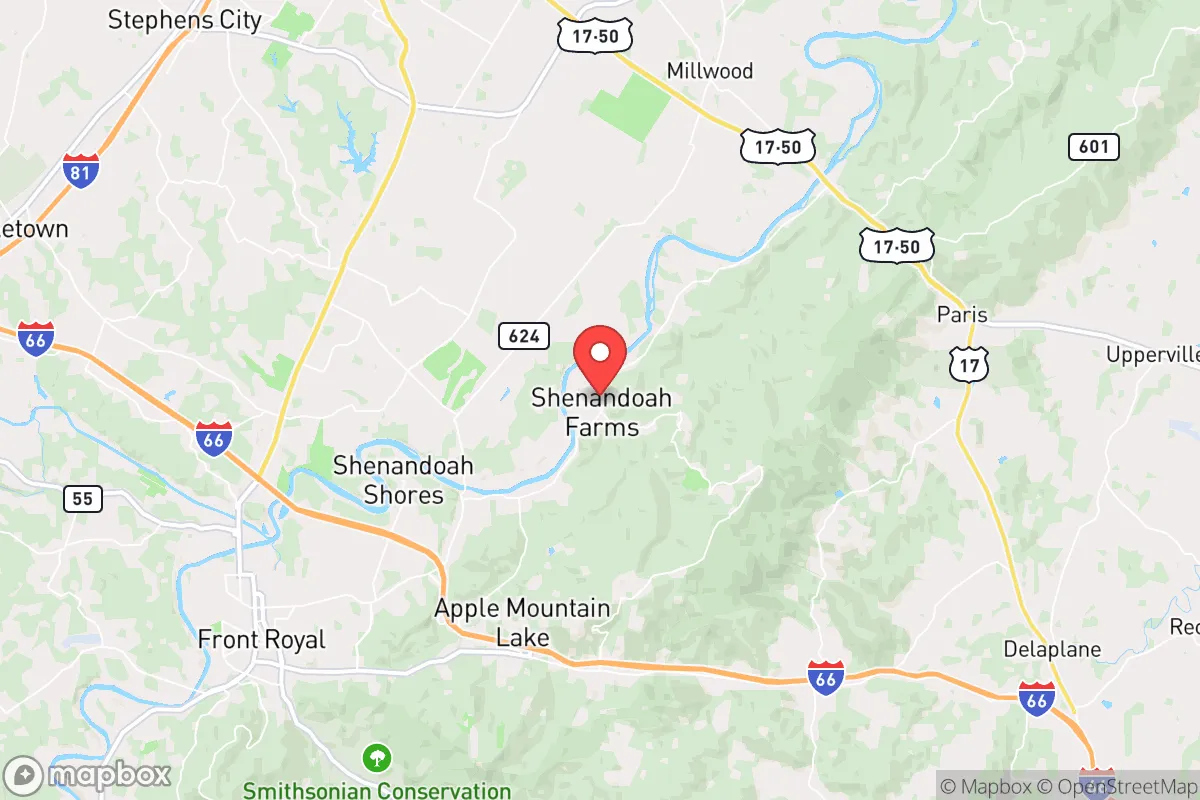
Shenandoah Farms, an unincorporated community in Clarke and Warren Counties, offers one of the lightest-touch governance environments in Northern Virginia — a place where the regulatory floor is low and personal autonomy is the default operating system. For a single individual or family weighing relocation, the calculus here is straightforward: you trade proximity to D.C.-area amenities for a jurisdiction where county governments assume you can manage your own land, your own defense, and your own household without a thicket of permissions. The trade is not for everyone, but for those who prioritize sovereignty, the area delivers a level of personal latitude that is increasingly rare within a two-hour drive of the capital.
Tax burden and regulatory posture in Clarke and Warren Counties
Virginia is a Dillon's Rule state, meaning localities only exercise powers the General Assembly explicitly grants them — but in practice, Clarke and Warren Counties interpret that authority with a notably restrained hand. The real property tax rate in Clarke County sits around $0.53 per $100 of assessed value, while Warren County is slightly higher at roughly $0.62 per $100; both are well below the statewide average and a fraction of what you would pay in Loudoun or Fairfax counties just 30–40 miles east. There is no county-level income tax in Virginia — a structural advantage that keeps the total effective tax burden on a typical household in the mid-single digits as a percentage of income, compared to double-digit effective rates in neighboring Maryland or the District.
Regulatory posture is equally permissive. Neither county imposes a general business license on most home-based enterprises, and there are no county-level zoning overlays that restrict what you can do on your own acreage beyond basic agricultural and residential use. The Virginia Department of Environmental Quality does require permits for certain activities — wetland disturbance, large-scale earthmoving, or commercial-scale animal operations — but for a standard residential parcel, the permitting process is minimal and typically resolves in weeks, not months. The absence of a county-wide building inspection mandate for owner-occupied single-family homes (Virginia allows localities to opt out, and both counties have historically kept inspections limited to commercial and multi-family structures) means a homeowner can build, renovate, or repair without county sign-off, provided the work meets state code if the property is ever sold.
Self-defense and gun law specifics in Shenandoah Farms
Virginia is a shall-issue state for concealed handgun permits, and both Clarke and Warren County circuit courts process applications with routine efficiency — typically 30–45 days from submission to issuance. The state does not require a permit to open carry, and since 2021, permitless concealed carry is legal for any adult 21 or older who can legally possess a firearm. That means the legal baseline for self-defense in Shenandoah Farms is about as permissive as it gets on the East Coast: no waiting periods, no firearm registration, no assault weapon ban, and no magazine capacity limits at the state level.
Use-of-force law in Virginia follows the Castle Doctrine, and the commonwealth is a "stand your ground" state — there is no duty to retreat in any place where you are lawfully present. For a homeowner in a rural, low-density area like Shenandoah Farms, this matters practically: the nearest sheriff's deputy from the Warren County Sheriff's Office substation in Front Royal is typically 15–25 minutes away, and Clarke County's response times in the Farms' eastern sections can stretch to 20 minutes. The legal framework effectively assumes you are the first responder on your own property, and the statutes back that assumption. One nuance to note: Virginia prohibits carrying in certain places — courthouses, schools, and airports — and private property owners can post restrictions, but the unincorporated nature of Shenandoah Farms means there are no municipal ordinances to navigate, which is a genuine advantage over nearby incorporated towns like Front Royal or Berryville.
Self-reliance and homesteading viability: lot sizes, zoning, and off-grid feasibility
Shenandoah Farms is zoned primarily as Agricultural-Residential (A-R), with a minimum lot size of 1 acre in most sections, though many parcels run 3–10 acres, and some larger tracts exceed 20. The zoning code explicitly permits "the keeping of farm animals, including horses, cattle, sheep, goats, and poultry" as an accessory use on parcels of one acre or more, with no county permit required for up to four animal units per acre. For a family wanting chickens, a couple of goats, or a small orchard, the regulatory path is essentially frictionless — you simply do it.
Off-grid feasibility is genuinely high, with one significant caveat. The area sits on a fractured bedrock aquifer, and well yields are generally adequate — most drilled wells in the Farms produce 5–15 gallons per minute, enough for household use and modest irrigation. Septic systems are permitted by the Virginia Department of Health, and the county does not require connection to any central sewer (none exists in most of the Farms). Solar is where the caveat appears: Virginia's net metering rules cap residential systems at 1 megawatt, and both counties' zoning allows rooftop and ground-mounted arrays as a by-right use, but the region's tree cover and valley fog mean solar production runs roughly 15–20% below sunnier parts of the state. A hybrid approach — solar plus a propane or wood backup — is the practical pattern most off-grid households adopt. The one genuine regulatory hurdle is the Virginia State Building Code, which applies to any new dwelling regardless of county inspection policy; if you build yourself, you must still meet code for electrical and structural safety, though enforcement is complaint-driven rather than proactive.
Personal liberties: parental rights, medical autonomy, speech, and property
Virginia's legal framework for parental rights is among the more protective in the mid-Atlantic. The state's Code § 1-240.1 explicitly recognizes "the fundamental right of parents to direct the upbringing, education, and care of their children," and both Clarke and Warren County school boards have adopted policies that defer to parental authority on curriculum objections and medical decisions. Homeschooling is a straightforward statutory process — file a notice of intent with the local school division, provide evidence of a curriculum, and submit annual assessments — and the homeschool population in Warren County runs around 8–10% of school-age children, one of the highest rates in Virginia, which means a robust support network of co-ops and shared activities exists in the immediate area.
Medical autonomy is more mixed. Virginia does not mandate COVID-19 vaccines for adults, and there is no state-level vaccine registry accessible to employers, but the commonwealth does require certain childhood immunizations for school attendance unless a parent files a medical or religious exemption — the religious exemption is broad and rarely challenged. On the property front, Virginia's right-to-farm law (Code § 3.2-301) protects agricultural operations from nuisance lawsuits, which matters if you keep livestock or run a small farm stand. Speech and assembly rights are governed by the First Amendment without notable local abridgment; there are no county-level noise ordinances in the unincorporated areas, and no permit is required for gatherings on private property. One practical liberty worth noting: Virginia is a "no cause" eviction state for month-to-month tenancies, but for property owners, there is no rent control, no county-wide short-term rental ban (though Warren County does require a $50 STR permit), and no transfer tax on real estate sales — a meaningful edge over Maryland's 1.5% recordation tax.
Relative to other exurban Virginia communities, Shenandoah Farms sits at the permissive end of the sovereignty spectrum — comparable to parts of Pittsylvania or Buckingham County, but with the advantage of being 70 miles from D.C. for occasional urban access. The regulatory environment is not libertarian utopia; the state still collects sales tax, requires vehicle inspections, and enforces building code on new construction. But for a person who wants to live largely unbothered — to carry a firearm without a permit, keep livestock on an acre, generate their own power, and make their own medical and educational choices — this corner of the Shenandoah Valley delivers a level of personal sovereignty that is genuinely difficult to find elsewhere in the region. The trade is real: fewer services, longer drives, and a community that expects you to handle your own problems. For the right person, that is not a drawback — it is the point.

* Values derived from national, state, county, city and local statistics and may differ in a specific area. Last updated: 2026-09-22T01:53:00.000Z
Narrative content on this page is AI-generated and may contain mistakes. Verify any details that matter before acting on them.
ReloMaps may earn a commission from affiliate links at no extra cost to you.

