Demographics of Shenandoah Farms, VA
Affluence Level in Shenandoah Farms, VA
A middle-class area roughly in line with national averages across income, home values, education, and employment.
People of Shenandoah Farms, VA
Shenandoah Farms, Virginia, is a rural residential enclave of roughly 3,956 people where the population is overwhelmingly White (94.8%) and native-born, with only 2.0% foreign-born residents. The community is characterized by its low density, single-family homes on acreage, and a population that skews older and less college-educated (26.5%) than nearby urban centers. Its identity is rooted in post-war recreational and second-home development, not historic town settlement, and it remains a predominantly homogeneous, family-oriented area with a strong conservative tilt.
How the city was settled and grew
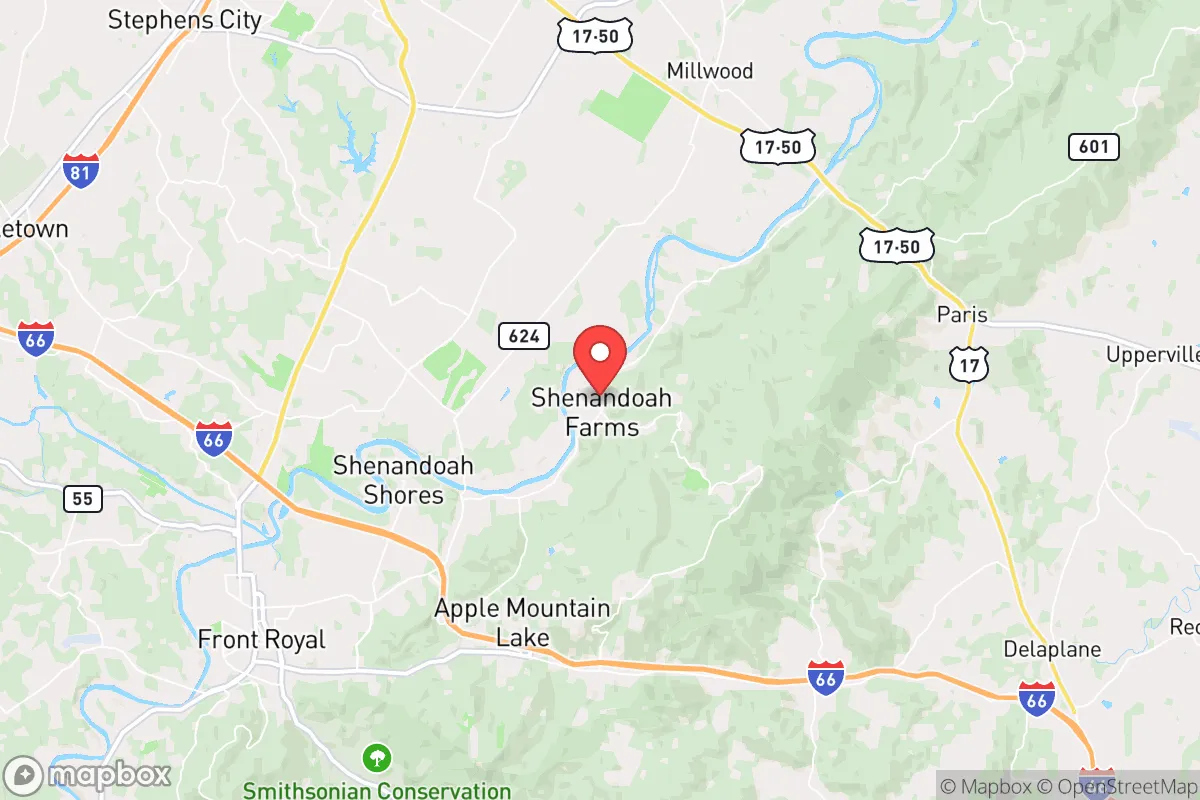
Shenandoah Farms was never a traditional town or village. It was platted and marketed in the 1960s as a recreational subdivision on former farmland and forest in western Clarke County, near the Shenandoah River. The original population consisted of Washington, D.C., and Northern Virginia families seeking affordable weekend retreats and hunting cabins. The earliest developed sections—Farms North and Farms South—were laid out with large lots (typically 1–5 acres) and minimal infrastructure, attracting a wave of middle-class white families from the D.C. suburbs. No significant colonial or 19th-century settlement occurred on the site itself; the area was sparsely populated by small-scale farmers and timber workers until the 1960s subdivision boom. The original buyers were almost exclusively white, drawn by low land prices and the promise of rural privacy within commuting distance of the capital.
Modern era (post-1965)
After the 1965 Hart-Cellar Act, Shenandoah Farms saw virtually no influx of foreign-born residents—the foreign-born share remains at just 2.0% today, far below national averages. Instead, domestic in-migration defined the modern era. Throughout the 1980s and 1990s, the subdivision filled in with permanent residents—many retirees and telecommuters—who built primary homes on what had been weekend lots. The River Bend section, along the Shenandoah River, attracted a slightly wealthier cohort seeking waterfront access, while Farms West developed later with larger, newer homes. The Black population (2.1%) and Hispanic population (1.9%) are small and dispersed, with no distinct ethnic neighborhoods; they are scattered across the older sections of Farms North and Farms South. The East/Southeast Asian share (0.2%) and Indian subcontinent share (0.0%) are negligible. The area’s racial homogeneity has persisted because the subdivision model—large lots, no rental housing, no public transit—naturally filters for buyers with the means and preference for low-density, car-dependent living.
The future
The population of Shenandoah Farms is projected to remain stable or grow slowly, driven by continued domestic migration from the D.C. metro area, particularly among remote workers and retirees seeking lower taxes and more land. The demographic profile is unlikely to shift dramatically toward diversity: the housing stock (almost entirely single-family, owner-occupied) and lack of rental or multifamily units limit the arrival of younger, more diverse cohorts. The Farms East section, the newest and most expensive, is attracting higher-income families, but these remain overwhelmingly white. The Hispanic and Black shares may inch upward slowly as some families move from Winchester or Front Royal, but the foreign-born share will likely stay below 3%. The cultural identity will remain conservative, rural, and family-centric, with a growing emphasis on home-based work and local recreation. For a new resident, Shenandoah Farms offers a stable, low-diversity, low-density environment where privacy and space are the primary draws, and where demographic change is measured in decades, not years.
Bottom-line: Shenandoah Farms is becoming a more permanent, slightly more affluent version of its original recreational-subdivision self—still overwhelmingly white, native-born, and conservative. For someone moving in now, the area offers a predictable, slow-changing community where the population is aging in place and new arrivals are most likely to be domestic telecommuters or retirees, not immigrants or urban transplants.

* Values derived from national, state, county, city and local statistics and may differ in a specific area. Last updated: 2026-09-22T01:53:00.000Z
Narrative content on this page is AI-generated and may contain mistakes. Verify any details that matter before acting on them.
ReloMaps may earn a commission from affiliate links at no extra cost to you.

