
Photo: Wikipedia
Political ClimatePolitical Climate in Sandusky, OH
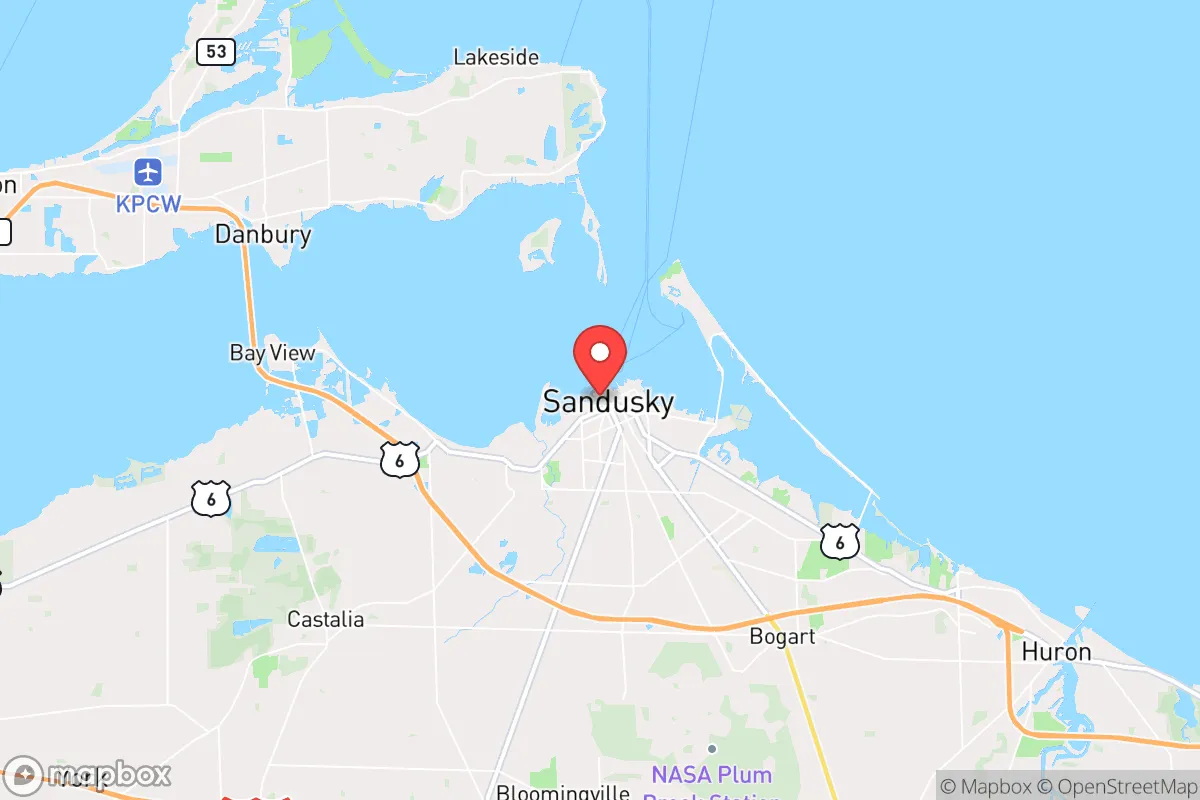
District shown is the primary district for this city’s centroid. Cities may span multiple districts.
Local Political AnalysisPolitical Analysis of Sandusky, OH
Sandusky sits in a political middle ground that surprises a lot of people. While the city itself has a Democratic history, the surrounding Erie County and the wider region have shifted right, giving the area an overall lean of R+3 on the Cook PVI. That’s slightly more competitive than Ohio as a whole, which sits at R+5, but it’s not the kind of place where you’ll see a blue wave anytime soon. The real story here is a slow, steady drift rightward, driven by the rural and exurban voters who surround the city limits.
How it compares
The R+3 rating puts Sandusky and Erie County in a different lane than the rest of the state. Ohio’s R+5 is a solidly Republican lean, but Sandusky’s closer margin reflects the lingering influence of union labor, lakefront tourism workers, and a historic Democratic base in the city proper. Drive 20 minutes south to Norwalk or east to Huron, and you’ll find precincts that vote 65-70% Republican in most cycles. Head west toward Port Clinton or east toward Vermilion, and the pattern holds — these are the towns that push the county’s overall numbers rightward. Meanwhile, Sandusky’s core neighborhoods, especially around the older wards near Cedar Point and the marina, still vote Democratic in local races, though the margins have shrunk since the 1990s. The 2024 presidential results mirrored this split: the city precincts went narrowly for the Democrat, but the county as a whole landed comfortably in the Republican column, matching the R+3 PVI almost exactly.
What this means for residents
For conservative residents, the practical effect is that their votes carry real weight in county-level races — sheriff, commissioner, and prosecutor are reliably Republican, and the county GOP has a strong organizational presence. You’ll see Republican signs dominate the rural roadsides, and the local party holds monthly meetings that draw a committed crowd. For liberal residents, the picture is more nuanced. You can win a city council seat in Sandusky as a Democrat, and the mayor’s office has flipped between parties in recent cycles, but you’ll be in the minority at the county level. Statehouse representation is solidly Republican, and the county’s state representative and senator both caucus with the GOP. That means issues like abortion access, gun policy, and school funding are decided in Columbus, not locally, and Sandusky’s Democratic voters have limited leverage there. The one area where the two sides find common ground is economic development — both parties in Erie County support tourism investment, Cedar Point expansion, and port infrastructure, which keeps the local political conversation more pragmatic than ideological.
Culturally, Sandusky is a working-class lake town with a pragmatic streak. The Cedar Point economy brings in seasonal workers and tourists from across the Midwest, which gives the city a more transient, open feel than the surrounding farm communities. You won’t find the hard-edged culture-war politics here that you see in Ohio’s more affluent suburban counties like Delaware or Warren. Instead, the local discourse tends to focus on jobs, lake levels, and property taxes. The trajectory over the next decade likely mirrors the state: a slow rightward drift as older Democratic voters age out and younger transplants, many drawn by remote work and lakefront property, bring a mix of libertarian-leaning and moderate Republican views. Sandusky isn’t going to flip blue, but it’s also not going to become a deep-red stronghold like the counties further south. It’s a bellwether — a place where the statewide mood shows up in miniature, just a few points more purple than Ohio as a whole.

State Political ClimatePolitical Climate in Ohio
State Political AnalysisPolitical Environment in the State
Ohio sits at R+5 on the Cook Partisan Voting Index, making it a solidly Republican state in presidential elections, but the story is more layered than that single number suggests. The state has drifted rightward over the past 15 years — Barack Obama won it twice, Donald Trump carried it by 8 points in 2016 and again in 2020, and the GOP now holds every statewide executive office and a supermajority in the legislature. If you’re moving here, you’re entering a state where Republicans set the agenda, but where the margins in places like Columbus, Cincinnati, and Cleveland keep the overall picture from being a foregone conclusion.
Urban vs. rural divide
The political map of Ohio is a textbook case of the urban-rural split, with a few important wrinkles. The three big Cs — Columbus, Cincinnati, and Cleveland — are the Democratic anchors. Franklin County (Columbus) has become the state’s Democratic powerhouse, delivering margins that have grown every cycle as the metro absorbs transplants and young professionals. Cuyahoga County (Cleveland) remains the largest Democratic county by raw votes, while Hamilton County (Cincinnati) has shifted from a swing county to a reliably blue one, driven by the city’s booming urban core. The rest of the state is overwhelmingly Republican, and that’s where the real numbers live. The rural counties of eastern and southern Ohio — places like Belmont, Muskingum, and Scioto — vote Republican by 40 to 50 points, and they turn out reliably. The suburbs tell a more interesting story. Delaware County, just north of Columbus, was once a GOP stronghold but has become a genuine battleground as exurban growth brings in a mix of voters. Meanwhile, the Cincinnati suburbs of Mason and West Chester remain staunchly conservative, anchored by a strong evangelical and family-oriented base. The net effect: Democrats win the cities, Republicans win everything else, and the state’s rural weight is enough to keep it out of reach for Democrats in most statewide races.
Policy environment
Ohio’s policy environment is defined by a low-tax, light-regulation posture that has been in place for over a decade. The state has a flat income tax of 3.5% (down from a progressive top rate of 7.5% a decade ago), and the legislature has been steadily chipping away at it with an eye toward eventual elimination. Property taxes are moderate, and the state’s sales tax sits at 5.75% plus local add-ons. The regulatory climate is business-friendly, with a right-to-work law on the books since 2011 and a tort reform regime that has made Ohio a popular venue for corporate litigation. On education, Ohio has a robust school choice system — the EdChoice voucher program is one of the largest in the country, and charter schools are well-established. Healthcare is a mixed bag: the state expanded Medicaid under the Affordable Care Act in 2013, but the legislature has since passed restrictions on abortion (a six-week ban that was later repealed via ballot initiative) and has been hostile to vaccine mandates. Election law is moderately restrictive — voter ID is required, early voting is available but shorter than in some states, and the state purges inactive voters regularly. For a conservative relocator, the tax and regulatory environment is a clear plus; for a liberal one, the social policy landscape is the main friction point.
Recent policy direction
The last few years have seen Ohio’s legislature push hard on a specific set of priorities that tell you where the state is headed. On guns, Ohio became a permitless carry state in 2022, meaning anyone 21 or older can carry a concealed firearm without a license or training. The same year, the legislature passed a “stand your ground” law, removing the duty to retreat in self-defense situations. On education and parental rights, the state passed the Parental Rights in Education bill in 2023, which requires schools to notify parents of any changes to a student’s health or well-being and restricts instruction on gender identity in early grades. On speech and privacy, Ohio has enacted a data privacy law (the Ohio Personal Privacy Act) that gives residents more control over how companies use their personal data, though it’s weaker than California’s version. On medical and bodily autonomy, the picture is more contested: voters passed Issue 1 in 2023, enshrining abortion rights in the state constitution, and also legalized recreational marijuana the same year — both over the legislature’s objections. That’s a notable split: the GOP supermajority is socially conservative on paper, but the ballot initiative process has let voters override them on the two most personal issues. On taxation, the trend is unambiguously downward, with the flat tax and a phase-out of the commercial activity tax on the horizon. On voting, the state has tightened rules — stricter ID requirements and a ban on ballot drop boxes — but has not gone as far as some Southern states in restricting mail voting.
Civil unrest & political movements
Ohio has seen its share of political flashpoints, and a new resident will notice the energy on both sides. The most visible recent unrest was the 2020 protests in Columbus and Cincinnati following the murder of George Floyd, which included property damage and a heavy National Guard presence in the capital. That period also saw a surge in Second Amendment activism, with gun sales spiking and a visible open-carry presence at statehouse rallies. The immigration debate is quieter than in border states, but it’s present: Ohio has no sanctuary cities, and the legislature has passed laws requiring local law enforcement to cooperate with federal immigration authorities. The most organized political movements are on the right — the state GOP has been pulled further right by grassroots groups focused on election integrity (a recurring theme since 2020, with claims of irregularities in Cuyahoga County that were never substantiated) and by anti-abortion activists who continue to push for restrictions despite the 2023 constitutional amendment. On the left, the energy is concentrated in the cities, with progressive coalitions in Columbus and Cleveland pushing for tenant protections, police reform, and a higher minimum wage. There’s also a quiet but persistent strain of Appalachian regional identity in the southeast — places like Athens County — that doesn’t fit neatly into either party’s national narrative.
Projection
Over the next five to ten years, Ohio’s political trajectory is likely to be a slow but steady continuation of the current pattern: the state stays Republican at the statewide level, but the margins could tighten as the Columbus metro continues to grow. Franklin County is adding population faster than any other county, and if that trend holds, it could eventually offset some of the rural Republican dominance — but not enough to flip the state in the near term. The more interesting dynamic is internal: the GOP supermajority is likely to keep pushing on tax cuts and social issues, while the ballot initiative process will remain the pressure valve for voters who disagree. Expect continued fights over abortion access (the legislature may try to chip away at the amendment through regulation), marijuana implementation, and school choice expansion. In-migration is modest — Ohio isn’t a Sun Belt boom state — but the people who do move in tend to be either retirees from the Northeast seeking lower taxes or young professionals drawn to Columbus’s job market. Both groups lean slightly Democratic, which could shave a point or two off the Republican margin over time. A decade from now, Ohio will probably look like a slightly less red version of today — still R+3 or R+4, still Republican-controlled, but with a more competitive Columbus-centered coalition on the Democratic side.
For a new resident, the bottom line is that Ohio rewards people who know what they’re getting into. If you’re conservative, you’ll find a state that taxes you lightly, respects your gun rights, and gives you broad school choice — but you’ll also live in a place where the cities vote against you and where ballot initiatives can override the legislature on social issues. If you’re liberal, you’ll find welcoming urban enclaves in Columbus, Cleveland, and Cincinnati, but you’ll be living under a Republican supermajority that will limit your policy wins to what you can pass at the ballot box. The practical takeaway: Ohio is a purple state with a red tint, and your experience will depend heavily on which county you choose to call home.
* Values derived from national, state, county, city and local statistics and may differ in a specific area. Last updated: 2026-10-13T01:05:46.000Z
Narrative content on this page is AI-generated and may contain mistakes. Verify any details that matter before acting on them.
ReloMaps may earn a commission from affiliate links at no extra cost to you.

