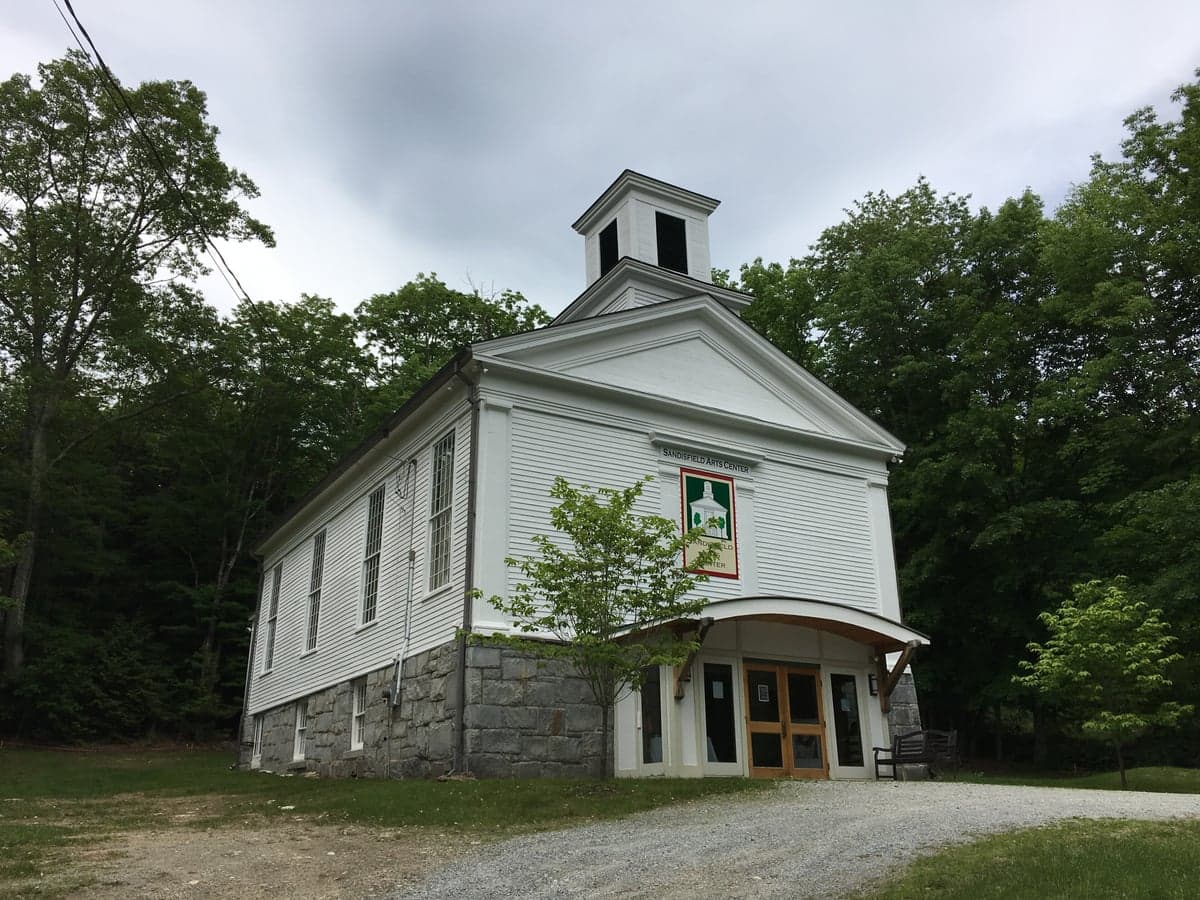
Photo: Wikipedia
Demographics of Sandisfield, MA
Affluence Level in Sandisfield, MA
An upper-middle-class area. Household wealth, education levels, and homeownership run ahead of national benchmarks.
People of Sandisfield, MA
The people of Sandisfield, Massachusetts, today number roughly 2,566, making it one of the most sparsely populated towns in Berkshire County. The population is overwhelmingly white (93.3%) and notably homogeneous, with a foreign-born share of just 0.3%—far below state and national averages. Residents are concentrated in a handful of historic hamlets and along winding rural roads, and the town’s identity is defined by deep generational roots, a working-forest landscape, and a quiet, self-reliant character that appeals to those seeking seclusion rather than suburban convenience.
How the city was settled and grew
Sandisfield was first settled in 1750 by English colonists from Connecticut and Rhode Island, drawn by the promise of fertile valley land and abundant timber. Incorporated in 1767, the town grew slowly as a subsistence-farming and small-milling community. The original settlers clustered in what are now the South Sandisfield and North Sandisfield hamlets, where the earliest meetinghouses and burying grounds remain. A modest wave of Irish laborers arrived in the 1840s and 1850s, working on railroad construction and in the region’s charcoal and potash industries; they settled primarily in the New Boston district, a cluster of small homes along the Farmington River tributaries. By 1900, the population had peaked near 1,200, then declined as industrial jobs moved to larger towns. No significant immigrant wave followed. The town’s population remained almost entirely native-born white through the mid-20th century, with a scattering of families in the Hartsville and Montville corners—tiny crossroads that once supported a school, a store, or a sawmill.
Modern era (post-1965)
After the 1965 Hart-Cellar Act reshaped American immigration, Sandisfield saw virtually no new foreign-born arrivals. The foreign-born share today is 0.3%, essentially unchanged from 1970. Instead, the modern era has been defined by domestic in-migration—primarily white retirees and second-home buyers from the Hartford and New York metro areas, drawn by low property taxes and the Berkshire scenery. These newcomers have concentrated in the West Sandisfield area, where larger lots and renovated farmhouses are common, and along Route 57 near the Otis town line. The Hispanic population, at 2.5%, is the largest minority group, but it remains small and dispersed rather than forming a distinct ethnic neighborhood. The Black (0.7%) and East/Southeast Asian (0.2%) populations are negligible. The Indian-subcontinent share is 0.0%. The college-educated share has risen to 35.0%, reflecting the arrival of remote workers and retirees with higher education levels, but the town’s overall demographic profile remains overwhelmingly white and native-born.
The future
Sandisfield’s population is projected to remain stable or decline slightly over the next decade, as the aging cohort of second-home owners and retirees is not replaced by younger families. The town’s school-age population has been shrinking, and the lack of rental housing, employment centers, and public transit makes it unlikely to attract significant diversity. The Hispanic share may inch upward slowly, mirroring statewide trends, but the foreign-born share is expected to stay below 1%. New construction is limited by zoning that favors large lots and by the town’s rural character protections. The cultural identity is likely to remain that of a quiet, predominantly white, land-rich community where newcomers are expected to respect the existing pace of life. No new ethnic or racial concentrations are forming; the few minority residents are scattered across the South Sandisfield and New Boston hamlets without clustering.
For someone moving in now, Sandisfield offers a stable, low-density, and culturally homogeneous environment—a place where the population is not changing rapidly and where the dominant identity is rooted in Yankee independence and Berkshire rural tradition. It is best suited for those who value privacy, open space, and a community where nearly everyone shares a similar background, rather than for those seeking demographic diversity or urban amenities.

* Values derived from national, state, county, city and local statistics and may differ in a specific area. Last updated: 2026-10-20T07:51:46.000Z
Narrative content on this page is AI-generated and may contain mistakes. Verify any details that matter before acting on them.
ReloMaps may earn a commission from affiliate links at no extra cost to you.

