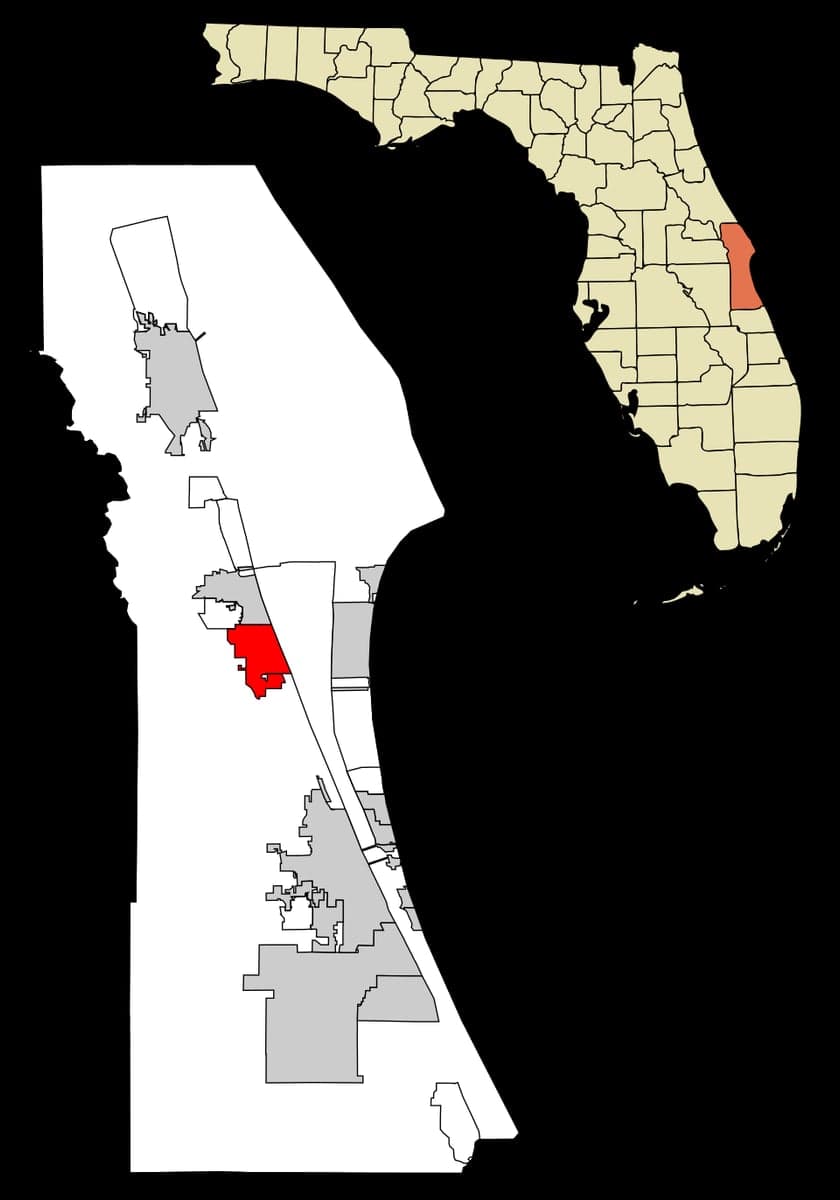
Photo: Wikipedia
Political ClimatePolitical Climate in Rockledge, FL
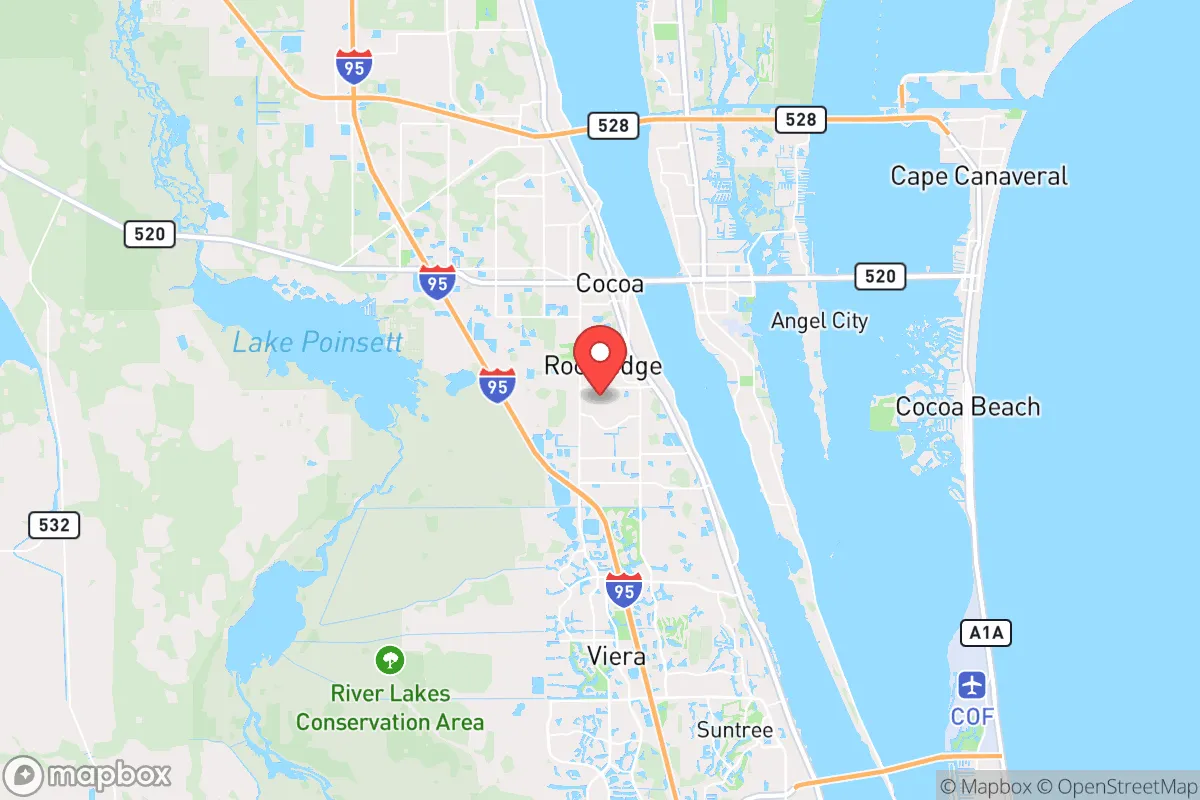
District shown is the primary district for this city’s centroid. Cities may span multiple districts.
Local Political AnalysisPolitical Analysis of Rockledge, FL
Rockledge leans solidly Republican, with a Cook PVI of R+11 that places it well to the right of the national average. This isn't a recent shift—the area has been a GOP stronghold for decades, anchored by a mix of military retirees, aerospace workers, and long-time Florida families who value fiscal conservatism and limited government. The political trajectory here is steady: while Brevard County as a whole has trended slightly redder since 2020, Rockledge itself has remained remarkably consistent, with local elections often decided in the Republican primary rather than the general. You won't see the dramatic swings you get in, say, Orlando or Tampa; this is a place where political allegiances are baked in from generation to generation.
How it compares
Compared to Florida as a whole, Rockledge is noticeably more conservative. The state's Cook PVI is unknown, but statewide elections have been decided by razor-thin margins in recent cycles—think the 2022 governor's race, which was a 19-point blowout for DeSantis, versus the 2020 presidential race, which was only a 3-point win for Trump. Rockledge, by contrast, routinely delivers 60-65% of its vote to Republican candidates. The contrast is even sharper when you look at nearby cities: Melbourne, just 15 minutes south, has a more moderate-to-liberal tilt, especially in its downtown and college-adjacent neighborhoods, while Cocoa Beach to the east leans slightly left due to its tourist and retiree mix. Head north to Titusville, and you'll find a similar red hue, but with a stronger libertarian streak. Rockledge sits in the middle of this spectrum—conservative but not hardline, with a practical, "get things done" attitude that reflects its aerospace and defense industry roots.
What this means for residents
For conservative residents, Rockledge is a comfortable fit. Local government is generally business-friendly, zoning is permissive, and tax rates are low compared to coastal cities. You'll find plenty of churches, gun-friendly policies, and a school board that emphasizes parental rights. For liberal residents, the reality is more nuanced. While you won't face hostility, you will be in the minority—political conversations at neighborhood gatherings or PTA meetings will skew right, and local Democratic clubs are small but active. The practical impact is that progressive policy priorities, like expanded public transit or affordable housing mandates, rarely gain traction at the city council level. That said, Rockledge is not a place of political tension; most residents prioritize quality of life over partisan battles, and you'll find bipartisan cooperation on issues like hurricane preparedness and infrastructure maintenance.
Culturally, Rockledge distinguishes itself from the rest of Florida by its slower pace and stronger sense of community. Unlike the transient feel of Orlando or the tourist-driven vibe of Miami, Rockledge has a "small town inside a growing county" identity. The city's policy decisions reflect this: there's a deliberate resistance to overdevelopment, with strict height limits and preservation of green spaces that wouldn't fly in more growth-hungry parts of the state. For newcomers, the biggest adjustment is the lack of political diversity in local media and civic life—but for those who value stability and predictability, that's exactly the draw. Looking ahead, as Brevard County continues to attract remote workers and space-industry transplants, Rockledge may see a slight moderation, but its core conservative character is likely to hold for at least another decade.

State Political ClimatePolitical Climate in Florida
State Political AnalysisPolitical Environment in the State
Florida has transformed from a quintessential swing state into a solidly Republican-leaning powerhouse over the past decade, driven by a massive influx of conservative-leaning transplants from the Northeast and Midwest. The state hasn't voted for a Democrat for governor since 1994, and in 2024, Donald Trump carried Florida by over 13 points, a stark contrast to the 2012 election when Barack Obama won it by less than a point. This rightward shift is powered by a coalition of Cuban-American and Venezuelan voters in South Florida, conservative retirees in the I-4 corridor, and rapidly growing exurban communities around Jacksonville and Tampa, while the Democratic base has largely consolidated in a few dense urban cores like Miami, Orlando, and Tallahassee.
Urban vs. rural divide
The political map of Florida is a study in stark contrasts. The Democratic strongholds are concentrated in the urban cores of Miami-Dade County, Orange County (Orlando), and Leon County (Tallahassee), but even these have shifted right. Miami-Dade, once a Democratic bastion, flipped to Trump in 2020 and 2024, driven by Cuban and Venezuelan voters who are deeply skeptical of left-wing economic policies. Meanwhile, the sprawling suburbs of Tampa, Jacksonville, and Fort Myers have become reliably Republican, with Hillsborough and Duval counties trending red. The rural Panhandle, from Pensacola to Panama City, is deeply conservative, often voting 70-80% Republican. The I-4 corridor, stretching from Tampa to Daytona Beach, remains the key battleground, but even here, fast-growing exurbs like Lakeland and Ocala are pulling the region rightward. The only blue-leaning area outside the major cities is the Gainesville area, anchored by the University of Florida, which provides a liberal counterweight in an otherwise conservative region.
Policy environment
Florida's policy environment is defined by a low-tax, low-regulation posture that appeals strongly to conservative relocators. There is no state income tax, a major draw for high-earners and retirees. The corporate tax rate is a flat 5.5%, and the state has a robust right-to-work law, meaning union membership is voluntary and union power is limited. On education, Florida was a national leader in school choice, with the Family Empowerment Scholarship program allowing state funds to follow students to private or charter schools. The state also banned Critical Race Theory in public schools and passed the Parental Rights in Education Act (HB 1557), which prohibits classroom instruction on sexual orientation and gender identity in early grades. Healthcare policy is market-driven; Florida did not expand Medicaid under the Affordable Care Act, leaving roughly 800,000 residents in the coverage gap. Election laws have been tightened: the state requires voter ID, limits drop boxes, and restricts mail-in ballot requests to two years, a response to the 2020 election controversies. Property rights are strongly protected, with no state-level rent control allowed, and the state has preempted local ordinances that would restrict short-term rentals like Airbnb.
Recent policy direction
The last five years have seen Florida accelerate its conservative policy agenda under Governor Ron DeSantis. On gun rights, Florida enacted permitless carry (HB 543) in 2023, allowing residents to carry concealed firearms without a permit, though open carry remains illegal. The state also passed a "stand your ground" law and preempts all local gun ordinances, meaning cities like Miami cannot enact their own restrictions. On parental and education rights, the "Don't Say Gay" law (HB 1557) was expanded in 2023 to cover all grades, and the state banned DEI (Diversity, Equity, and Inclusion) programs in public universities. Speech protections were strengthened with a law requiring social media platforms to host political candidates equally, though this has faced legal challenges. On medical and bodily autonomy, Florida banned abortion after six weeks in 2023 (HB 5), with exceptions for rape, incest, and the life of the mother, and the state has restricted gender-affirming care for minors. Property rights were bolstered by a law limiting homeowners' association (HOA) fines and making it easier to remove deed restrictions. On voting, the state created a new election police force, the Office of Election Crimes and Security, which has prosecuted a handful of cases of alleged voter fraud. Taxation remains a priority: the state has periodically offered gas tax holidays and property tax relief for homeowners, but a full repeal of property taxes has not gained traction.
Civil unrest & political movements
Florida has seen its share of political flashpoints, but large-scale civil unrest is rare compared to states like Oregon or Minnesota. The most visible protests in recent years were the 2020 Black Lives Matter demonstrations in Miami, Orlando, and Tampa, which were largely peaceful but saw some property damage and curfews. Immigration politics are a constant undercurrent, particularly in South Florida, where the state has bused migrants to sanctuary cities like Martha's Vineyard and Sacramento as a political statement. There is no sanctuary city policy in Florida; in fact, the state passed a law (SB 1718) in 2023 that requires businesses with 25 or more employees to use E-Verify and makes it a felony to transport undocumented immigrants into the state. Election integrity remains a hot-button issue: the 2020 and 2022 elections saw no major fraud scandals, but the state's new election police unit has been controversial, with critics calling it a tool for voter intimidation. Secession or nullification rhetoric is minimal, though some far-right groups have called for a "Florida Republic" in response to federal COVID mandates. The most visible political movement is the "DeSantis effect" — a populist conservative coalition that has reshaped state politics and made Florida a national model for conservative governance.
Projection
Over the next 5-10 years, Florida is likely to become even more Republican, driven by continued in-migration from high-tax, high-regulation states like New York, California, and Illinois. The state is projected to add 3-4 million residents by 2035, with most settling in the exurban and suburban areas that lean red. The Democratic base will shrink further as older, more conservative retirees replace younger, more liberal ones, and as Hispanic voters in South Florida continue to trend right. However, there are countervailing forces: the growing Puerto Rican population in Central Florida tends to vote more Democratic, and the state's young voters (Gen Z and Millennials) are more liberal on social issues like abortion and LGBTQ rights. If the national Democratic Party moderates on cultural issues, it could claw back some ground in the I-4 corridor. But the structural advantages for Republicans — no income tax, strong property rights, school choice, and a business-friendly climate — are deeply entrenched and unlikely to change. A new resident moving in now should expect a state that is increasingly conservative on fiscal and cultural issues, with a government that is proactive in shaping policy rather than reactive.
For a new resident, the bottom line is that Florida offers a stable, predictable political environment that strongly favors conservative values on taxes, education, and personal liberty, but with clear limits on abortion and LGBTQ rights. If you're a conservative, you'll find a state government that actively supports your priorities and a growing community of like-minded transplants. If you're a liberal, you'll find vibrant urban enclaves in Miami, Orlando, and Tallahassee where your views are shared, but you'll be living under a state government that is often hostile to your policy preferences. The practical takeaway is that Florida is not a swing state anymore — it's a red state with blue cities, and the trajectory is firmly rightward.
* Values derived from national, state, county, city and local statistics and may differ in a specific area. Last updated: 2026-08-19T14:45:03.000Z
Narrative content on this page is AI-generated and may contain mistakes. Verify any details that matter before acting on them.
ReloMaps may earn a commission from affiliate links at no extra cost to you.

