Photo: Wikipedia
Political ClimatePolitical Climate in Ridgway, PA
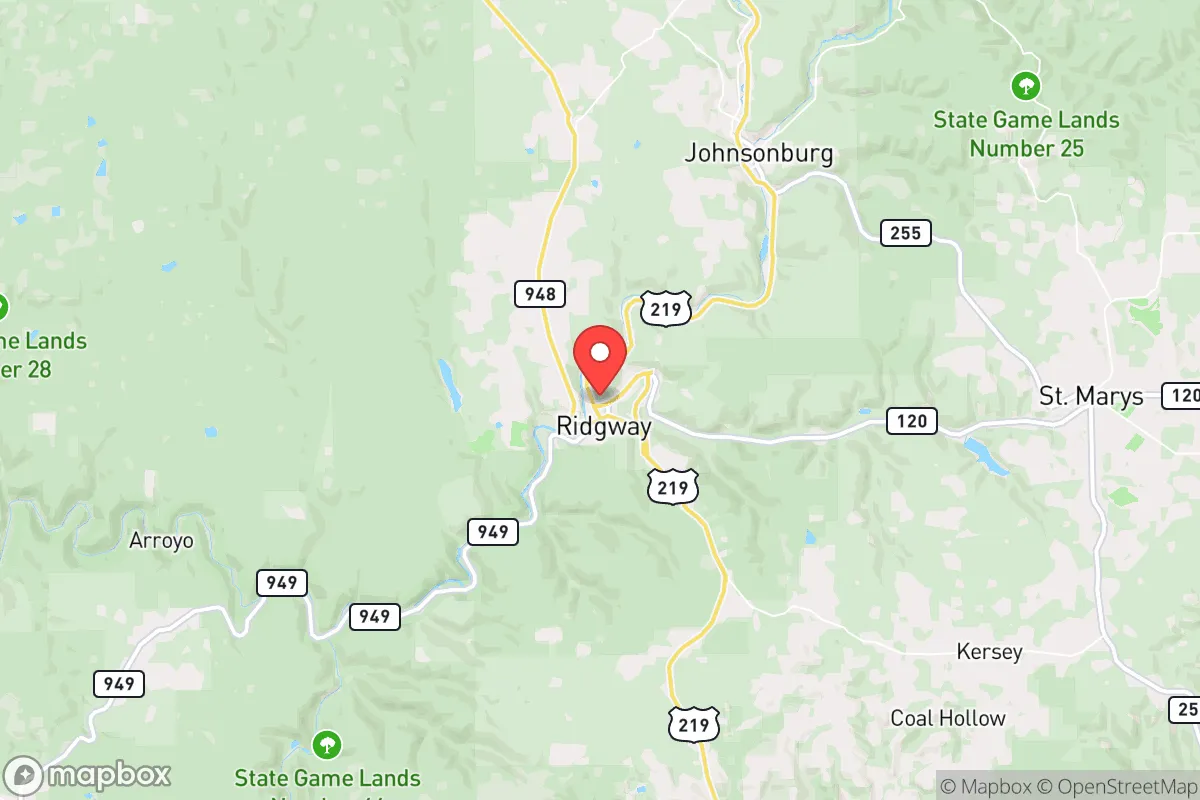
District shown is the primary district for this city’s centroid. Cities may span multiple districts.
Local Political AnalysisPolitical Analysis of Ridgway, PA
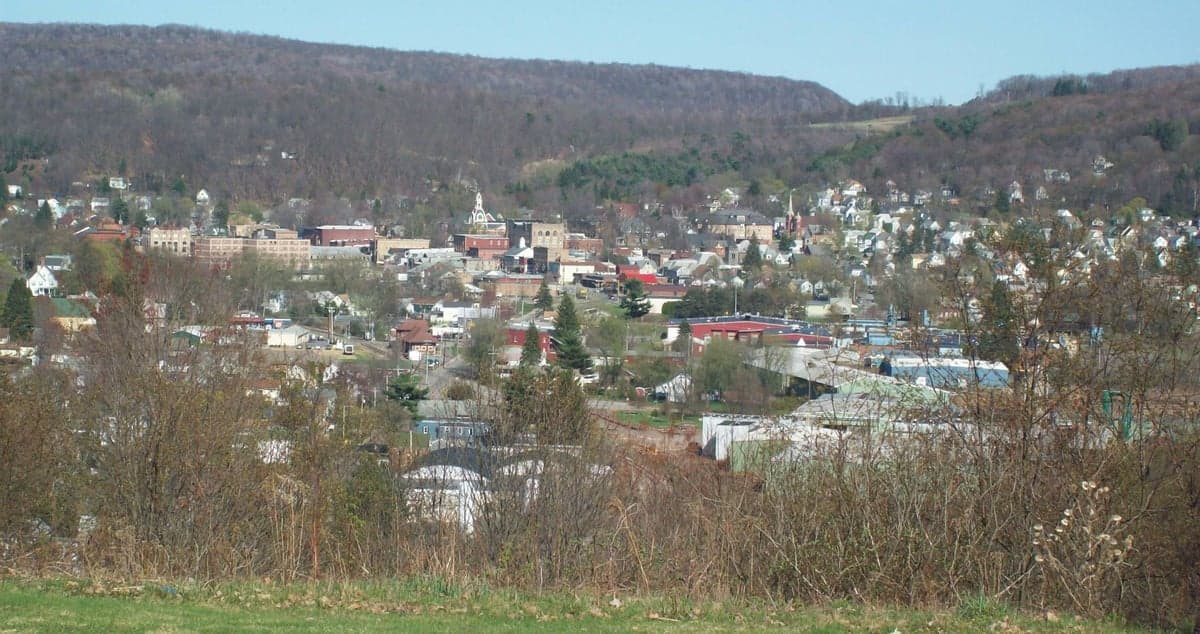
Ridgway sits in one of the reddest corners of a purple state. Elk County and the surrounding Pennsylvania Wilds region run roughly R+19 by Cook Partisan Voting Index, meaning the area votes about 19 points more Republican than the nation as a whole — while Pennsylvania statewide is dead even at PVI EVEN. In practice, that gap shows up everywhere from the courthouse in downtown Ridgway to the ballot box: local races are often decided in the Republican primary, and Democratic candidates for county row offices sometimes don't bother filing. The trajectory has been steady, not sudden — the region was already ancestrally Republican before the realignment of the 2010s, and it has only deepened since.
How it compares to the rest of Pennsylvania
The contrast is starkest when you look east and south. Philadelphia and its collar counties — Montgomery, Chester, Delaware, Bucks — are solidly Democratic and drive the statewide PVI to even. Pittsburgh and Allegheny County lean blue but with a strong populist streak. Even nearby mid-size towns like St. Marys, Bradford, and DuBois are more competitive than Ridgway, largely because of unionized manufacturing and a larger Catholic Democratic tradition. Ridgway itself is small — under 4,000 people — and its politics are shaped by the timber, powdered-metal, and carbon industries that dominate the local economy, plus a deep-rooted skepticism of Harrisburg and Washington that predates the Trump era. If you're moving from the Philly suburbs or State College, expect to be in the minority at the diner.
What this means for residents in practice
For conservative residents, the lean translates into real influence: local GOP committee seats are contested, school board races matter, and county commissioners generally reflect the majority's views on land use, hunting regulations, and property rights. For liberal or independent residents, the reality is quieter but real — you can live comfortably here, but you'll likely keep political opinions to yourself at the hardware store, and your vote in a general election for state or federal office carries less weight than it would in a swing district. Neither side is persecuted; it's more a matter of social friction than policy hostility. The bigger practical divide is generational: younger transplants often find the politics jarring, while longtime residents see it as continuity.
The cultural distinctions run deeper than party labels. Ridgway's identity is tied to the Allegheny National Forest, the Clarion River, and the outdoor-recreation economy — issues like public land access, ATV trails, and gas leasing cut across party lines in ways that don't map neatly onto national politics. In the near term, expect the R+19 lean to hold or even widen slightly as older union Democrats age out and younger families move in for the low cost of living and remote-work opportunities. Long term, the wild card is whether the outdoor-recreation boom brings in enough newcomers to soften the edges — but don't bet on a blue turn anytime soon. This is a place where the politics are personal, the pace is slow, and the sign on the lawn tells you more about your neighbor than any poll ever could.

State Political ClimatePolitical Climate in Pennsylvania
State Political AnalysisPolitical Environment in the State
Pennsylvania is the quintessential swing state — Cook Political Report rates it EVEN, and it has voted for the winner in 12 of the last 14 presidential elections, including a 3.4-point flip to Donald Trump in 2024 after Joe Biden's 1.2-point win in 2020. The coalition math is stark: Democrats dominate Philadelphia and its collar counties plus Pittsburgh and Harrisburg, while Republicans run up huge margins across the central "T" — the rural spine from Erie's hinterland down through State College, Altoona, and Johnstown to the Maryland line. The 20-year arc has been a slow, steady rightward drift in the small towns and a hardening leftward consolidation in the cities, with the Philadelphia suburbs (Montgomery, Chester, Delaware, Bucks) acting as the true fulcrum. If you're moving here, understand that you're not moving to a red state or a blue state — you're moving to a state where the collar counties around Philadelphia decide everything, and where your local politics will vary wildly depending on which side of a county line you land.
Urban vs. rural divide
The political map breaks cleanly along density lines. Philadelphia and Pittsburgh are deep blue and drive roughly 40% of the statewide Democratic vote between them; add the four suburban collar counties and you've got the entire Democratic coalition. Meanwhile, the Republican vote is spread across a vast, low-density interior — places like Lancaster (which went +18 for Trump in 2024), York, Erie outside the city, and the old industrial towns of Scranton and Wilkes-Barre in Luzerne County, which flipped from blue to red in 2016 and has stayed there. The Lehigh Valley — Allentown and Bethlehem — is the state's true bellwether, splitting nearly evenly and often deciding statewide margins. What a new resident notices: the suburbs are where the culture war is actually fought (school board meetings in Bucks and Chester counties get loud), while the cities are solidly progressive and the rural counties are solidly conservative with little ambiguity. The interesting friction is in the middle — places like State College, where Penn State's university vote sits inside a conservative county, and Lancaster city, which is more Democratic than its surrounding county suggests.
Policy environment
Pennsylvania's tax structure is a mixed bag: a flat 3.07% personal income tax (one of the lowest flat rates in the nation), but property taxes vary enormously by school district and are a perennial complaint in places like Allentown and Reading, where millage rates run high. The state has no sales tax on food or clothing, which softens the blow for families. Regulatory posture is moderate — the state is not a right-to-work state (unions retain real power, especially in Pittsburgh's building trades and Philadelphia's municipal workforce), but it's also not California-style aggressive on business regulation. Education policy is currently a live battlefield: the 2023 Commonwealth Court ruling in William Penn School District v. PA Department of Education found the school funding system unconstitutional, and the legislature has been slowly phasing in a new formula — a fight that will shape property taxes for a decade. On healthcare, Pennsylvania expanded Medicaid under the ACA in 2015 and has a state-based exchange; on election law, the state has no-excuse mail voting (Act 77, 2019) but a voter ID requirement for in-person voting that's been contested. The state also has a robust open-records law and a relatively strong right-to-know framework, which matters if you care about local government transparency.
Recent policy direction
The last few years have been a tug-of-war between a Democratic governor (Josh Shapiro, elected 2022) and a divided legislature — Republicans control the Senate, Democrats narrowly control the House. Concrete moves: Shapiro signed a 2023 executive order expanding automatic voter registration at DMV offices, and the state has been rolling out mail-in ballot pre-canvassing reforms (still unresolved as of 2025) that would speed up counting. On guns, Pennsylvania has a shall-issue concealed carry system but no assault weapons ban; Shapiro has pushed for universal background checks and red-flag laws, which pass the House but stall in the Senate. On parental rights, the state passed a 2022 law requiring schools to post curriculum online (a transparency win for conservatives) but has resisted "don't say gay"-style restrictions. On medical autonomy, Pennsylvania has a 6-week abortion ban bill that has passed the Senate but is vetoed by Shapiro — the state's current law allows abortion up to 24 weeks. On property rights, the state has been slow to reform its eminent-domain and zoning laws, though Pittsburgh and Philadelphia have both experimented with inclusionary zoning. On speech and privacy, Pennsylvania has a strong anti-SLAPP law (2022) and a biometric privacy bill pending. The overall direction: incremental progressive movement on social policy, gridlock on guns and taxes, and a growing rural-urban split on election administration.
Civil unrest & political movements
Pennsylvania has seen its share of flashpoints. The 2020 protests in Philadelphia after George Floyd's death turned into looting and arson in Center City, and the state's National Guard was deployed. The 2021 Capitol riot in Washington included a notable Pennsylvania contingent, and the state has been a focus of election-integrity controversies — the 2020 "Sharpiegate" claims in Delaware County, the 2022 audit push in Lancaster County, and ongoing litigation over mail-ballot dating. On the right, the state has an active "Constitutional Sheriffs" movement in rural counties like Bedford and Fulton, where sheriffs have publicly said they won't enforce certain federal gun laws. On the left, Philadelphia has a strong sanctuary-city policy (Mayor Cherelle Parker has kept it), and Pittsburgh declared itself a "welcoming city" for immigrants. Immigration politics is visible in the mushroom farms of Chester County and the poultry plants of the Shenandoah Valley, where ICE raids have occurred. Secession talk is fringe but present in some rural counties. A new resident will notice: yard signs are everywhere during election season, local Facebook groups are politically charged, and the state's gun culture is real — hunting is a major pastime in the "T."
Projection
Over the next 5-10 years, expect Pennsylvania to remain a true toss-up, but with a slight Republican edge in statewide races if the current trends hold. The state's population is aging and growing slowly (it lost a congressional seat after the 2020 census), and the in-migration is mostly to the suburban collar counties and the Lehigh Valley — which tends to favor Democrats — while the rural "T" continues to lose population. However, the Republican gains among working-class white voters in places like Erie and Luzerne counties are likely to deepen. The wild card is the Philadelphia suburbs: if they continue to trend Democratic (they've moved left since 2016), the state stays blue in presidential years; if Republicans can claw back moderate suburbanites on taxes and crime, it flips. On policy, expect more fights over school funding, gun control, and election administration, with little movement on taxes. The state's energy politics — fracking in the Marcellus Shale — will remain a major economic and political force, especially in Washington County and Greene County.
Bottom line for a new resident: Pennsylvania is a state where your daily life is shaped more by your county and school district than by the statehouse. If you're conservative, you'll find friendly ground in the rural "T," in Lancaster and York counties, and in the outer suburbs — but you'll pay higher property taxes in the blue-collar towns and face a state government that's still run by a Democratic governor. If you're liberal, the cities and inner suburbs are your home, but you'll be living alongside a large, vocal conservative population that shows up at school board meetings and gun shows. The state's EVEN rating is real: it's a place where your vote matters, where politics is a contact sport, and where the next decade will be decided in the collar counties around Philadelphia. Come for the low flat income tax and the proximity to both mountains and cities; stay aware that the political ground under your feet is always shifting.
* Values derived from national, state, county, city and local statistics and may differ in a specific area. Last updated: 2026-11-03T14:21:51.000Z
Narrative content on this page is AI-generated and may contain mistakes. Verify any details that matter before acting on them.
ReloMaps may earn a commission from affiliate links at no extra cost to you.

