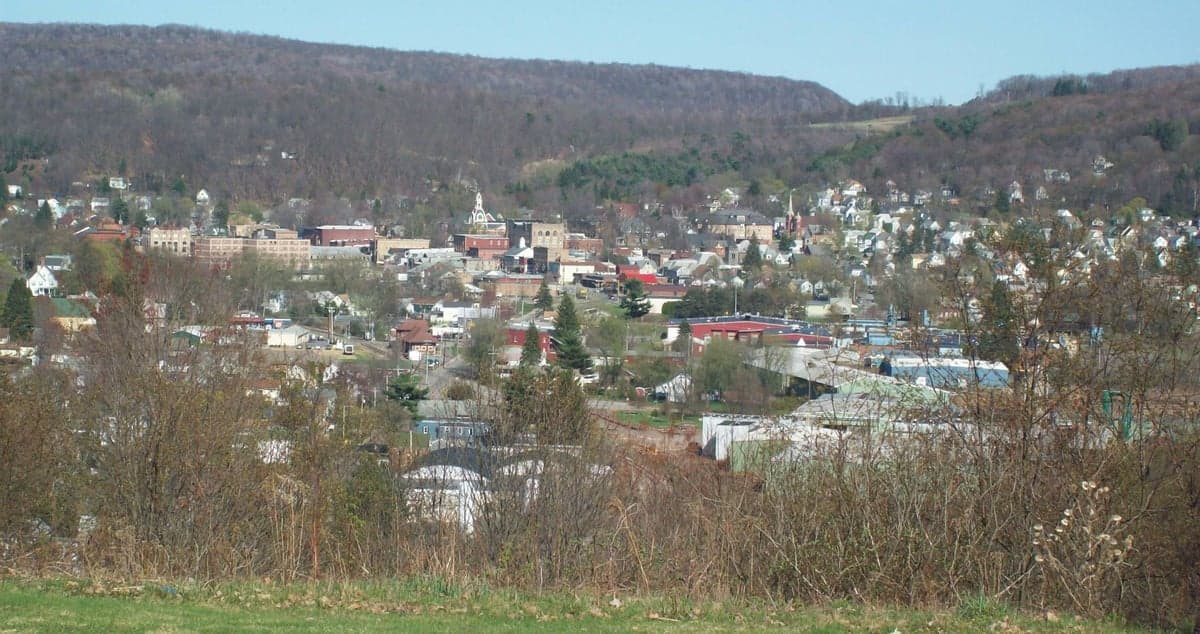
Photo: Wikipedia
Personal Sovereignty in Ridgway, PA
Strong independent fundamentals that actively favor personal liberty and low regulation.
What does Personal Sovereignty tell us?
Personal Sovereignty measures your capacity for self-reliance and independence with minimal government friction. Higher scores mean fewer barriers between you and the way you want to live... but it assumes you have the space you need and good neighbors.
What does this tell us?
Personal Sovereignty measures your capacity for self-reliance and independence with minimal government friction. Higher scores mean fewer barriers between you and the way you want to live... but it assumes you have the space you need and good neighbors.
State Policy
Energy independence: Net exporter (274% of energy produced in-state)
Personal Liberty
Homesteading

Personal Liberty Analysis
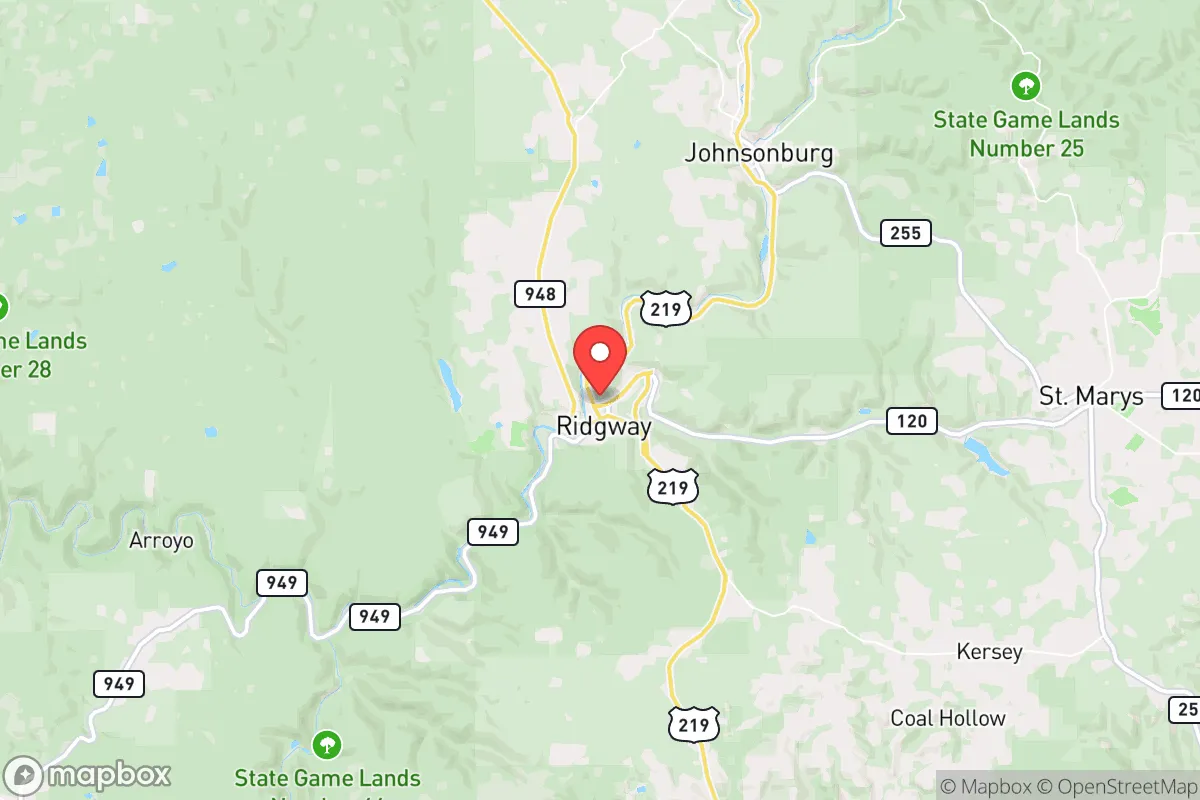
Ridgway sits in Elk County in north-central Pennsylvania, a region where the practical experience of personal autonomy is shaped less by any municipal ordinance than by Pennsylvania's statewide framework — and that framework is a mixed bag for anyone who prioritizes independence. The state has no local sales tax, no vehicle property tax, and a right-to-work-adjacent labor environment that is friendlier than its union-heavy reputation suggests, but it also carries one of the nation's more aggressive local property tax systems and a regulatory apparatus that reaches into septic systems, building permits, and land subdivision. For a borough of roughly 1,300 people surrounded by the Allegheny National Forest and the Elk County countryside, the day-to-day reality is that government is small and visible, but the state rulebook still governs the big decisions.
How heavy is the tax and regulatory burden in Ridgway?
Pennsylvania's flat 3.07% personal income tax is among the lowest state income rates in the country, and Ridgway residents pay no local earned income tax beyond what the borough and school district levy — Elk County's local EIT sits in the low single digits depending on municipality, and the Ridgway Area School District property tax is the line item that actually stings. Property taxes in rural Pennsylvania are assessed on a county-wide base that has not been reassessed in Elk County in decades, which means long-time owners often carry assessments well below market value while new buyers inherit a millage rate applied to a stale base — a quirk that can work either for or against you depending on the parcel. The state's inheritance tax (4.5% to lineal heirs, 12% to siblings, 15% to others) is a genuine burden with no equivalent in most states, and Pennsylvania is one of only a handful of states that taxes retirement distributions at the state level. Regulatory posture is moderate: the borough requires building permits and the state's Uniform Construction Code applies, and any on-lot septic system falls under Elk County's Sewage Enforcement Officer, which is the single most common friction point for rural buyers. There is no local business privilege tax of note, no plastic bag ban, no short-term rental registry, and no municipal broadband or utility monopoly beyond the standard electric and water providers.
What Pennsylvania gun law means for self-defense in Ridgway
Pennsylvania is a shall-issue state for License to Carry Firearms, issued by the Elk County Sheriff in Ridgway, and the process is straightforward: application, background check, and a $20 fee, with the license valid for five years. Open carry is legal without a permit statewide, and concealed carry is legal with the LTCF; Pennsylvania recognizes licenses from a long list of states but does not have constitutional carry, so an out-of-state mover should plan to obtain the LTCF rather than assume reciprocity. The state's Castle Doctrine and Stand Your Ground provisions are codified in 18 Pa.C.S. § 505, providing no duty to retreat in your home, vehicle, or any place you have a legal right to be — a meaningful protection that puts Pennsylvania ahead of states like New Jersey or Maryland on self-defense law. Long gun purchases are unrestricted for adults 18 and over with no permit required, and there is no assault weapons ban, magazine capacity limit, or waiting period. The practical caveat: the federal Gun-Free School Zones Act and Pennsylvania's prohibition on carrying in courthouses and certain municipal buildings still apply, and the borough itself has no additional firearms ordinances beyond state law.
Is homesteading and off-grid living viable around Ridgway?
This is where Ridgway scores well. Elk County is heavily forested — roughly 80% of the county is woodland, much of it within the Allegheny National Forest — and rural parcels of 5 to 50 acres are routinely available at prices well below national rural averages, often in the $1,500 to $4,000 per acre range depending on road frontage and timber. Zoning is the key variable: much of Elk County outside borough limits is unzoned or lightly zoned at the township level, which means agricultural use, livestock, and accessory structures face far less scrutiny than in suburban or exurban counties. Off-grid feasibility is real but not frictionless: Pennsylvania requires a permitted septic system or an approved alternative for any dwelling, and the state's Uniform Construction Code applies to new homes regardless of whether you connect to the grid. Solar is viable but north-central Pennsylvania averages only about 3.5 to 4 peak sun hours per day, so a serious off-grid setup needs battery capacity and a generator backup. Water is generally abundant — springs and shallow wells are common — and the region's rainfall supports rain catchment, though Pennsylvania regulates rainwater collection for potable use. Hunting, fishing, and foraging on the surrounding state game lands and national forest are legitimate food-security assets, and Pennsylvania's right-to-farm law protects small-scale agricultural operations from nuisance suits.
How personal liberties play out for families and individuals
Pennsylvania's parental rights framework is generally protective: the state's homeschool law is one of the more permissive in the Northeast, requiring only a notarized affidavit, a portfolio review, and standardized testing in certain grades, and Ridgway's rural character means homeschooling families face little social friction. Medical autonomy is more complicated — Pennsylvania has a school immunization requirement with religious and philosophical exemptions available, but the state's COVID-era emergency powers and the Wolf administration's business closure orders left a lasting skepticism in rural Elk County, where local officials pushed back on statewide mandates. Speech and property rights are standard Pennsylvania fare: the state constitution's free speech protections track the federal First Amendment, and the borough has no sign ordinance beyond basic safety rules. Property rights are strong in practice — eminent domain use is rare in Elk County, and the region's timber and gas lease economy means mineral rights are often severed from surface rights, a detail buyers should verify before closing. The one area where the state leans heavier is environmental regulation: any stream crossing, wetland disturbance, or large earth disturbance triggers DEP review, which can slow rural building projects.
Relative to the national landscape, Ridgway lands in the "moderately free, practically autonomous" category — not as light-touch as Tennessee or Wyoming on taxes, but far more permissive than New York, New Jersey, or Illinois on firearms, homeschooling, and rural land use. The state income tax is low, the self-defense law is solid, and the surrounding county offers genuine homesteading viability at accessible prices. The trade-offs are the property tax system, the inheritance tax, and the septic and construction permitting that comes with any rural build. For a reader who values independence and is willing to navigate a state rulebook rather than a heavy local one, Ridgway is a credible candidate — particularly for families who want land, hunting access, and a school district small enough to know your name.

* Values derived from national, state, county, city and local statistics and may differ in a specific area. Last updated: 2026-11-03T14:21:51.000Z
Narrative content on this page is AI-generated and may contain mistakes. Verify any details that matter before acting on them.
ReloMaps may earn a commission from affiliate links at no extra cost to you.

