Photo: Wikipedia
Demographics of Ridgway, PA
Affluence Level in Ridgway, PA
A below-average socioeconomic profile. Incomes, home values, and educational attainment trail the U.S., with higher poverty and unemployment.
People of Ridgway, PA
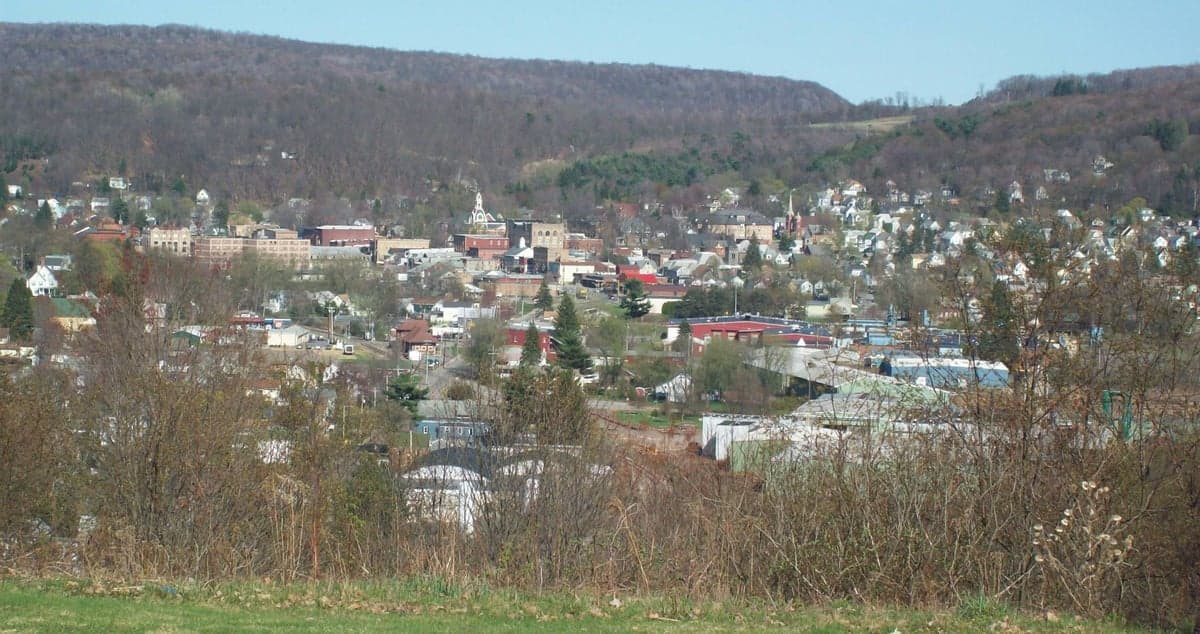
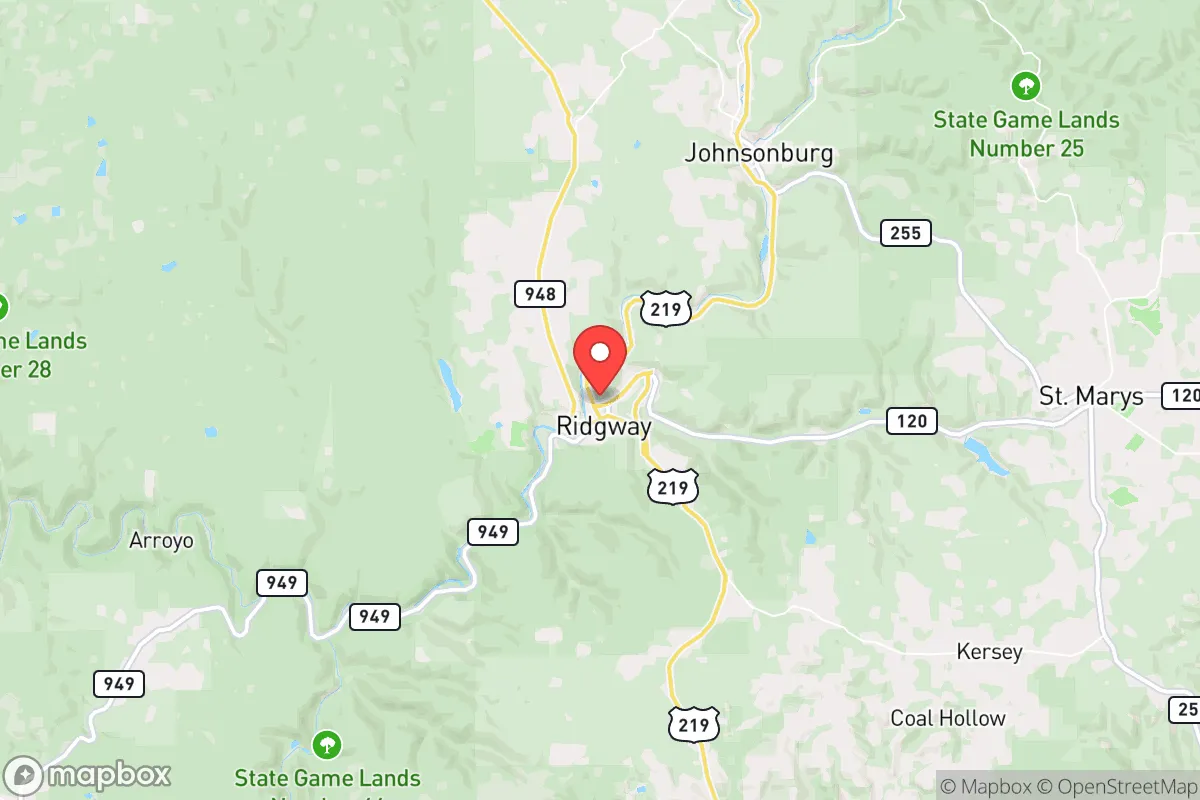
Ridgway is a small, overwhelmingly native-born borough of about 3,991 people in Elk County, where roughly 93% of residents are white and the foreign-born share rounds to zero. It is the seat of county government and the historic headquarters of the powdered-metal industry, and its identity was built by German and Irish railroad and factory workers who arrived in the 1880s and whose descendants still fill the borough's churches and neighborhoods. Households here are older, less college-educated (24.8% hold a bachelor's degree or higher) and more rooted than the Pennsylvania average — a place where surnames repeat across generations.
How Ridgway was settled and grew
Ridgway is a late-19th-century industrial town, not a colonial settlement. It was laid out in 1824 as the seat of newly formed Jefferson County and named for Jacob Ridgway, a Philadelphia merchant who never lived there; growth stalled until the railroads arrived in the 1860s and 1870s, when the Philadelphia & Erie and the Buffalo, Rochester & Pittsburgh lines met the surrounding hardwood forests. That access turned Ridgway into a lumber town almost overnight. Sawmills, tanneries and the Hyde-Murphy hardwood flooring plant drew German, Irish and Scots-Irish laborers from eastern Pennsylvania, New York and directly from Europe, who settled in the grid streets around the courthouse square and along the river flats near the mills. A second wave arrived in 1916, when the St. Marys-based powdered-metal firm that became Domtar and later GKN Sinter Metals established operations in Ridgway, anchoring a skilled factory workforce that persisted for a century. By the mid-20th century the borough's population peaked near 5,500, with ethnic parishes, fraternal halls and company housing clustered in the blocks closest to the plants.
Modern era (post-1965)
The 1965 Hart-Celler Act reshaped immigration nationally, but its effect on Ridgway was essentially nil: the borough's foreign-born population remains at 0.0%, and the 2020s census profile shows 93.3% white, 0.4% Hispanic, 0.3% Black and 0.4% East/Southeast Asian residents, with no measurable Indian-subcontinent population. The real post-1965 story is domestic out-migration. As hardwood and textile employment contracted in the 1970s and 1980s, young adults left for Pittsburgh, Erie and the Sun Belt, and the population fell from its mid-century peak to just under 4,000. The residents who stayed concentrated in the older core — the courthouse-square blocks, the West End streets toward the Clarion River bridge, and the mill-adjacent North Side — while newer single-family subdivisions spread along the borough's southern and eastern edges. The one visible modern addition is a small Filipino and East/Southeast Asian presence drawn by healthcare and manufacturing jobs at Penn Highlands Elk hospital and the surviving GKN plant, though at 0.4% it remains a handful of households rather than a community.
The future
Ridgway is not becoming meaningfully more diverse; it is becoming older and smaller. Elk County's population has declined in every census since 1980, and the borough's median age sits well above the state figure, which means deaths will continue to outpace births for the foreseeable future. The most likely 10-to-20-year trajectory is a slow loss of a few hundred residents, a modest increase in the Hispanic and Asian shares from a very low base as regional healthcare and manufacturing employers recruit outside the area, and continued concentration of the remaining population in the walkable courthouse-square core as outlying housing stock ages. Cultural identity will likely harden around the things that already define it — the Ridgway Chainsaw Carvers Rendezvous, the Elk County Catholic and Ridgway Area school traditions, and the paper-mill and powdered-metal heritage — rather than diversify.
For someone moving in now, Ridgway is a stable, low-cost, homogenous small town with a shrinking but intact industrial and healthcare job base and almost no immigrant community to plug into. Families seeking tight-knit schools and low housing prices will find it; newcomers expecting demographic churn, urban amenities or a diverse social scene will not. The borough's future is continuity, not transformation.

* Values derived from national, state, county, city and local statistics and may differ in a specific area. Last updated: 2026-11-03T14:21:51.000Z
Narrative content on this page is AI-generated and may contain mistakes. Verify any details that matter before acting on them.
ReloMaps may earn a commission from affiliate links at no extra cost to you.

