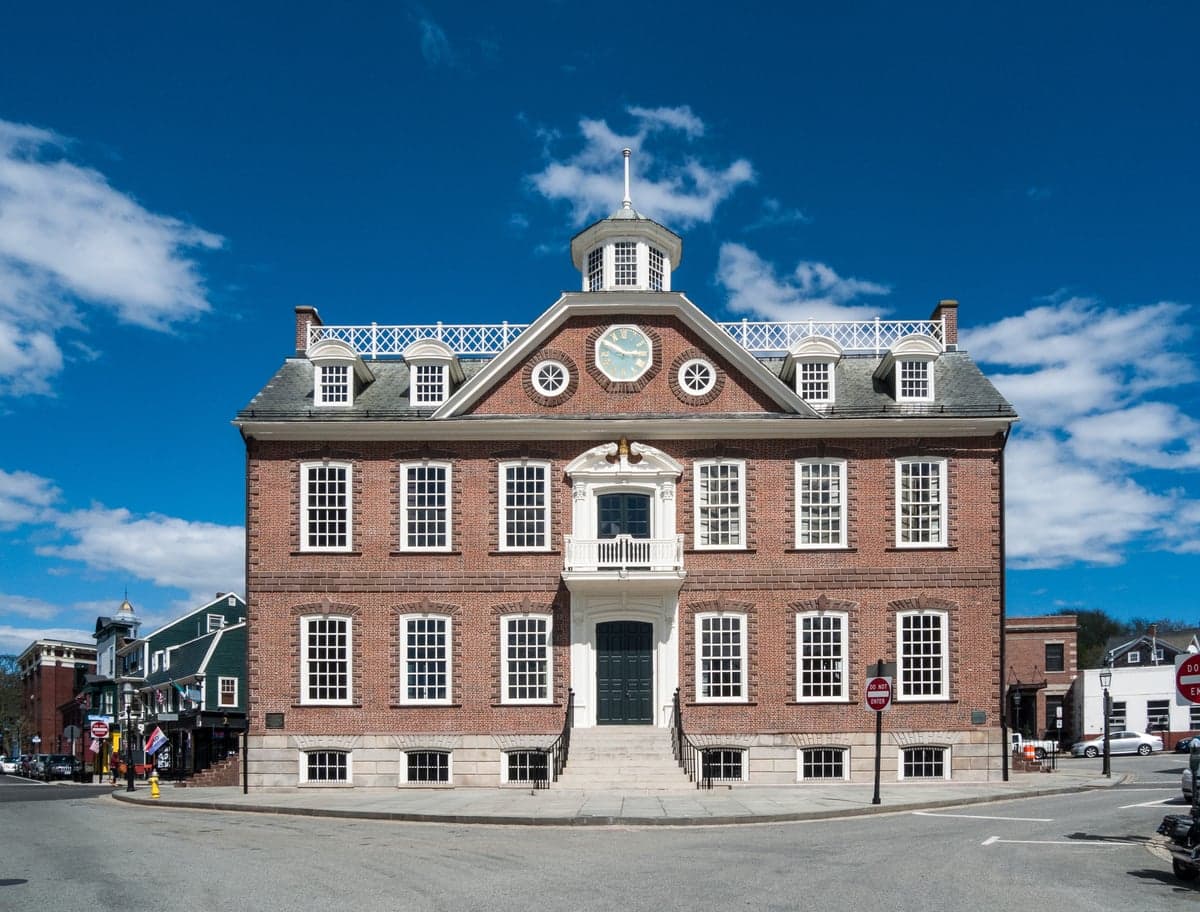
Photo: Wikipedia
Political ClimatePolitical Climate in Newport County
Showing district-level results — no local-only data available.
Local Political AnalysisPolitical Analysis of Newport County
Newport County is the bluest corner of an already blue state, carrying a Cook Partisan Voting Index of D+12 compared to Rhode Island's statewide D+8. That extra four-point Democratic lean isn't uniform across the county, though—it's driven by the dense, coastal, and historically wealthy towns of Newport and Middletown, while the more rural inland communities like Tiverton and Little Compton lean noticeably more conservative, sometimes even flirting with Republican wins in local races. The overall trajectory has been steadily Democratic since the 1990s, but the gap between the waterfront and the farm country has actually widened in the last two cycles.
How it compares to Rhode Island as a whole
Statewide, Rhode Island is reliably Democratic but with a strong independent streak—voters here will split tickets for moderate Republicans like former Governor Lincoln Chafee (who later became an independent and then a Democrat). Newport County amplifies that pattern. In the 2024 presidential race, Newport and Middletown delivered margins of 30+ points for the Democratic candidate, while Tiverton and Little Compton came in closer to 10-point Democratic wins. The town of Portsmouth sits in the middle, often mirroring the statewide average. What sets Newport County apart from the rest of Rhode Island is the intensity of its Democratic lean in the urban core: Providence County, which includes the capital, has a D+15 PVI, but Newport County's D+12 is still significantly bluer than the state's rural western counties like Kent (D+6) or Washington (D+7). The county's high concentration of second-home owners from Massachusetts and New York, many of whom are affluent and socially liberal, pushes the numbers further left than the state's working-class mill towns.
What this means for residents
For liberal residents, Newport County is a comfortable place to live politically. Local government in Newport and Middletown consistently prioritizes environmental protection, historic preservation, and social services. The county's Democratic lean means state-level representatives from the area—like Senator Dawn Euer and Representative Lauren Carson—are influential in Providence, often championing coastal resilience funding and affordable housing initiatives. For conservative residents, the reality is more nuanced. You'll find plenty of like-minded neighbors in Tiverton and Little Compton, where town councils and school committees often have Republican or conservative independent members. But countywide elections are a long shot for Republicans, and social conservatives may feel out of step with the dominant culture in Newport's tourist-driven downtown. The practical effect is that conservative voices tend to focus on local issues—tax rates, school budgets, zoning—rather than national culture wars, which keeps politics here more pragmatic than polarized.
Culturally, Newport County stands apart from the rest of Rhode Island in a few key ways. The presence of the Naval War College and the Naval Station Newport brings a steady flow of military families from across the country, which injects a more transient, nationally minded perspective into local politics. The summer tourist economy also shapes policy: short-term rental regulations, parking enforcement, and event permitting dominate town council agendas in a way they don't in Providence or Cranston. And while the county is deeply Democratic, it's a particular brand of New England liberalism—fiscally cautious, environmentally focused, and skeptical of rapid development. That means even in deep-blue Newport, you'll hear as much debate about property tax caps as about national politics, and the local Democratic Party is more concerned with seawalls and sewer bonds than with the latest DNC platform. It's a political climate that rewards engagement at the town level, regardless of your party registration.

State Political ClimatePolitical Climate in Rhode Island
State Political AnalysisPolitical Environment in the State
Rhode Island is a reliably Democratic state with a Cook PVI of D+8, meaning it votes about eight points more Democratic than the national average in presidential elections. The dominant coalition is a blend of organized labor, coastal liberals in Providence and Newport, and a growing suburban progressive base, but the state has not shifted as far left as Massachusetts or Connecticut in recent cycles. Over the past 10-20 years, the Ocean State has moved from a moderate-blue, union-heavy stronghold to a more uniformly Democratic entity, though it retains a stubborn, independent-minded streak that occasionally surprises outsiders.
Urban vs. rural divide
The political map is sharply divided between the urban core and the rural periphery. Providence is the engine of Democratic dominance, with its large student population, immigrant communities, and unionized public sector driving margins of 70-80% for Democratic candidates. Newport and Bristol are also reliably blue, buoyed by tourism, military retirees, and a concentration of white-collar professionals. In contrast, South Kingstown and Narragansett in Washington County lean more moderate, often splitting tickets in local races. The rural western half of the state—Foster, Glocester, Burrillville, and West Greenwich—votes Republican by comfortable margins, with some precincts hitting 60-65% for GOP candidates. These towns are home to gun owners, small farmers, and commuters who resent Providence-centric policy. The divide is less about culture war and more about economics: urban voters prioritize public transit and social services, while rural voters focus on property taxes and land-use restrictions.
Policy environment
Rhode Island’s policy environment is decidedly progressive, but with a pragmatic, small-state twist. The state has a progressive income tax with rates from 3.75% to 5.99%, and a state sales tax of 7%—one of the highest in the nation. Property taxes vary wildly, with Providence levying among the highest rates in New England, while rural towns like Foster keep them lower. The state has no right-to-work law, and unions remain powerful in construction, education, and municipal government. Education policy is centralized: the state funds schools through a formula that favors urban districts, which frustrates suburban and rural taxpayers. Healthcare is heavily regulated, with a strong Medicaid expansion under the Affordable Care Act and a state-run health insurance exchange. Election laws are moderately restrictive: no-excuse absentee voting was only recently expanded, and voter ID is required. The state does not have a “sanctuary” law per se, but Providence and other cities limit cooperation with federal immigration enforcement.
Recent policy direction
Over the last five years, Rhode Island has moved decisively left on several fronts. In 2022, the legislature passed a comprehensive gun safety package that banned open carry, raised the purchase age to 21, and prohibited magazines over 10 rounds. Self-defense laws are narrow: there is no “stand your ground” statute, and Castle Doctrine protections are limited. On education, the state enacted a “Right to Read” law in 2019 that mandates phonics-based literacy instruction, but also expanded LGBTQ+ inclusive curriculum mandates in 2023. Parental rights in education are weaker than in many states; school boards have limited authority to opt out of state curriculum standards. On medical and bodily autonomy, Rhode Island codified abortion rights into law in 2019 and passed a shield law protecting providers from out-of-state lawsuits. Property rights are constrained by strong environmental regulations, including the Rhode Island Coastal Resources Management Council, which can block development near the coast. Tax policy has seen modest cuts: the corporate tax rate was reduced from 9% to 7% in 2014, but the overall burden remains high. Voting access expanded with early in-person voting (20 days) and automatic voter registration at the DMV, but same-day registration is not allowed.
Civil unrest & political movements
Rhode Island has a history of localized, issue-driven activism rather than mass protests. The 2020 Black Lives Matter protests in Providence were large but peaceful, leading to police reform legislation that banned chokeholds and created a statewide use-of-force standard. On the right, the Rhode Island Statewide Coalition and local gun rights groups have been active, particularly during the 2022 gun law debate, but they lack the numbers to reverse legislation. Immigration politics are less volatile than in border states; Providence’s sanctuary policies have drawn occasional federal scrutiny but no major flashpoints. Election integrity controversies have been minimal—the state uses paper ballots with optical scanners and has not seen the fraud allegations common elsewhere. A notable movement is the “Foster-Glocester” school secession effort, where rural towns have repeatedly tried to break away from regional school districts over funding disputes, reflecting a deeper frustration with Providence-centric governance. New residents will notice that political conversations are less polarized than in many states, but the divide between coastal liberals and inland conservatives is real and occasionally surfaces in town council meetings.
Projection
Over the next 5-10 years, Rhode Island is likely to become slightly more Democratic, but not dramatically so. In-migration is modest and mostly from other blue states (Massachusetts, New York), reinforcing the existing lean. The state’s population is aging and slowly declining, which could shift priorities toward healthcare and property tax relief rather than new social programs. The rural-urban divide will persist, but rural towns lack the population growth to flip any statewide races. Expect continued progressive legislation on climate (offshore wind is a major industry), gun control, and tenant rights, but with a pragmatic brake from the state’s fiscal constraints. A conservative relocating here will find a few friendly enclaves (Foster, Glocester, West Greenwich) but will be outvoted on most state-level issues. A liberal relocating will find a comfortable environment, though the high cost of living and slow bureaucracy may frustrate.
For a new resident, the bottom line is this: Rhode Island is a blue state where your vote in state elections will rarely be decisive, but your voice in local town government can matter a lot. If you’re conservative, you’ll want to target rural towns with low property taxes and strong school choice options. If you’re liberal, the urban and coastal areas offer a dense, walkable, and socially progressive lifestyle. Either way, expect high taxes, strong unions, and a political culture that values stability over disruption. The state’s small size means you’re never far from the other side of the aisle—and that’s not necessarily a bad thing.
* Values derived from national, state, county, city and local statistics and may differ in a specific area. Last updated: 2026-06-16T22:25:38.000Z
Narrative content on this page is AI-generated and may contain mistakes. Verify any details that matter before acting on them.
ReloMaps may earn a commission from affiliate links at no extra cost to you.

