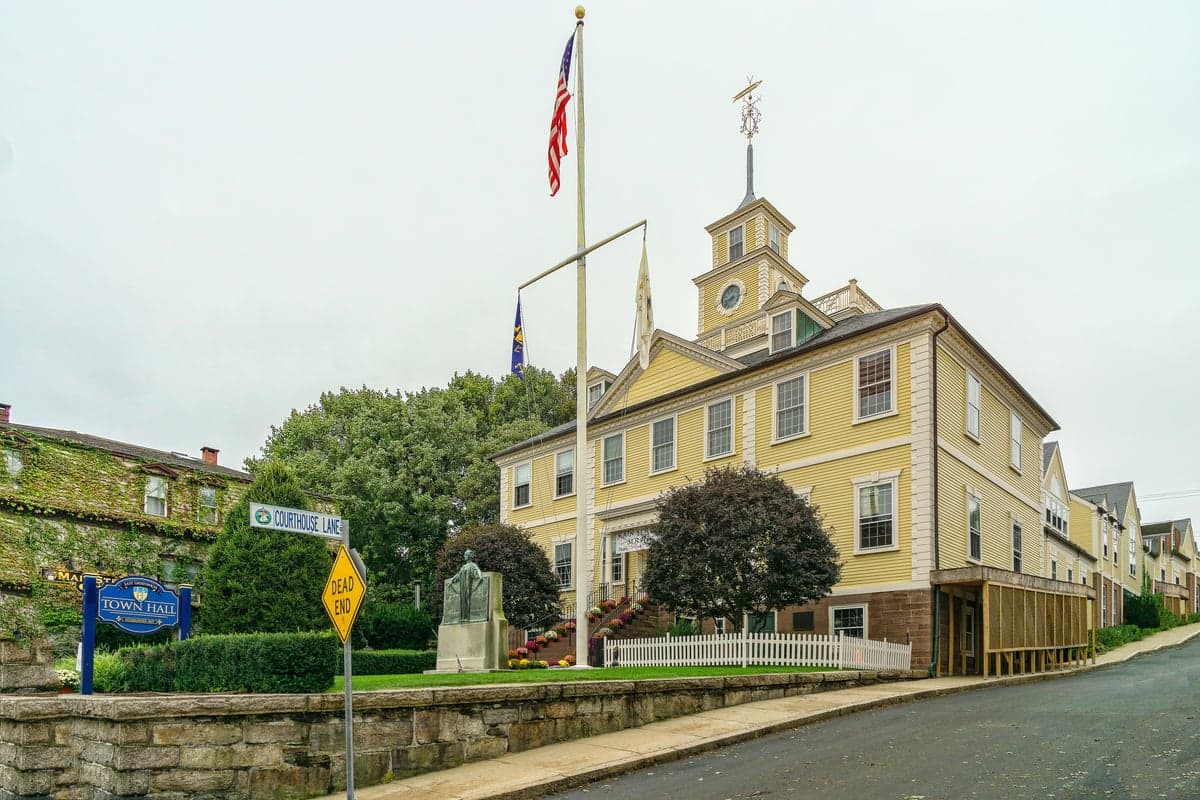
Photo: Wikipedia
Political ClimatePolitical Climate in Kent County
Showing district-level results — no local-only data available.
Local Political AnalysisPolitical Analysis of Kent County
Kent County is Rhode Island’s political bellwether, a place where the state’s Democratic lean meets a stubborn streak of independent and Republican voting. With a Cook Partisan Voting Index of D+4, the county is notably less blue than the state as a whole (D+8), and that gap has been a defining feature of local politics for the last decade. While Rhode Island reliably goes Democratic in presidential races, Kent County often provides the margin of victory for moderate Republicans and conservative Democrats, especially in down-ballot races for the General Assembly and local offices. The county’s political center of gravity has shifted slightly leftward since 2016, but it remains the most competitive turf in the state.
How it compares
The D+4 rating puts Kent County roughly four points to the right of Rhode Island’s statewide average, a gap that shows up clearly in election results. In the 2024 presidential race, for example, the county voted for Kamala Harris by a single-digit margin, while the state gave her a double-digit win. The variation within the county is stark. Warwick, the largest city, is a classic swing area — its working-class precincts in the west and south lean Republican, while the more affluent neighborhoods near the bay and the city’s core tilt Democratic. Coventry and West Warwick are the county’s reddest towns, routinely voting for Republican candidates for governor and Congress, even when those candidates lose statewide. East Greenwich, by contrast, is the blue anchor: a wealthy, educated suburb that often delivers the highest Democratic margins in the county, sometimes exceeding the state average. The swing precincts are concentrated in Warwick’s 2nd and 3rd wards and the rural edges of West Greenwich, where independent voters decide local races.
What this means for residents
For conservative residents, Kent County is one of the few places in Rhode Island where a Republican vote feels competitive. Local GOP candidates regularly win town council and school board seats in Coventry and West Warwick, and the county’s legislative delegation includes some of the state’s most prominent moderate Republicans. For liberal residents, the county offers a more pragmatic, less ideological version of Rhode Island politics — progressive policies on housing and education often get watered down in the General Assembly by Kent County’s swing votes, but the county also provides a reliable base for Democratic candidates who can appeal to union households and suburban moderates. The practical effect is that policy debates in Kent County tend to be more centrist than in Providence or Newport, with a heavy emphasis on property taxes, school funding, and local economic development rather than culture-war issues.
Culturally, Kent County feels more like a collection of small towns than a cohesive political region. Warwick retains its blue-collar, union-heavy identity, while East Greenwich has become a haven for professionals who commute to Providence or Boston. Coventry and West Warwick are more rural and conservative, with a strong tradition of localism and skepticism of state government. The county’s political culture is best described as pragmatic — residents expect their elected officials to deliver on roads, schools, and taxes, and they punish incumbents who don’t, regardless of party. That makes Kent County a tough place for ideologues of either stripe, but a comfortable one for moderates who can navigate the cross-currents of Rhode Island’s most competitive political landscape.

State Political ClimatePolitical Climate in Rhode Island
State Political AnalysisPolitical Environment in the State
Rhode Island has been a reliably Democratic state for decades, carrying a Cook Partisan Voting Index of D+8, meaning it votes about eight points more Democratic than the nation as a whole. The state hasn't backed a Republican for president since 1984, when it went for Ronald Reagan, and the Democratic grip on the General Assembly has been near-total for generations. But if you look closer, the political reality is more layered than the registration numbers suggest — the state has a strong, organized conservative minority, especially in the western and southern exurbs, and the dominant Democratic coalition is split between a progressive Providence axis and a more moderate, union-anchored old guard.
Urban vs. rural divide
The political map of Rhode Island is essentially a story of Providence versus everything else. Providence itself is the engine of the state's Democratic lean — a dense, diverse, heavily renter city where progressive candidates routinely win by 40-50 point margins. The rest of the state is far more mixed. The suburban ring around Providence — places like Cranston, Warwick, and East Providence — tends to vote Democratic but by much narrower margins, often electing moderate or even Republican local officials. The real conservative strongholds are in the western and southern parts of the state, particularly in Kent and Washington counties. Towns like Coventry, West Greenwich, and Exeter regularly vote Republican, and the rural communities along the Connecticut border — Burrillville, Glocester, Foster — are where you'll find the highest concentration of Trump signs and Second Amendment activism. The 2020 election map showed Biden winning the state by 20 points, but Trump carried 21 of the state's 39 municipalities, mostly in these rural and exurban pockets. The divide isn't just geographic — it's cultural. The urban core is dominated by college students, service workers, and a growing immigrant population, while the rural west is older, whiter, and more rooted in the state's traditional manufacturing and farming economy.
Policy environment
Rhode Island's policy environment reflects its Democratic dominance, but with a distinctly Northeastern pragmatism that stops short of the most aggressive progressive experiments. The state has a progressive income tax with rates from 3.75% to 5.99%, and a statewide sales tax of 7%, one of the highest in the nation. Property taxes are notoriously high, especially in Providence and the core suburbs, though rural towns like Foster and Scituate have significantly lower rates. The regulatory climate is generally business-friendly by New England standards, but the state's permitting processes — especially for construction and development — are slow and expensive, a constant complaint from the conservative business community. On education, Rhode Island has a statewide funding formula that directs more money to urban districts, but school choice is limited; charter schools exist but face political headwinds from the teachers' unions, which remain a powerful force in the Democratic coalition. Healthcare is dominated by Lifespan and Care New England, the two major hospital systems, and the state expanded Medicaid under the Affordable Care Act. Election laws are relatively accessible — same-day voter registration is available, and early voting was expanded in 2022. There is no voter ID law requiring a photo, though a signature match is used. For a conservative relocator, the tax burden and regulatory density are the biggest practical concerns, while the absence of a state-level right-to-work law and the strength of public-sector unions shape the labor environment.
Recent policy direction
The last five years have seen Rhode Island move in a distinctly progressive direction on several fronts, though the pace has been tempered by the state's moderate Democratic leadership. In 2021, the General Assembly passed the Rhode Island Cannabis Act, legalizing recreational marijuana for adults 21 and over, with a regulatory framework that prioritizes social equity licenses. On gun policy, the state has moved steadily toward restriction: in 2022, it passed a ban on "ghost guns" and raised the purchasing age for rifles and shotguns to 21, and in 2023, it enacted a ban on open carry of firearms in public, a direct response to the Supreme Court's Bruen decision. The state also has a "red flag" law and requires background checks on all private firearm sales. On education, the state passed a law in 2023 requiring all public schools to teach LGBTQ-inclusive history, which drew sharp opposition from conservative parents. Parental rights have been a flashpoint: the state has no law requiring schools to notify parents if a child changes their gender identity or pronouns, and several school committees have adopted policies that explicitly withhold such information. On abortion, Rhode Island codified Roe v. Wade protections into state law in 2019, and the right to abortion is protected regardless of gestational age. Property rights are a mixed bag: the state has no statewide zoning reform, but Providence and a few other cities have implemented rent control ordinances, and the state's tax assessment system is widely criticized for being opaque and inequitable. Voting access has been expanded: no-excuse mail voting was made permanent after the pandemic, and automatic voter registration was implemented in 2023. For a conservative relocator, the direction on guns, parental rights, and taxes is likely concerning, while the state's relatively stable fiscal management and moderate Democratic leadership provide some counterbalance.
Civil unrest & political movements
Rhode Island has a history of visible, organized political activism on both sides, though the scale is modest compared to larger states. The Black Lives Matter protests in Providence in 2020 were large and sustained, leading to the removal of a statue of Christopher Columbus in the city's square and a push to rename streets and schools. The conservative movement is well-organized, particularly around gun rights and parental rights. The Rhode Island Second Amendment Coalition is one of the most active grassroots groups in the state, regularly turning out for hearings at the State House and running local candidates. The parental rights movement has been especially energized since 2021, with groups like RI Parents United organizing against school mask mandates, critical race theory, and LGBTQ-inclusive curriculum. Immigration politics are less volatile than in border states, but Rhode Island is a sanctuary state — a 2014 executive order by then-Governor Gina Raimondo limited state and local cooperation with federal immigration enforcement, and Providence has a formal "Welcoming City" ordinance. Election integrity has been a lower-tension issue here than in swing states, though conservative activists have raised concerns about the state's same-day registration and mail voting systems. The most visible political flashpoint in recent years has been the debate over the Washington Bridge closure in 2023, which became a symbol of the state's aging infrastructure and the political blame game between the governor's office and the General Assembly. A new resident would notice that political engagement is high, but the state's small size means that local issues — a school committee decision, a zoning change, a tax assessment — often generate as much heat as national politics.
Projection
Over the next five to ten years, Rhode Island's political trajectory is likely to continue its gradual leftward drift, but with significant friction from the state's conservative exurbs and a growing independent vote. The demographic trends favor the Democratic coalition: Providence is growing slowly but steadily, driven by immigration and the expansion of Brown University and Rhode Island School of Design, while the rural west is aging and losing population. The state's in-migration is modest, but the people moving in tend to be younger and more educated, drawn to the Providence job market and the coastal lifestyle in Newport and Bristol. The Republican Party in Rhode Island remains weak at the statewide level, but it has a real base in the western towns and could win a governor's race or a congressional seat if the Democratic coalition fractures. The most likely scenario is a continuation of the current pattern: Democratic control of the governorship and the General Assembly, with progressive policy wins on climate, housing, and social issues, tempered by the fiscal constraints of a small state with high fixed costs. A conservative moving to Rhode Island should expect to live in a state where their political views are a minority at the ballot box, but where local control in the exurbs and rural towns allows for a degree of cultural and political autonomy. The tax burden is unlikely to decrease, and gun laws will probably get tighter, but the state's small size means that political engagement is unusually effective — a motivated minority can have real influence at the local level.
For a new resident, the bottom line is that Rhode Island offers a high degree of political stability and predictability, but the direction of travel is clearly progressive. If you're a conservative who values low taxes, broad gun rights, and local control over education, you'll find the state's policy environment frustrating, though you'll also find a like-minded community in the western and southern towns. If you're a liberal, you'll find a state that is generally aligned with your values, with a functioning government and a relatively low level of political dysfunction. The practical takeaway is that Rhode Island is a small state where politics is personal — your vote matters more here than in almost any other state, and your ability to influence local decisions is real, regardless of which side you're on.
* Values derived from national, state, county, city and local statistics and may differ in a specific area. Last updated: 2026-07-01T17:05:23.000Z
Narrative content on this page is AI-generated and may contain mistakes. Verify any details that matter before acting on them.
ReloMaps may earn a commission from affiliate links at no extra cost to you.

